
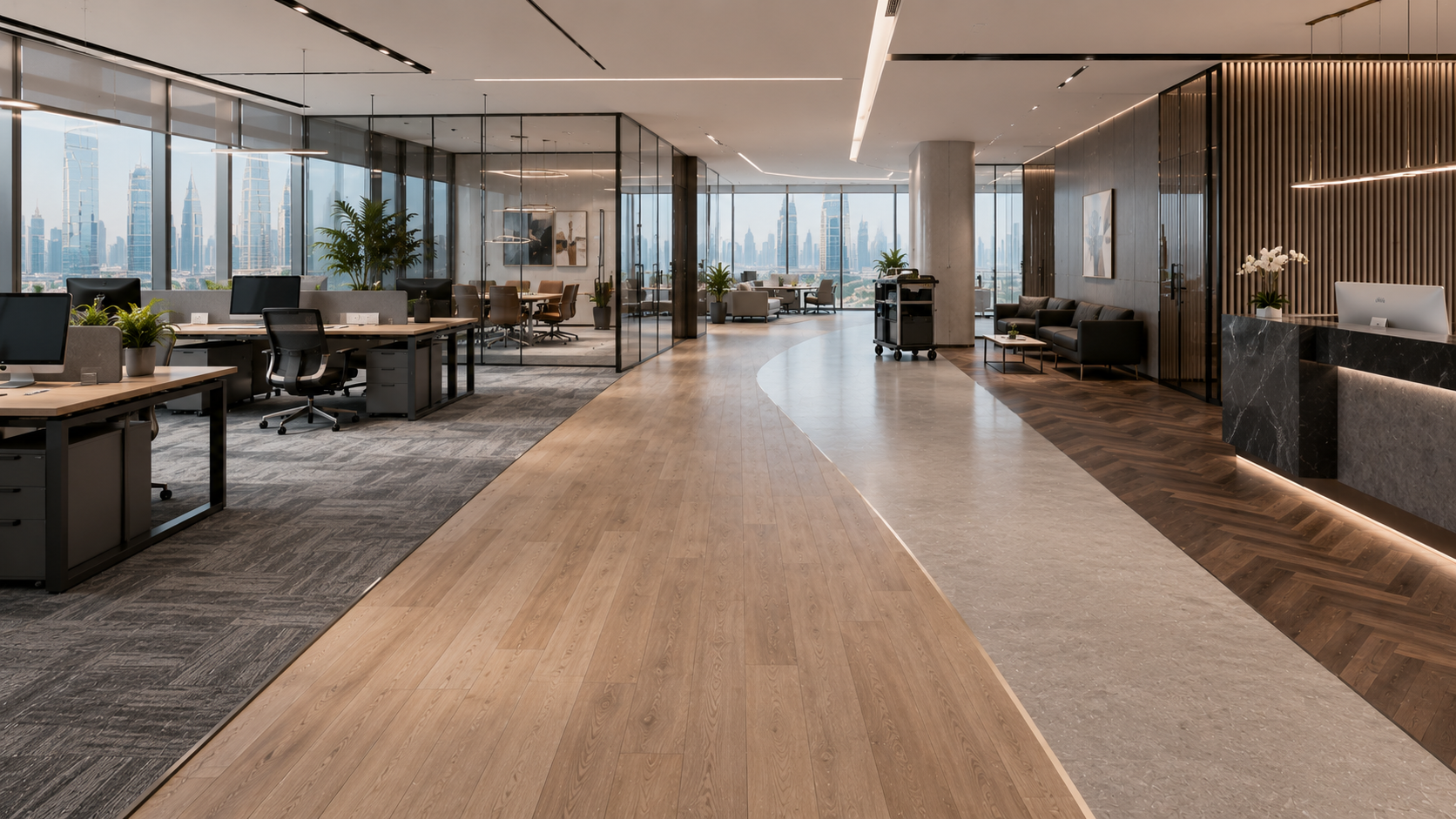
Quick Answer: The best commercial flooring in Dubai depends entirely on your sector. SPC and commercial-grade LVT dominate offices, retail, and F&B. Homogeneous vinyl is the standard for healthcare and education. Engineered wood and parquet remain the premium choice for hotel lobbies, boardrooms, and hospitality reception areas. Every specification choice must account for Dubai’s extreme HVAC cycles, heavy foot traffic, and local building compliance requirements.
Key Takeaways
- No single flooring material works across all commercial sectors in Dubai
- SPC (Stone Plastic Composite) is the most climate-resilient option for most commercial spaces
- Homogeneous vinyl is the correct specification for healthcare, laboratories, and education – not SPC or LVT
- Engineered wood can work commercially when specified correctly for lower-traffic areas
- Wear layer thickness is the single most important commercial specification – minimum 0.55mm for light commercial, 0.70mm+ for high traffic
- Total installed cost in Dubai ranges from AED 85 to AED 680 per sqm depending on material and sector
- Dubai Municipality and DHA compliance are non-negotiable for healthcare and hospitality projects
- Sustainable, FSC-certified, and low-VOC flooring is increasingly required by UAE green building standards
Introduction: Why Commercial Flooring Decisions in Dubai Are Different
A floor specified for a Dubai office building faces conditions that simply do not exist in most other markets. Outside temperatures regularly exceed 45°C. Inside, aggressive central air conditioning drops surface temperatures dramatically. The delta between outdoor heat and indoor cool creates relentless expansion and contraction cycles that will destroy the wrong floor within a single summer. Add Dubai’s omnipresent desert dust – which acts as an abrasive on every surface – and you start to understand why materials that perform well in Europe or North America often underperform here.
Beyond climate, Dubai’s commercial market is genuinely diverse. A retail podium in Dubai Mall, a hospital ward in Dubai Healthcare City, a corporate boardroom in DIFC, and a restaurant in JBR have almost nothing in common from a flooring specification perspective. Each demands different performance standards, compliance requirements, aesthetic expectations, and maintenance capabilities.
This guide covers every major commercial sector in Dubai. It tells you what floor to specify, why, what it should cost, and what mistakes to avoid. It is written for interior designers, fitout contractors, project managers, and business owners making real purchasing decisions – not for people looking for a generic list of flooring types.
The Dubai Commercial Flooring Market in 2026
Dubai’s construction pipeline remains one of the most active in the world. With ongoing development in Dubai South, Creek Harbour, and Business Bay, and major hospitality and healthcare expansions driven by the UAE’s Vision 2031 agenda, commercial flooring demand is structurally strong. The UAE’s wood and laminate flooring market was valued at approximately USD 477.9 million in 2024, with SPC and rigid-core vinyl flooring products showing the strongest growth trajectory through 2030.
What this means practically: supplier capacity is good, lead times are reasonable, and product quality – particularly from European manufacturers – is increasingly available through Dubai-based distributors. But it also means the market is crowded with generic advice. The guidance below cuts through it.
How Dubai’s Climate Affects Every Commercial Flooring Decision
Before going sector by sector, understand the three climate factors that affect every floor in this city.
Thermal cycling. An outdoor temperature of 45°C dropping to an air-conditioned 20°C creates a 25-degree swing that affects the dimensional stability of any material that expands and contracts. Solid hardwood fails in this environment. Flexible LVT (non-rigid) develops problems. Materials without a stable core – a rigid stone-polymer composite or a properly engineered multi-ply core – are not appropriate for most commercial applications in Dubai.
Humidity fluctuation. Dubai’s humidity swings from extremely dry desert air in summer (before the AC kicks in) to coastal humidity that enters buildings through high-traffic doorways. Any material that swells or contracts with moisture – including poorly stabilised laminates or solid wood – will show movement, edge lifting, or gapping.
Sand and dust abrasion. Desert dust is fine-grained silica. It acts as continuous fine-grit sandpaper on floor surfaces. This is why wear layer thickness matters far more in Dubai than in most European markets. A 0.3mm wear layer appropriate for a European office will degrade noticeably faster in a Dubai environment.
Sector-by-Sector Guide
1. Corporate Offices and Co-Working Spaces
The specification challenge:
Office flooring must handle castor chair traffic, high daily footfall, frequent cleaning, and – in Dubai specifically – the aesthetic expectations of a global financial centre. Business Bay, DIFC, and One Central tenants expect floors that look premium on day one and still look respectable three years later.
What works:
Commercial-grade LVT with a 0.55mm–0.70mm wear layer is the workhouse of Dubai office fitouts. It performs well under standard castor chair traffic, comes in realistic wood and stone finishes that satisfy the “luxury feel” demand, and handles thermal cycling with minimal issues. For open-plan offices, glue-down LVT is preferred over click-lock for one simple reason: floating floors develop creaking and movement under chair casters over time.
SPC with a 0.5mm+ wear layer is an excellent alternative, particularly in spaces that need a harder underfoot feel or where subfloor imperfections make a rigid system preferable. SPC’s near-zero expansion coefficient makes it the more technically correct choice for heavily glazed offices that experience significant thermal gain.
Carpet tiles remain popular for private offices, meeting rooms, and executive floors – they absorb sound, provide castor chair comfort, and allow zone-based replacement. In an open-plan Dubai office, carpet tiles in the collaboration zone paired with LVT or SPC in the circulation zones is a sensible hybrid approach.
Engineered wood flooring or parquet flooring is appropriate in premium reception areas, boardrooms, and executive suites where the impression of a natural material justifies the additional cost and care. Specify a minimum 4mm wear veneer and ensure installation is climate-controlled with acclimatisation time before fitting.
What does not work: Laminate flooring in commercial offices. It cannot handle sustained castor chair traffic and its HDF core is vulnerable to moisture ingress at joints – a problem in high-traffic entrance zones. It is a residential product dressed in commercial language.
Cost reference (Dubai, installed, 2026):
| Material | AED per sqm (installed) |
| Glue-down commercial LVT (0.55mm wear) | AED 120–200 |
| SPC click-lock (commercial grade) | AED 130–220 |
| Carpet tiles (commercial grade) | AED 85–180 |
| Engineered wood (boardroom/reception) | AED 260–480 |
| Parquet (herringbone, premium reception) | AED 300–600 |
2. Retail Spaces and Shopping Malls
The specification challenge:
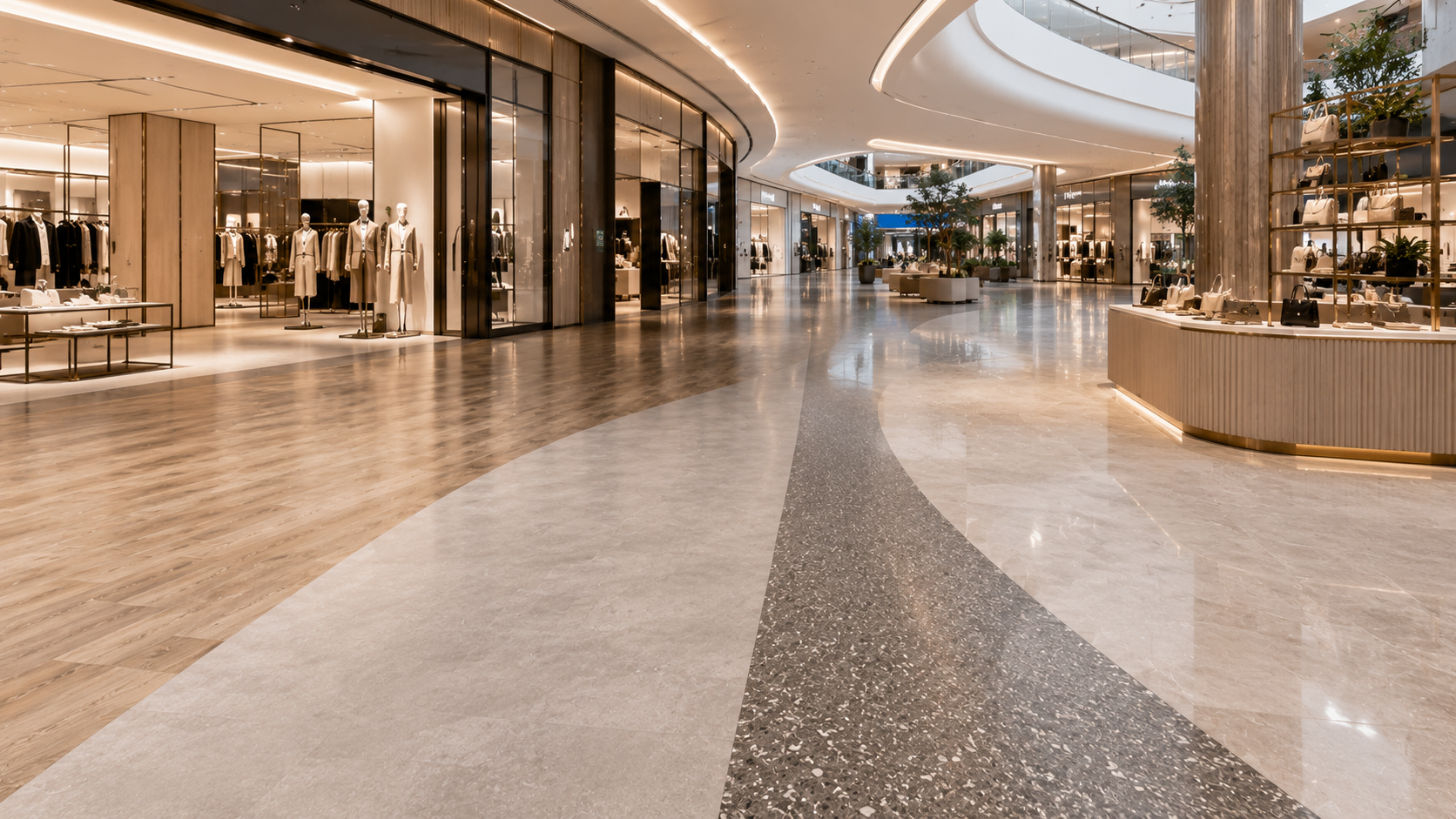
Retail floors in Dubai are under exceptional stress. A flagship store in Dubai Mall, a boutique in Mall of the Emirates, or a food court in City Walk may see thousands of footsteps daily, combined with wheeled display units, cleaning machine traffic, and the constant opening and closing of doors that introduces heat and dust.
What works:
For standard retail floors, SPC with a 0.7mm wear layer is the correct specification. It is dimensionally stable, scratch-resistant, handles the traffic load, and can be installed over existing tiles without screeding – a genuine advantage in UAE retail fitouts where project timelines are aggressive.
For luxury retail – jewelry, fashion, and lifestyle – large-format porcelain tiles (1200×2400mm) are often the correct choice. They carry no risk of wear layer degradation, clean effortlessly, and communicate a permanence and quality that vinyl – however good – does not. For these spaces, the higher installation cost and inflexibility of porcelain is an acceptable trade-off.
Homogeneous vinyl in commercial grade (wear class 33 minimum, class 34 preferred) works well in mid-range retail where budget is a constraint and aesthetics are secondary to durability.
What does not work: Click-lock SPC in high-traffic retail with wheeled trolleys or display carts. The floating installation develops movement under load. Glue-down is the correct installation method for serious retail traffic.
Cost reference:
| Material | AED per sqm (installed) |
| Glue-down SPC (0.7mm wear, retail grade) | AED 150–250 |
| Homogeneous vinyl (class 33/34) | AED 110–180 |
| Large-format porcelain (luxury retail) | AED 180–450 |
3. Hotels, Serviced Apartments, and Hospitality
The specification challenge:
Hotel flooring in Dubai is a prestige specification. From ultra-luxury properties on Palm Jumeirah to business hotels in DWTC, the floor must communicate quality, perform across thousands of guest-nights, and remain maintainable by housekeeping teams with minimal specialist knowledge.
What works:
Hotel guest rooms are a classic engineered wood or high-quality LVT application. Engineered wood with a 3mm+ wear veneer communicates warmth and luxury that guests respond to physically and emotionally – it is one of the elements that differentiates a five-star room from a four-star one. Specify stabilised engineered boards with a lacquered or oiled finish, installed in herringbone or wide-plank formats for maximum visual impact.
For hotel corridors – which are genuinely high-traffic, include wheeled luggage, and get cleaned daily with water – carpet or commercial-grade LVT (glue-down, 0.7mm wear) is the practical standard. Carpet corridors absorb sound between rooms, which is a legitimate acoustic benefit in dense hotel layouts.
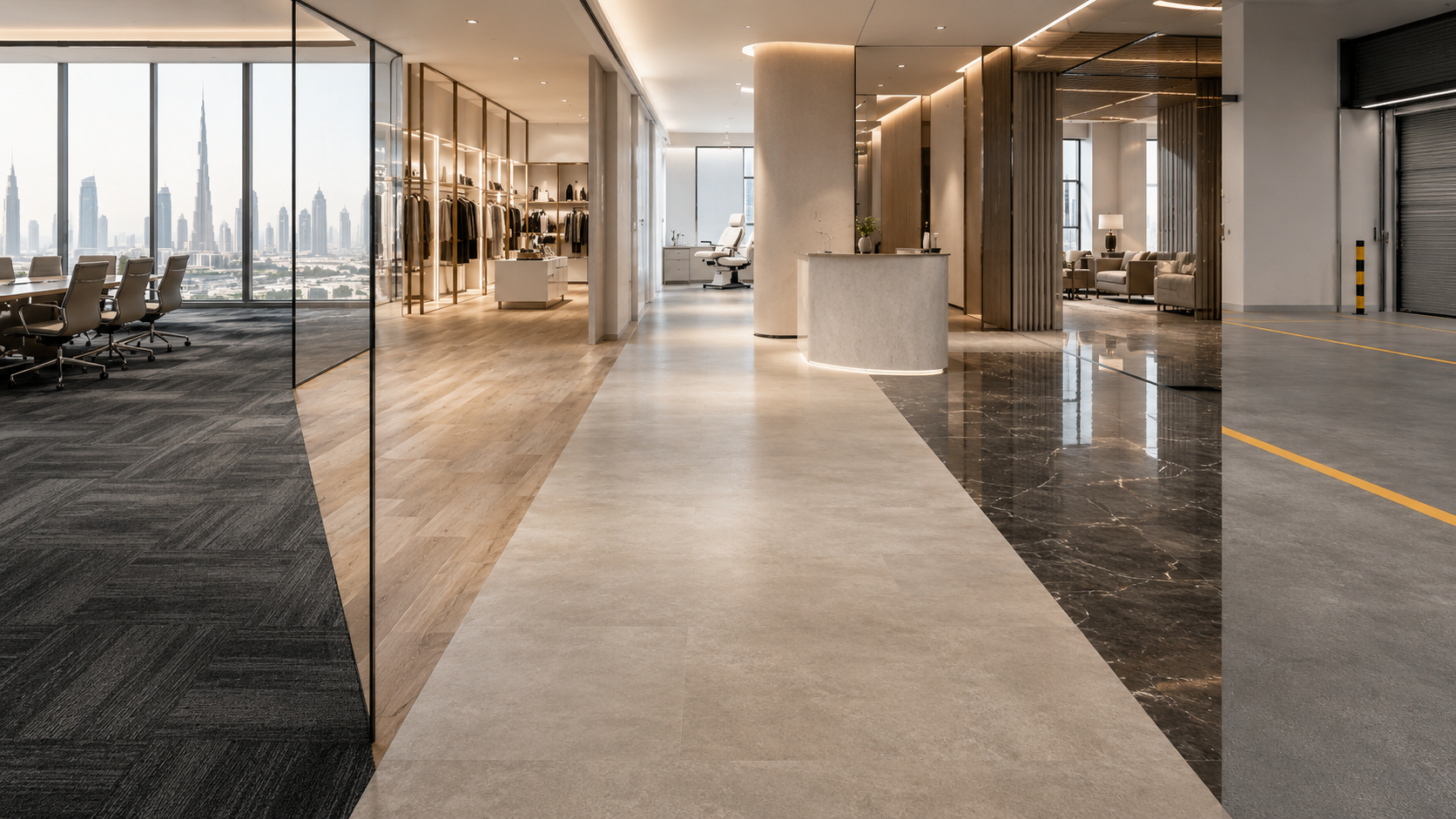
Hotel lobbies and reception areas are where premium specification belongs. Large-format stone-effect porcelain, engineered oak in wide-plank or herringbone, or premium LVT with stone visuals are all appropriate depending on the brand positioning. Dubai’s five-star market increasingly uses large marble-effect porcelain slabs in lobbies – they photograph well, are easy for a maintenance team to keep pristine, and are genuinely durable.
Pool areas and outdoor terraces: composite wood decking or porcelain with R11 slip resistance. Neither natural wood nor SPC is appropriate for pool-edge exposure.
What does not work: Laminate in hotel rooms – it cannot handle the spillage, housekeeping cleaning cycles, or moisture from en-suites. Solid wood in any part of a hotel that receives outdoor air or is near wet areas.
Cost reference:
| Area | Material | AED per sqm (installed) |
| Guest rooms | Engineered wood (herringbone/wide plank) | AED 300–650 |
| Guest rooms | Premium LVT glue-down | AED 150–250 |
| Corridors | Commercial carpet (broadloom/tiles) | AED 100–200 |
| Lobby/reception | Large-format porcelain slab | AED 200–500 |
| Outdoor terrace | Composite decking | AED 250–450 |
4. Healthcare Facilities, Hospitals, and Clinics
The specification challenge:
This is the most technically demanding sector. Healthcare flooring in Dubai is subject to DHA (Dubai Health Authority) requirements. Flooring must be seamless (no joints for bacteria), non-porous, chemical-resistant to hospital-grade disinfectants, slip-resistant (R9 minimum), and in operating theatres and ICUs, electrostatically dissipative (ESD-rated) to protect sensitive equipment.
What works:
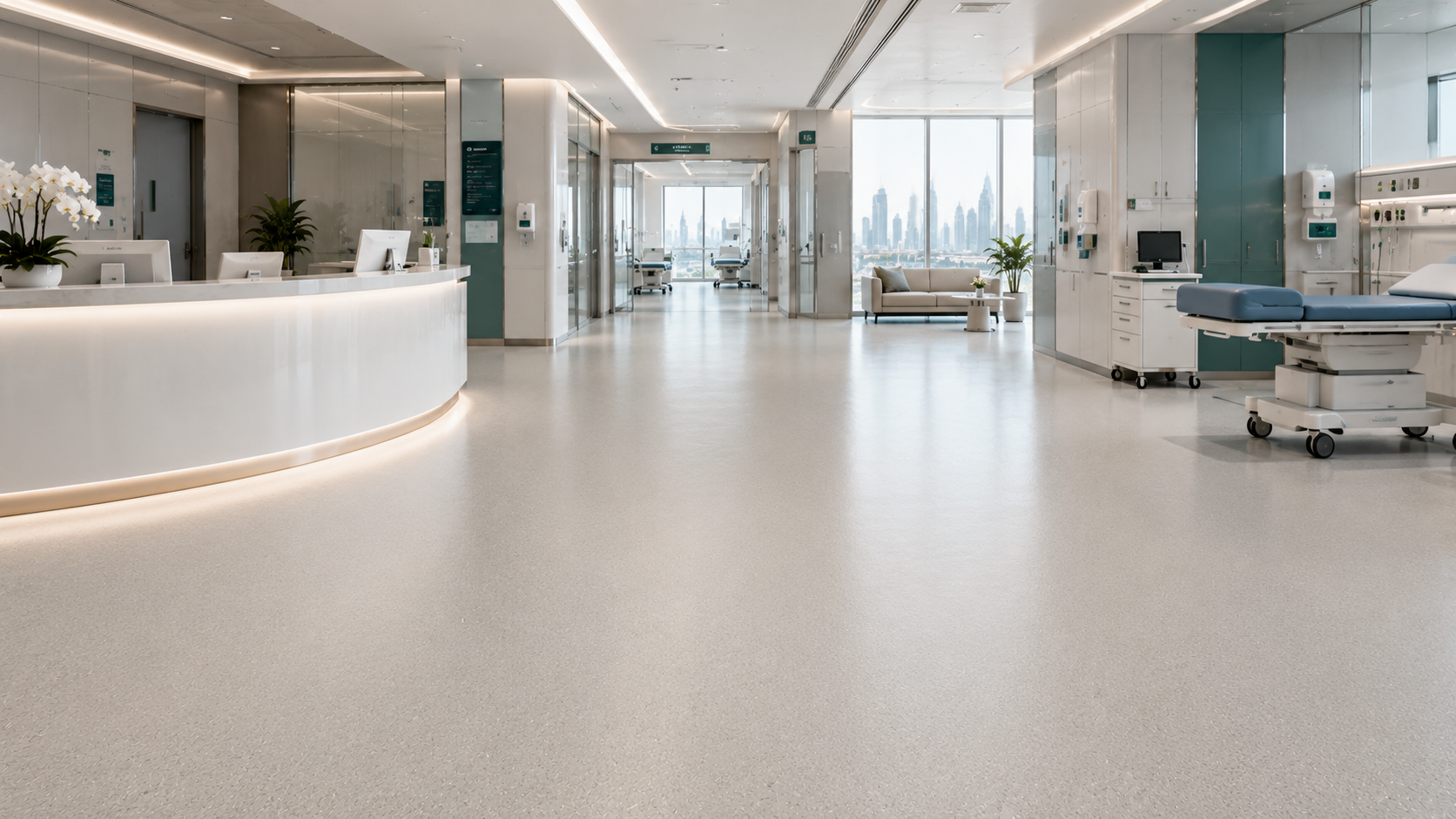
Homogeneous vinyl is the correct specification for virtually all healthcare spaces in Dubai. It is a single-layer vinyl product where the colour and composition are uniform throughout the material – unlike heterogeneous vinyl (LVT/SPC) which has a decorative film layer. This means a homogeneous floor can be abraded and cleaned repeatedly without losing its performance characteristics.
For general wards, corridors, and consultation rooms: homogeneous vinyl sheet (class 34 minimum), installed as a continuous sheet with heat-welded seams to eliminate any joint where bacteria can accumulate. Products meeting EN ISO 10581 and with PUR surface treatment are the baseline standard.
For operating theatres, ICUs, and pharmacies: ESD-rated conductive homogeneous vinyl. This prevents static buildup that can interfere with life-support and monitoring equipment. The electrical resistance must fall within the range of 5×10⁴ to 10⁶ Ohms (per EN 1081).
For wet areas and laboratory spaces: slip-resistant homogeneous vinyl with R10 rating minimum, with welded coved skirting to create a fully sealed wet room surface.
LVT and SPC, while excellent in commercial offices and retail, are incorrect for most healthcare applications. Their layer structure means seams at joints cannot be heat-welded to the same seamless standard. An infection-control auditor will flag them.
What does not work: SPC or LVT in operating theatres, ICUs, or any area requiring seamless hygiene certification. Carpet anywhere in clinical zones. Wood in any area with risk of fluid contamination.
Cost reference:
| Area | Material | AED per sqm (installed) |
| Wards / corridors | Homogeneous vinyl sheet (class 34) | AED 120–200 |
| OT / ICU | ESD conductive homogeneous vinyl | AED 180–280 |
| Wet rooms / labs | R10 homogeneous vinyl + coved skirting | AED 160–260 |
5. Educational Institutions – Schools and Universities
The specification challenge:
School floors take a specific kind of abuse. Heavy daily foot traffic from students, chair and desk movement, dropped objects, cleaning with strong detergents, and the need for acoustic performance in classrooms all apply simultaneously.
What works:
Commercial-grade heterogeneous vinyl (LVT/SPC, class 33–34) works well in administrative areas, libraries, and reception zones. For classrooms, homogeneous vinyl or high-quality heterogeneous vinyl with acoustic backing is the correct specification – the acoustic backing reduces impact noise (critical for upper-floor classrooms) and provides the standing comfort that teachers benefit from during a full teaching day.
For sports halls: polyurethane (PU) sports flooring or maple hardwood sports floors are the specification standard. These are distinct products from commercial flooring – see the Sports Flooring section below.
For corridors and circulation areas: commercial-grade SPC or homogeneous vinyl, depending on budget. SPC handles the impact and moisture from outdoor shoes well and is dimensionally stable in UAE temperature conditions.
Cost reference:
| Area | AED per sqm (installed) |
| Classrooms (commercial LVT/SPC) | AED 110–190 |
| Classrooms (homogeneous vinyl + acoustic) | AED 140–220 |
| Corridors (SPC/homogeneous vinyl) | AED 100–180 |
6. Food and Beverage – Restaurants, Cafés, and Hotel F&B
The specification challenge:
Restaurant flooring in Dubai faces three simultaneous demands that pull in different directions: it must look premium enough to attract diners, handle the operational stress of daily spills and cleaning, and be safe (slip-resistant) for staff who are moving quickly in wet conditions.
What works:
For front-of-house dining areas in mid-to-upscale restaurants, engineered wood or parquet flooring (properly lacquered to seal the surface) creates the warmth and energy that diners respond to. Herringbone oak parquet is particularly popular in Dubai’s F&B scene – it is seen throughout restaurants in d3, City Walk, and La Mer. The key specification requirement is a sealant topcoat that makes the surface resistant to liquid penetration, and a maintenance protocol that includes periodic re-coating.
For high-volume, fast-casual concepts where cleaning is frequent: large-format anti-slip porcelain (R10+ for dining, R11+ for any zones adjacent to kitchen pass-through) is the maintenance-correct choice.
For kitchen and back-of-house: non-negotiably, anti-slip porcelain or epoxy resin flooring with R11+ slip resistance. No wood, no vinyl, no SPC.
For bar areas: porcelain or sealed engineered wood with drain points considered in the layout.
What does not work: Standard click-lock SPC in restaurant dining areas – it is not sealed at the joints, which means liquid from spills or cleaning can penetrate and cause edge swelling or mould under the floor. LVT with a floating installation in restaurant kitchens is a health and safety risk.
Cost reference:
| Area | Material | AED per sqm (installed) |
| Dining (premium) | Engineered wood / herringbone parquet | AED 280–600 |
| Dining (mid-range) | Anti-slip large-format porcelain | AED 180–350 |
| Kitchen / BOH | Epoxy resin or porcelain (R11) | AED 150–350 |
7. Sports Facilities and Gyms
The specification challenge:
Sports flooring is a specialist category with its own performance standards. A gym floor must absorb impact without returning energy in a way that causes injury (shock absorption), provide appropriate grip for lateral movement, and resist the constant load of weights, machines, and foot traffic.
What works:
For commercial gym floors: rubber flooring (10mm–20mm) is the standard for free weight areas and functional training zones. It absorbs equipment impact, is virtually indestructible under normal gym use, and is easy to clean. Thickness determines the shock absorption level – weight rooms specify 20mm+ rubber; cardio equipment areas can use 10–12mm.
For multipurpose sports halls, basketball courts, and indoor courts: polyurethane (PU) sports flooring systems or hardwood maple sports floors certified to EN 14904. These provide the point elasticity (localised give under foot) and area elasticity (distributed spring) that sports performance standards require.
For yoga, pilates, and studio spaces: EVA foam tiles or polyurethane sports flooring with a softer durometer. Rubber is too hard for floor-based exercise.
What does not work: SPC, LVT, or any rigid floating floor under gym equipment. The point loads from dumbbells and barbell drops will damage the locking mechanism and create permanent surface indentations.
Cost reference:
| Area | Material | AED per sqm (installed) |
| Weight room / crossfit | Commercial rubber (15–20mm) | AED 80–160 |
| Sports hall | PU sports flooring (EN 14904) | AED 200–380 |
| Hardwood maple court | Maple sports floor system | AED 350–600 |
The Single Most Important Specification Decision: Wear Layer Thickness
Every commercial flooring buyer in Dubai should understand this one number. The wear layer is the protective top coat that sits above the decorative layer in any LVT or SPC product. It is the layer that takes all the abrasion, scratching, and cleaning. When it is depleted, the floor must be replaced.
Dubai’s conditions – sand abrasion, frequent cleaning, UV exposure – deplete wear layers faster than equivalent European environments. This is a fact that vendors rarely mention.
The correct wear layer for each commercial application:
| Use Case | Minimum Wear Layer |
| Light commercial (private offices, showrooms) | 0.55mm |
| Standard commercial (open offices, boutique retail) | 0.55–0.70mm |
| Heavy commercial (busy retail, F&B, education) | 0.70mm |
| Extreme traffic (airports, malls, hospital corridors) | 0.70mm+ |
A product sold as “commercial grade” with a 0.3mm wear layer is a residential product with commercial marketing. Do not accept it
Total Cost of Ownership: What Buyers Miss
Most procurement decisions focus on installed cost per sqm. This is the wrong metric for commercial flooring. The correct metric is cost per year of useful life.
A homogeneous vinyl floor at AED 180/sqm, properly maintained, will perform for 20+ years. A budget LVT at AED 90/sqm with a 0.3mm wear layer in a Dubai retail environment may need replacement in 5 years. The “cheap” floor costs double over a decade.
Indicative lifecycle comparison (medium-traffic commercial, Dubai):
| Material | Installed Cost | Useful Life | Annual Cost |
| Budget LVT (0.3mm wear) | AED 90/sqm | 5–7 years | AED 13–18/sqm/year |
| Commercial LVT (0.7mm wear) | AED 180/sqm | 15–20 years | AED 9–12/sqm/year |
| Homogeneous vinyl sheet | AED 160/sqm | 20–25 years | AED 6–8/sqm/year |
| Engineered wood (premium) | AED 400/sqm | 25–30 years (refinishable) | AED 13–16/sqm/year |
| Large-format porcelain | AED 300/sqm | 30+ years | AED 8–10/sqm/year |
The commercial LVT and homogeneous vinyl outperform budget LVT significantly on lifecycle cost. The porcelain, despite high upfront cost, is often the cheapest floor over 30 years for the right application.
Common Specification Mistakes in Dubai Commercial Projects
These are real errors that create real problems. They are more common than they should be.
- Specifying residential-grade products for commercial spaces. Many flooring suppliers in Dubai sell the same products across residential and commercial channels. The label “suitable for commercial” often means nothing more than a marketing claim. Ask for the specific wear class (EN 15102 / EN ISO 10582) and verify it.
- Using click-lock (floating) installation in high-traffic commercial spaces. Floating floors move under sustained foot traffic and rolling loads. They creak, separate at joints, and can lift at edges. Glue-down is the correct commercial installation for LVT and SPC in any space that sees serious traffic.
- Ignoring subfloor preparation. Commercial flooring failures in Dubai are frequently subfloor failures. A new click-lock floor laid over an uneven screed, or over tiles that have started to hollow-bond, will fail at the weakest point. Proper subfloor preparation – levelling, priming, and moisture testing – is non-negotiable before any glue-down commercial installation.
- Choosing material by appearance alone. A floor that looks stunning in the showroom under controlled lighting may not perform in a restaurant kitchen. Always specify by performance requirements first, then select the aesthetic that meets them.
- Under-specifying for Dubai’s abrasion environment. European specification guides assume European conditions. Dubai’s sand environment means wear layer degradation runs faster. Always specify one wear layer category above the European recommendation for equivalent use.
- Skipping fire classification. All commercial flooring in Dubai must comply with UAE fire safety requirements. LVT and SPC must meet a minimum Cfl-s1 fire classification (limited flammability, limited smoke). For hotels, healthcare, and education, Bfl-s1 may be required. Confirm this before purchase and request the test certificate.
Sustainability and Green Building Compliance
Dubai’s green building requirements are not static. Estidama (Abu Dhabi), LEED certification, and Dubai’s own Green Building Regulations are driving commercial developers to specify flooring that meets low-VOC, sustainable sourcing, and recyclability criteria.
For wood-based products (engineered wood, parquet): FSC (Forest Stewardship Council) certification is the standard proof of responsible sourcing. LEED projects require documented chain-of-custody certification.
For vinyl products (LVT, SPC, homogeneous vinyl): FloorScore or GREENGUARD Gold certification confirms the product meets indoor air quality standards for VOC emissions. In healthcare and education, these certifications are increasingly expected by project specification teams.
For all commercial projects: request Environmental Product Declarations (EPDs) from your flooring supplier. These are now common from leading European manufacturers and are increasingly required in UAE green building submissions.
Floor Concepts sources European-manufactured flooring, which typically meets these certification requirements as standard. Confirm certification documents as part of your procurement process.
How to Work with a Commercial Flooring Supplier in Dubai
A good commercial flooring supplier does three things that a product-only vendor does not.
Site assessment before quotation. Subfloor conditions, HVAC configuration, and traffic patterns in a specific commercial space determine which products will perform. A supplier who quotes without a site visit is guessing.
Sample provision and mock-up. Before specifying any floor across a large commercial area, test a sample under the actual lighting conditions of the space. Flooring looks different under cool-white office LEDs than under warm hospitality downlights. A good supplier will provide samples and installation mock-ups for review.
Technical documentation. For commercial projects, you need fire classification certificates, wear class ratings, VOC test reports, slip resistance test reports, and – for healthcare – DHA-relevant hygiene certifications. Request these before ordering, not after.
Floor Concepts provides consultation, site visits, European-sourced products with full technical documentation, and professional installation across Dubai’s residential and commercial sectors.
Frequently Asked Questions
Q: What is the best commercial flooring for a Dubai office?
Commercial-grade LVT (0.55–0.70mm wear layer, glue-down installation) or SPC (rigid core) are the strongest choices for most Dubai offices. They handle thermal cycling, castor chair traffic, and daily cleaning without degrading. For executive spaces, engineered wood or parquet is appropriate.
Q: What does homogeneous flooring mean?
Homogeneous vinyl flooring is a single-layer vinyl product where the colour and material composition are consistent from top to bottom. Unlike LVT or SPC, which have separate wear layers and decorative films, homogeneous vinyl performs the same throughout its thickness. This means it can be abraded repeatedly without losing hygiene performance – making it the standard for hospitals, clinics, laboratories, and any space requiring certified seamless hygiene.
Q: Is SPC better than LVT for commercial use?
SPC (Stone Plastic Composite) has a rigid stone-polymer core that gives it better dimensional stability than standard LVT, particularly in Dubai’s temperature extremes. For most commercial applications, SPC is the more technically appropriate choice. However, commercial-grade rigid-core LVT and SPC perform similarly when both are correctly specified. The wear layer thickness matters more than the core material for most commercial decisions.
Q: Can engineered wood flooring be used in commercial spaces?
Yes, but with important conditions. Engineered wood is appropriate in lower-traffic commercial areas – hotel rooms, executive offices, boardrooms, premium restaurant dining rooms, and reception areas. It is not appropriate for high-traffic corridors, food service kitchens, retail entrances, or healthcare spaces. Proper installation (climate-controlled acclimatisation, correct adhesive, stable subfloor) is critical.
Q: How much does commercial flooring installation cost in Dubai?
Costs vary significantly by material and sector. As a general guide for 2026: commercial LVT installs for AED 120–200/sqm; SPC for AED 130–220/sqm; homogeneous vinyl for AED 110–200/sqm; engineered wood for AED 260–650/sqm. These figures include supply and installation but not subfloor preparation, which may add AED 30–80/sqm depending on existing conditions.
Q: How long does commercial flooring installation take in Dubai?
A standard 500 sqm commercial LVT or SPC installation typically takes 3–5 days once the site is cleared and the subfloor is prepared. Engineered wood installation takes longer due to acclimatisation requirements (48–72 hours minimum before installation begins). Large-format porcelain projects can take 7–14 days for 500 sqm due to adhesive cure times and grouting.
Q: What fire classification does commercial flooring need in Dubai?
UAE commercial flooring must meet fire safety requirements under UAE Fire and Life Safety Code. The minimum generally required is Cfl-s1 (Class C flooring, limited smoke). For hotels, healthcare facilities, and educational buildings, Bfl-s1 is typically specified by project managers and may be required by building authority submissions. Always confirm the specific requirement with your project engineer.
Q: What certifications should I check when buying commercial flooring in Dubai?
Key certifications for commercial flooring in Dubai include: EN 15102 or EN ISO 10582 (wear class/durability rating); Bfl-s1 or Cfl-s1 (fire classification); R9/R10/R11 (slip resistance); FloorScore or GREENGUARD Gold (indoor air quality/VOC); FSC (for wood-based products); ISO 10581 (homogeneous vinyl for healthcare). Request test certificates directly from your supplier – not marketing claims.
Conclusion: The Decision Framework
Commercial flooring decisions in Dubai come down to four questions.
- What sector and use case? This determines the performance specification – wear class, installation method, hygiene requirements, slip resistance.
- What is the traffic load and type? Foot traffic, wheeled loads, chair castors, and cleaning machine traffic all affect the minimum wear layer and installation method required.
- What compliance requirements apply? Healthcare, hospitality, education, and retail each have regulatory contexts that constrain material choices.
- What is the total lifecycle cost? Not the unit cost per sqm – the cost per year of useful performance. A more expensive, correctly specified floor almost always costs less over a five-year period than a cheap, under-specified one.
Floor Concepts supplies and installs European-sourced commercial flooring across all sectors in Dubai, including engineered wood, parquet, SPC rigid core, LVT, homogeneous vinyl, sports flooring, and outdoor decking. Site consultations, technical documentation, and professional installation are part of the service.