
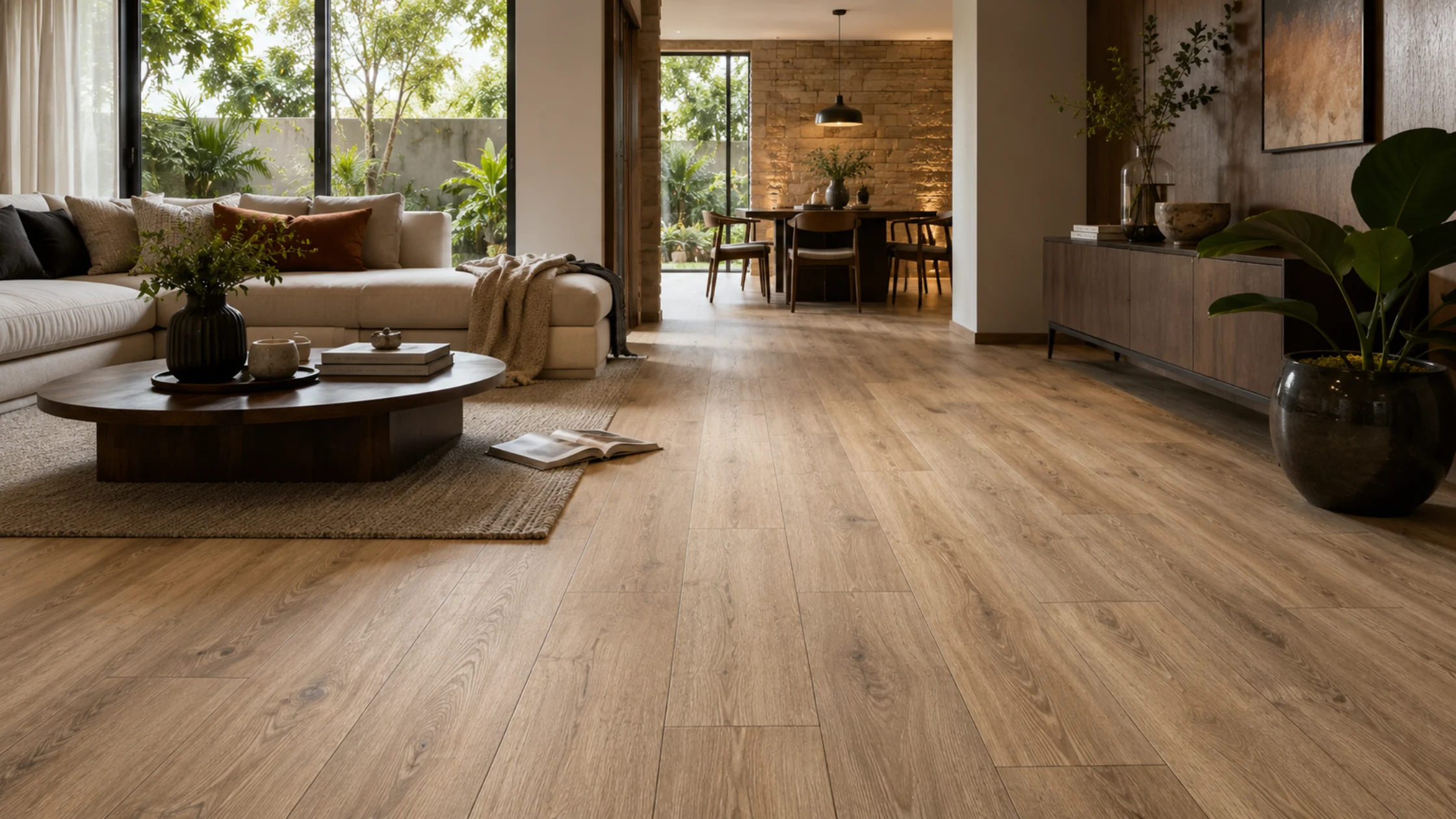
If you’ve been renovating a home recently, you’ve almost certainly come across luxury vinyl flooring. It’s showing up in apartments in Ahmedabad, office lobbies in Mumbai, and high-end villas across Gujarat – and for good reason.
The category has genuinely evolved. What most people think of when they hear “vinyl” is the cheap, slightly sticky stuff from the 1990s. That’s not what we’re talking about. Modern luxury vinyl plank (LVP) flooring is a multi-layer engineered product that can realistically replicate hardwood grain, has a rigid stone-plastic composite core, and holds up to India’s humidity, dust, and temperature swings far better than most people expect.
This guide covers everything you need to know before buying: what luxury vinyl flooring actually is, how it compares to laminate and hardwood, what to look for in quality, and what the installation process involves. If you’re looking at wooden flooring in Ahmedabad or anywhere in India, this will help you make a decision you won’t regret five years from now.
What Is Luxury Vinyl Flooring, Really?
Luxury vinyl flooring is a synthetic flooring product made primarily from PVC (polyvinyl chloride), but the word “luxury” matters here – it refers to a specific construction that’s meaningfully different from budget vinyl sheets.
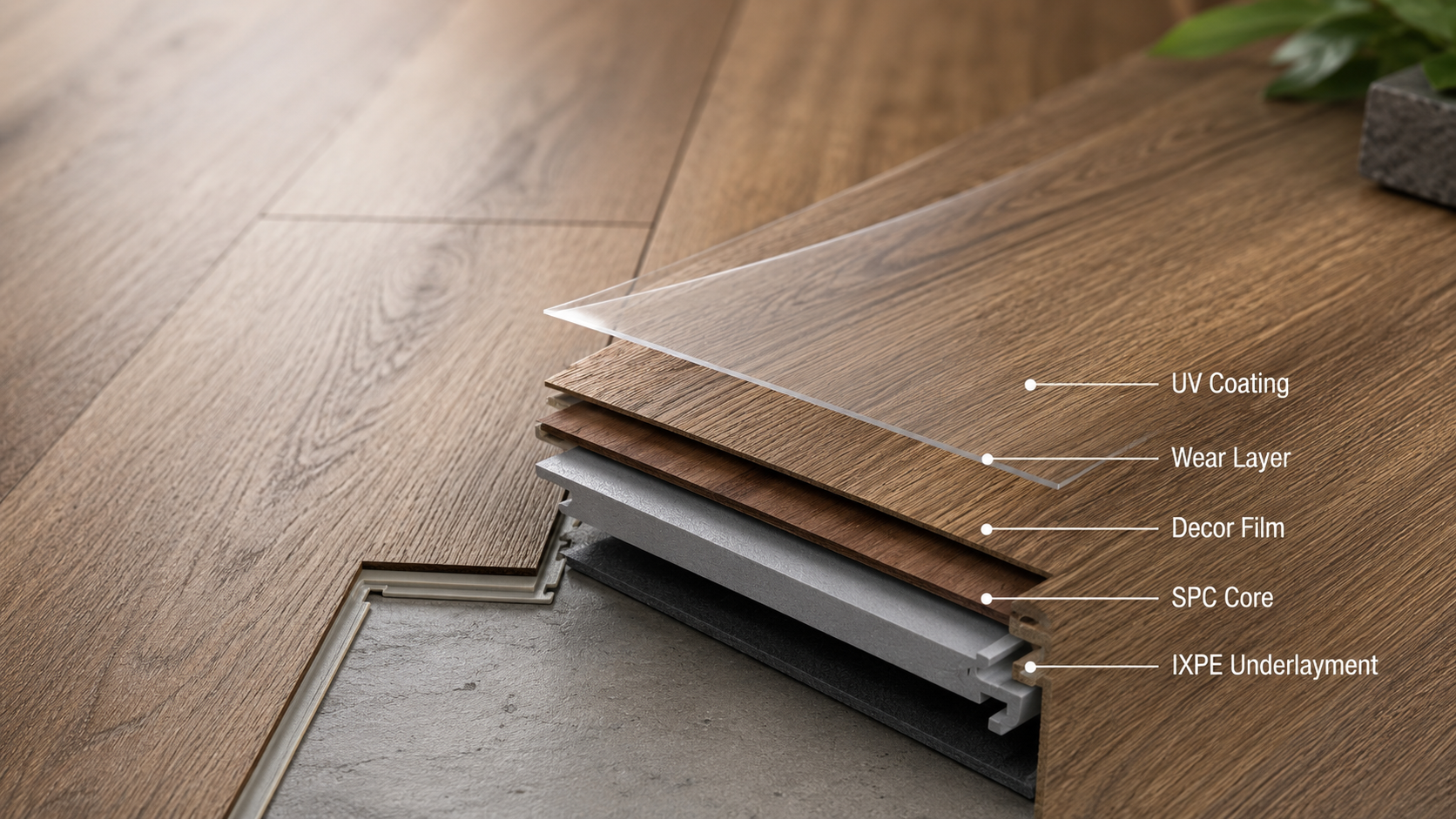
A proper luxury vinyl plank has multiple distinct layers:
IXPE / Foam Pad (bottom): An attached underlayment – usually 1mm IXPE foam – that provides cushioning, noise reduction, and slight thermal insulation. This is why LVP feels warmer and softer underfoot than ceramic tile.
LVT Base Layer: A flexible PVC base layer that gives the plank stability and helps it conform slightly to subfloor irregularities.
SPC Rigid Core: Stone Plastic Composite – a dense, rigid layer made from calcium carbonate and PVC. This is what separates premium LVP from cheap vinyl tiles. SPC cores don’t flex, warp, or expand with humidity. In a country like India, where monsoon humidity and dry winters create seasonal swings, this is important.
Decor Film Layer: A high-resolution photographic print that replicates the look of real wood – grain patterns, knot textures, color variation. The best decor films are indistinguishable from real oak or walnut at a glance.
Wear Layer (0.3mm–0.5mm): The transparent protective layer on top. Thicker is better. A 0.5mm wear layer handles heavy foot traffic, pet claws, dropped utensils, and chair legs without showing visible scratches.
UV Coating: A final surface treatment that adds sheen consistency and protects the print from UV fading.
All of this comes in at roughly 6mm total thickness for most residential-grade products – thin enough to sit under doors without adjustment, but structurally solid enough to feel like real flooring rather than a surface overlay.
Luxury Vinyl vs. Laminate vs. Hardwood: The Honest Comparison
This is the most common question buyers have. Here’s what actually matters:
Waterproofing
Luxury vinyl: 100% waterproof throughout. Water cannot penetrate to damage the core. This matters enormously for Indian kitchens, bathrooms, and any room in a humid climate.
Laminate: The surface layer resists water briefly, but the HDF wood core absorbs moisture over time. A spill left for 30 minutes can cause laminate to swell and buckle permanently. Traditional laminate should not be used in bathrooms or near kitchen sinks.
Hardwood: Not waterproof at all. Solid wood expands and contracts with humidity, which causes gaps, cupping, and warping. It can be managed with proper conditioning but requires ongoing attention in India’s climate.
Verdict for Indian homes: Luxury vinyl is the clear winner for most rooms, especially kitchens, bathrooms, balcony-adjacent areas, and ground-floor apartments.
Appearance
This is where laminate still holds a slight edge – though the gap has closed significantly. High-end laminate offers deeper, more textured embossing. But modern LVP with SPC cores can accommodate embossing that’s nearly indistinguishable from wood grain. Wide-plank LVP with hand-scraped textures, like those in the OAKA collection, competes directly with laminate on visual quality.
Hardwood looks best of all – but that’s expected given the cost difference.
Durability
All three options are durable for normal residential use. Where they differ:
- Luxury vinyl handles moisture damage; laminate does not
- Luxury vinyl has better scratch resistance per millimeter of wear layer vs. laminate’s AC rating
- Hardwood can be refinished multiple times; neither vinyl nor laminate can be sanded
- LVP is more resistant to denting under point loads (furniture legs) than some laminates, though neither matches hardwood’s density
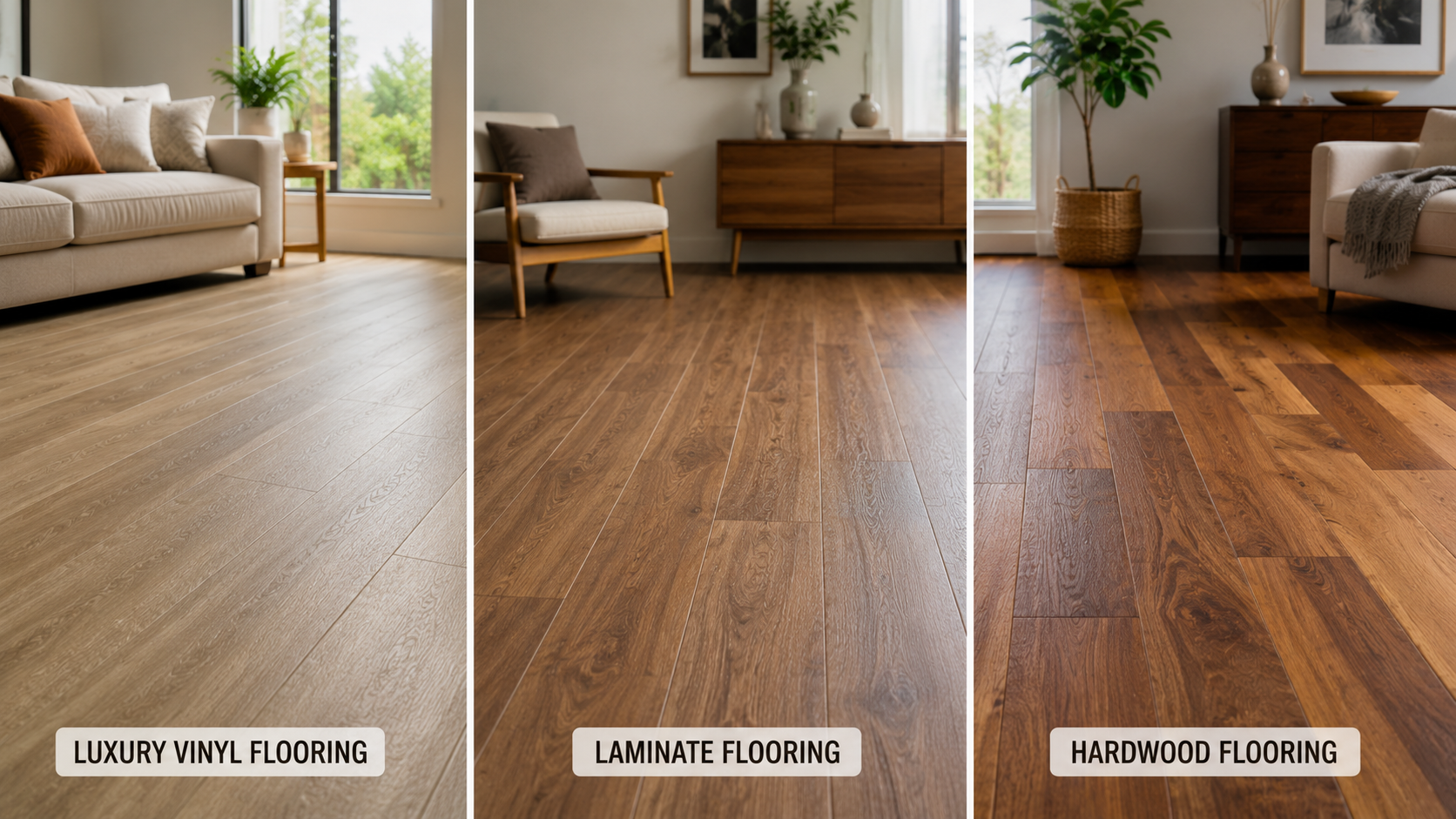
For families with children or pets, luxury vinyl’s combination of waterproofing and scratch resistance makes it the most practical long-term choice.
Cost in India
As a rough guide for the Indian market:
| Flooring Type | Material Cost (per sq ft) | Installation |
| Budget vinyl sheet | ₹60–₹120 | ₹20–₹40 |
| Luxury vinyl plank (LVP) | ₹180–₹600+ | ₹30–₹60 |
| Laminate | ₹100–₹300 | ₹30–₹60 |
| Engineered hardwood | ₹400–₹1,200 | ₹60–₹100+ |
| Solid hardwood | ₹800–₹2,500+ | ₹100–₹150+ |
Premium imported LVP with SPC cores – like the OAKA rigid vinyl collection – falls in the upper-mid range, which reflects the build quality. The SPC core, thicker wear layer, and attached IXPE underlayment are features that cheaper products don’t have.
What Makes LVP Right for India Specifically?
A lot of flooring advice online is written for temperate Western climates. India has specific conditions that change what “good flooring” means:
High humidity. Monsoon seasons push indoor humidity to levels that cause natural wood to swell. SPC-core LVP has virtually zero expansion coefficient – it won’t gap in winter or cup in summer.
Dust and grit. Indian households deal with significant fine dust, which acts as an abrasive on softer floor surfaces. A proper 0.5mm wear layer handles this far better than laminate’s surface, which scratches more easily under particle friction.
Hard subfloors. Most Indian construction uses concrete slabs rather than wooden subfloors. LVP’s built-in IXPE underlayment compensates for the hardness underfoot. Without it, walking on thin vinyl over concrete for hours becomes noticeably uncomfortable.
Varied room use. Indian homes often use the same continuous flooring across living areas, kitchen, and sometimes wet-facing balcony entrances. The waterproof SPC construction is the only flooring type that handles all of these zones without requiring different materials or special sealing.
The Herringbone Question
If you’ve been spending any time looking at flooring inspiration online, you’ve noticed herringbone is everywhere. It’s not just a trend – the diagonal installation pattern genuinely changes how a room feels. It draws the eye along the diagonal axis rather than the room’s length, making narrow or rectangular rooms feel wider.
Herringbone also highlights the grain and texture of the planks better than straight installation, which makes it particularly well-suited to LVP with realistic wood-look decor films.
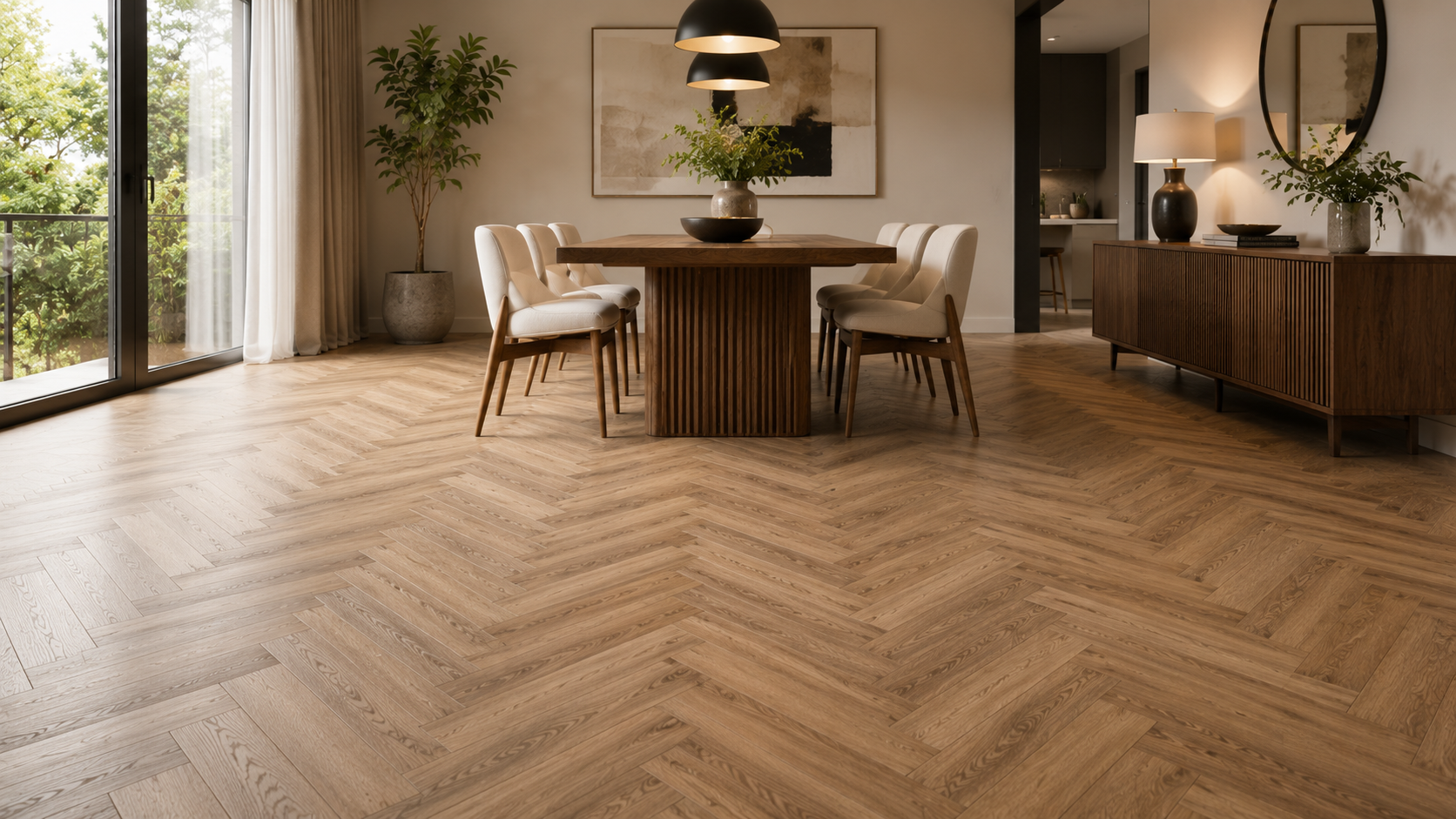
The trade-off is installation complexity. Herringbone requires more cuts, more precision, and typically 8–10% more material for waste. It’s not a DIY project for most homeowners – professional installation is strongly recommended for pattern work. But the visual result is worth the extra investment if you’re after a distinctive look.
Both straight plank and herringbone formats are available in the OAKA collection, using the same 110mm × 610mm planks with a 6mm SPC core.
What to Look For When Buying LVP in India
There’s a wide quality range in the Indian market, from very cheap vinyl tiles to premium SPC-core planks. These are the specs that actually matter:
Wear Layer Thickness: The single most important number. Look for 0.5mm or above for residential use. 0.3mm is acceptable in low-traffic bedrooms. Anything below 0.3mm wears through too quickly.
Core Type: SPC (Stone Plastic Composite) is superior to WPC (Wood Plastic Composite) for Indian conditions. SPC is more dimensionally stable and doesn’t absorb moisture even at the cut edges.
Total Thickness: 6mm is the standard residential grade. Thinner products feel hollow underfoot and are more susceptible to telegraphing subfloor irregularities.
Attached Underlayment: An integrated IXPE or EVA foam underlayment saves you the cost and hassle of a separate underlayment sheet, and ensures consistent performance across the install. Not all products have this – check before buying.
UV Coating: Important for any room with natural light. Without it, the decor layer can yellow or fade within a few years near south or west-facing windows.
Click System: A proper interlocking click system (rather than glue-down) allows the floor to float freely over the subfloor, accommodating any minor thermal expansion without buckling. It also makes individual plank replacement possible if a section is ever damaged.
Indoor Air Quality (VOC Certification): Reputable brands will have certifications confirming low VOC emissions. This matters particularly in enclosed rooms with limited ventilation.
Installation: What the Process Looks Like
Professional wooden flooring installation for LVP follows a predictable sequence. Understanding it helps you plan and ask the right questions.
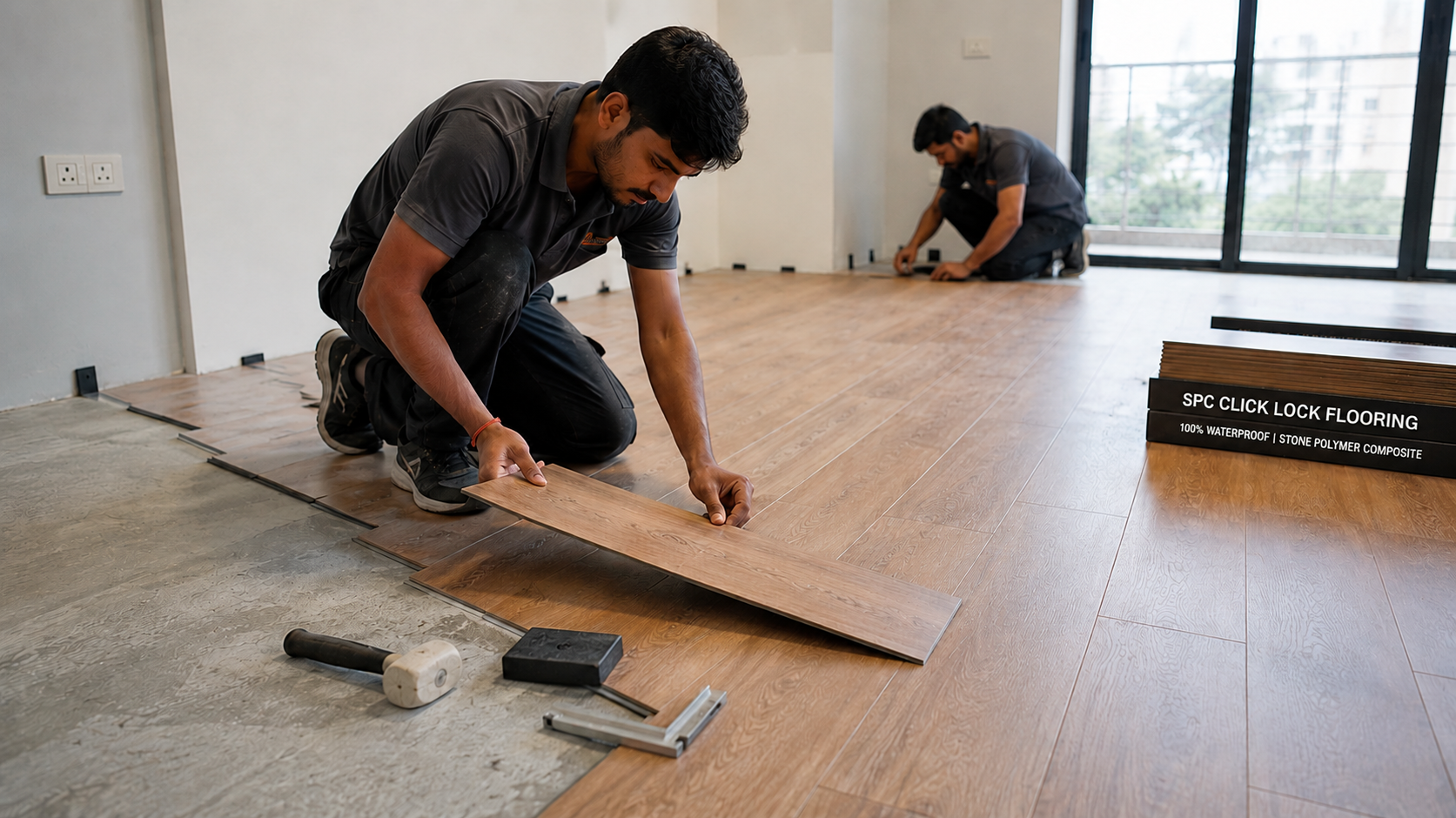
Subfloor assessment: The concrete must be level – typically within 3mm over 1.8m. Low spots get filled with a self-levelling compound; high spots get ground down. Skipping this step causes click locks to stress and pop open over time.
Acclimatization: LVP planks should sit in the installation room for 24–48 hours before laying. This allows the product to settle to the room’s temperature and humidity so you’re not installing it at a different dimension than it will stabilize to.
Layout planning: The installer marks out the direction of planks (usually running parallel to the longest wall or toward the main light source) and calculates the starting row to ensure cut pieces at both walls are roughly equal.
Installation: Click-lock planks are installed row by row, with a 10mm expansion gap maintained at all walls. This gap gets covered by skirting boards at the end.
Skirting and finishing: Matching skirting profiles in the same decor finish as the floor provide a clean visual transition to the wall and cover the expansion gap. Profile strips handle transitions between the LVP and adjacent flooring types (tile, carpet, etc.).
The full process for a 300–400 sq ft room typically takes one to two days for an experienced team.
Maintenance: What You Actually Need to Do
This is where LVP genuinely earns its practical reputation. Maintenance is minimal compared to hardwood.
Daily: A dry microfibre mop or vacuum removes dust and grit. Grit is the biggest enemy of wear layers – removing it regularly prevents the fine scratching that dulls the surface over years.
Spills: Wipe immediately. Despite being fully waterproof, leaving standing water at edges or seams for extended periods is not ideal. A damp mop is fine; soaking is not necessary.
Deep cleaning: A mild pH-neutral floor cleaner diluted in water, applied with a damp (not wet) mop, is sufficient. Avoid steam cleaners – the heat and pressure can affect the click joints over time. Avoid harsh solvents, bleach, or abrasive scrubbers.
What not to do: Don’t use wax, polish, or oil-based products. The wear layer doesn’t absorb them, and they leave a residue that attracts more dirt.
With reasonable care, a good SPC-core LVP with a 0.5mm wear layer should look good for 15–20 years in normal residential use.
Choosing the Right Look: Colour and Tone Guidance
The colour you choose affects the room more than almost any other single decision. A few principles that hold up across projects:
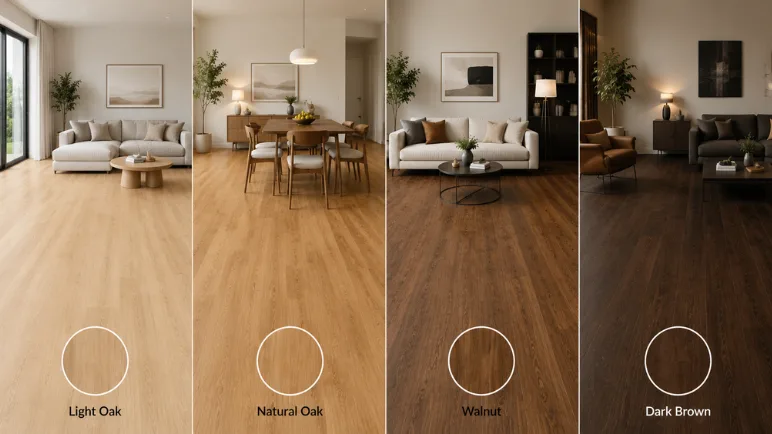
Lighter tones visually expand small rooms. A light beige or pale grey LVP in a 120 sq ft bedroom will make it feel meaningfully larger than a dark walnut tone in the same space.
Mid-tones are the safest choice for resale value. Warm beiges, greige tones, and medium browns work with the widest range of furniture styles and wall colours.
Dark floors look stunning but show dust and pet hair more readily. If you’re choosing a deep charcoal or dark walnut, factor in the daily maintenance commitment.
Wide planks (150mm+) look more contemporary and expensive. Narrow planks read more traditional or budget.
Herringbone in a lighter tone is one of the most impactful choices for open-plan living areas – it adds visual complexity without requiring pattern wallpaper or elaborate furniture.
Frequently Asked Questions
Is luxury vinyl flooring the same as vinyl plank flooring?
Luxury vinyl flooring is a broad category; vinyl plank flooring (LVP) is the plank-format version within it. There are also luxury vinyl tiles (LVT), which mimic stone or ceramic. For wood-look flooring, LVP is the relevant format.
Can luxury vinyl flooring be installed in bathrooms?
Yes. Unlike laminate or hardwood, SPC-core LVP is 100% waterproof and performs well in wet areas including bathrooms and kitchens. Use appropriate profile strips at edges and ensure there’s no gap that allows water to pool underneath.
How does luxury vinyl flooring handle Indian summers?
SPC-core products have a very low thermal expansion coefficient. They don’t buckle in summer heat the way laminate or hardwood can. That said, avoid direct prolonged sunlight without UV-protective window treatment – extreme direct heat over years can affect any flooring.
Is professional installation necessary?
For straight plank installation, a careful DIYer with patience can manage it. For herringbone patterns or any install involving stairs, professional installation is recommended. The result quality and click-lock longevity both improve significantly with experienced installers.
What’s the difference between SPC and WPC core?
SPC (Stone Plastic Composite) has a denser, harder core and is more dimensionally stable. WPC (Wood Plastic Composite) has a softer feel underfoot but is less rigid. For Indian conditions – concrete subfloors, humidity swings – SPC is generally the better choice.
How long does luxury vinyl flooring last in India?
With a 0.5mm wear layer and proper maintenance, 15–20 years is realistic for residential use. Commercial spaces with very high foot traffic would see more wear and should look at 0.7mm+ wear layer specifications.
Explore OAKA’s Rigid Vinyl Collection
OAKA Floors is a wooden flooring company offering premium rigid vinyl plank flooring across India and the UAE. The collection includes both straight plank and herringbone formats in 6mm SPC-core construction with a 0.5mm wear layer and attached 1mm IXPE underlayment.
Available shades include warm earthy tones (Warsaw, Bombay, Nevada), cool contemporary greys (Stockholm), deep dark browns (Melbourne, Detroit), and lighter fresh options (Vegas, Tromsø) – each designed to work across residential and commercial interiors.
Professional wooden flooring installation services are available in Ahmedabad and across India.
Explore the OAKA collection →
Contact OAKA for installation →