
Introduction: Why Dubai Homeowners Are Rethinking Their Floors
Dubai’s interiors have never looked better. Villas in Mudon and Mira Oasis, apartments along Dubai Marina, and commercial spaces across Business Bay are all gravitating toward one material: Engineered Wood Flooring.
The reason is not just aesthetics – though the warmth and grain of real wood speaks for itself. It is climate logic. Dubai’s combination of 40°C+ summer heat, air conditioning that runs around the clock, and occasional humidity spikes creates an environment that punishes the wrong flooring and rewards the right one. Engineered wood sits squarely in the “right” category for the UAE.
This guide covers everything: what engineered wood actually is, how it performs in the Gulf climate, how to compare products, what to look for in a supplier, and how to maintain your floors for decades.
What Is Engineered Wood Flooring?
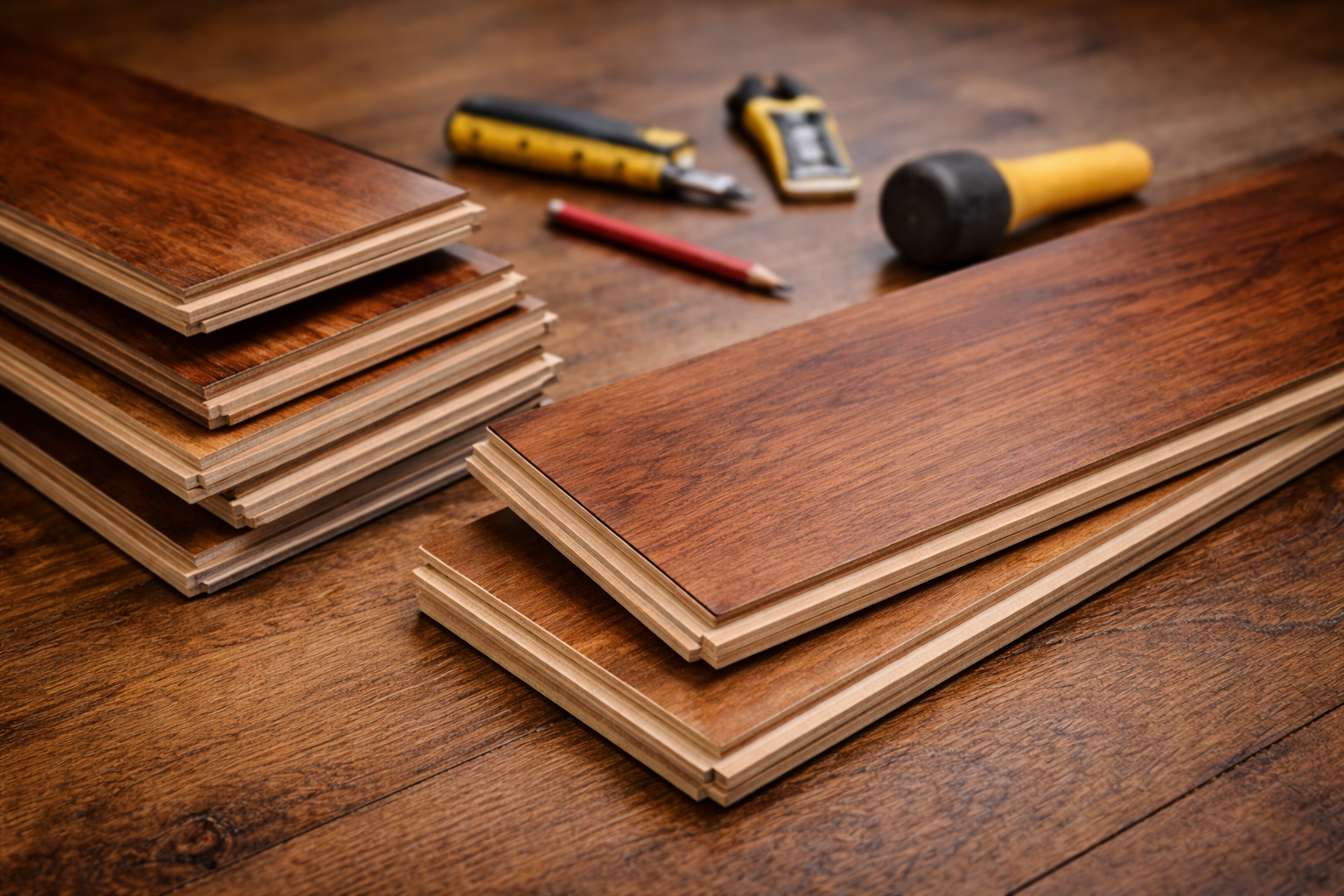
Engineered wood flooring is a multi-layer product built with a real hardwood veneer on top – usually 2 to 6mm of genuine wood – bonded over a plywood or high-density fiberboard (HDF) core. The cross-grain layering of the core is the engineering insight:
it mechanically resists expansion and contraction caused by temperature and humidity changes.
This is different from:
- Solid wood flooring – milled from a single piece of timber, beautiful and refinishable many times, but sensitive to moisture and temperature swings.
- Laminate flooring – uses a photographic image layer over a synthetic core, with no real wood on the surface.
- SPC / Rigid Core flooring – a stone-plastic composite, fully waterproof, but without the authentic feel of real wood underfoot.
Engineered wood gives you the genuine wood surface and the underfoot warmth of hardwood, with structural stability that makes it practical for Dubai’s environment.
Why Dubai’s Climate Makes Engineered Wood the Smart Choice
The Challenge With Solid Hardwood in the UAE
Solid hardwood is a magnificent product. In temperate climates – northern Europe, Canada, the northeastern United States – it performs beautifully for generations. In Dubai, it can become unpredictable.
The issue is dimensional movement. Wood absorbs and releases moisture from the air. When humidity rises, planks expand. When AC cools the space rapidly, they contract. In a Dubai apartment where balcony doors open to humid summer air and AC runs at 20°C inside, solid planks can cup, crown, or develop gaps within a few years. This is not a product failure; it is physics.
Engineered wood’s cross-layered core counteracts that movement. The layers are bonded at opposing grain angles, which mechanically prevents the plank from reacting to humidity changes the way a single piece of timber would.
Where Engineered Wood Excels in Dubai Properties
High-rise apartments – Temperature differentials between balcony and interior AC zones are significant. Engineered planks handle these transitions without visible gapping.
Villas with large windows – Direct sunlight heats the floor surface daily. Engineered wood deals with thermal cycling better than solid wood and, with UV-protective window film or mid-toned finishes, resists fading well.
Ground-floor spaces – Slight moisture migration from slabs is more common here. A well-bonded engineered floor with a plywood core tolerates this better than solid timber.
Commercial and hospitality spaces – Engineered wood is used in hotels, showrooms, and restaurants across the UAE because it holds up under foot traffic without requiring the strict humidity management that solid hardwood demands.
What to Look For When Comparing Engineered Wood Products
Not all engineered wood is the same. Walking into a showroom, every plank looks beautiful. The differences that matter are underneath the surface.
1. Wear Layer Thickness
The wear layer is the solid wood veneer on top – the part you see and touch. Thickness determines how many times the floor can be sanded and refinished over its life.
- 2–3mm wear layer: Adequate for rental properties or spaces with moderate traffic. Cannot be refinished.
- 3.5–4mm wear layer: Can typically be refinished once. Good for apartments planned for 10–15 year occupancy.
- 5–6mm wear layer: Premium option. Can be refinished 2–3 times. Suitable for long-term villas and high-investment residential projects.
For Dubai villas where the floor is expected to last 20–30 years, a 4mm or thicker wear layer is worth the investment.
2. Core Construction
Plywood core – Multiple thin sheets of wood bonded at opposing grain angles. Offers excellent stability and performs better in large open spaces with sunlight exposure. Preferred for UAE villas and premium residential projects.
HDF (High-Density Fiberboard) core – Denser and consistent, suitable for medium-sized spaces. Slightly less stable than plywood in high-temperature differential conditions.
For Dubai specifically, plywood cores perform better because they resist the daily heating cycles from sunlight and AC more reliably.
3. Surface Finish
- Lacquered / UV-coated: Easy to clean, low maintenance, resists staining. Ideal for family homes and commercial spaces.
- Oil-finished / hard wax oil: Looks and feels more natural, penetrates into the wood fiber. Requires periodic re-oiling (every 1–3 years depending on traffic) but is easier to repair locally if scratched.
- Brushed or hand-scraped: Texture that hides minor scratches and sand abrasion. Particularly practical near desert-facing communities in Dubai.
4. Wood Species
European oak remains the most popular choice in Dubai – adaptable to most interior palettes, available in dozens of finishes from pale grey-white to deep cognac. Other options include:
- Walnut – Rich dark tones, premium feel, suited to luxury residential and executive offices.
- Ash – Lighter grain, contemporary look, works well in minimalist and Scandinavian-influenced interiors.
Herringbone and chevron parquet – Pattern-cut engineered planks for bespoke statements in lobbies and master bedrooms.
Engineered Wood vs. Other Flooring Options: Dubai Context
| Factor | Engineered Wood | Solid Wood | SPC / Rigid Core | Porcelain Tile |
| Real wood surface | Yes | Yes | No | No |
| Climate stability (UAE) | Good | Requires consistent AC | Excellent | Excellent |
| Refinishable | 1–3 times | 5–7 times | No | No |
| Warmth underfoot | Yes | Yes | Moderate | Cold |
| Moisture resistance | Good | Limited | Waterproof | Waterproof |
| Installed cost (AED/sqm) | 150–400+ | 250–600+ | 120–260 | 50–300+ |
| Suitable for villas | Yes | (with climate control) | Yes | Yes |
Installation: What Good Looks Like
Floating vs. Glue-Down
Engineered wood can be installed two ways in Dubai:
Floating installation – Planks click together and sit on an underlay, not bonded to the subfloor. Faster and cleaner, easily reversible. Works well in apartments and spaces where you may want to change the flooring in the future. Not ideal for very large open-plan spaces where slight movement over time can create hollow sounds.
Full-bond / glue-down installation – Planks are fully adhered to the subfloor using a professional flooring adhesive. More stable for large areas, better acoustic performance, and the right approach for villas and commercial spaces with heavy foot traffic.
The adhesive quality matters in the UAE. Temperature-cycling stresses the bond annually. Using a high-performance polyurethane adhesive rated for the Gulf climate is not optional – it is the difference between a floor that lasts 25 years and one that lifts or creaks within 5.
Subfloor Preparation
A clean, level, and dry subfloor is non-negotiable. Uneven subfloors cause premature wear, hollow sections, and in worst cases, cracking. A professional installation team will always check for:
- Moisture content of the concrete slab (should be below 2–3% CM for glue-down)
- Level tolerance (typically ±3mm over 2 metres)
- Presence of any residual adhesive, dust, or contamination from previous flooring
Skipping subfloor preparation is the most common reason good flooring underperforms.
Maintenance: Keeping Engineered Wood Looking Perfect in Dubai
Dubai’s desert environment introduces a specific maintenance variable: fine sand and dust. Sand particles act like abrasive grit on flooring surfaces. On engineered wood, sand trapped underfoot gradually scratches the lacquer or oil finish.
Daily habits that protect your floor:
- Use quality door mats at all entrances to trap sand before it reaches the floor.
- Sweep or vacuum regularly using a soft-head attachment – not a rotating brush, which can mark the finish.
- Wipe spills immediately. Although engineered wood handles moisture far better than solid hardwood, standing water should never sit on any wood floor.
Periodic care:
- Lacquered floors can be cleaned with a lightly dampened microfibre mop and a pH-neutral wood floor cleaner.
- Oil-finished floors benefit from periodic re-oiling using the manufacturer’s recommended maintenance oil – typically once a year in residential use.
What to avoid:
- Steam mops – the heat and moisture combination is harmful to any wood floor.
- Abrasive cleaners or anything with bleach.
- Furniture dragged directly on the surface – use felt pads on all furniture legs.
Frequently Asked Questions
Is engineered wood flooring suitable for Dubai’s humidity?
Yes. Engineered wood’s cross-layered plywood or HDF core resists the expansion and contraction caused by humidity changes, making it far more stable than solid hardwood in the UAE. For spaces with consistent air conditioning, it performs reliably for 20–25 years or more.
Can engineered wood be installed over existing tiles in Dubai?
In most cases, yes – provided the existing tiles are level, securely bonded, and the combined floor height does not create issues at door thresholds. A site assessment by a professional installer will confirm suitability.
What is the cost of engineered wood flooring in Dubai?
Supply costs typically range from AED 150 to AED 400+ per square metre depending on species, wear layer thickness, and brand. Full installation including subfloor preparation and adhesive adds to the project cost. Always compare fully installed prices rather than just material costs.
How long does engineered wood flooring last in Dubai?
With a 4mm or thicker wear layer, professional installation, and proper maintenance, engineered wood floors in Dubai homes typically last 20–30 years. Premium products with a 6mm wear layer that are refinished periodically can last significantly longer.
What’s better for a Dubai villa: engineered wood or SPC?
Both are valid choices. Engineered wood offers a real wood surface – the authentic grain, texture, and warmth that SPC cannot replicate. SPC is fully waterproof and lower maintenance. For primary living areas and master bedrooms where aesthetics and comfort matter most, engineered wood is the preferred choice of Dubai’s premium residential market.
Can I install engineered wood in my kitchen or bathroom?
With appropriate moisture barriers and careful installation, engineered wood can work in kitchens. Bathrooms and wet rooms are better served by porcelain or SPC. Your installer should advise on moisture barrier requirements based on your specific slab conditions.
Choosing the Right Supplier in Dubai
The flooring market in Dubai is busy. There are dozens of suppliers, and product quality varies significantly. When evaluating options, consider:
Brand and origin transparency – Premium engineered wood is predominantly manufactured in Europe (Poland, Germany, Italy, Sweden, Portugal). Reputable Dubai suppliers will clearly identify the manufacturing origin and provide technical data sheets.
Warranty terms – Look for manufacturers offering at least 15–25 year residential warranties on the product. Ask separately about the installation warranty.
Sample quality – Request full-length sample boards, not small chips. Walk on them, feel the weight, check the wear layer thickness at the edge.
After-sales support – A floor lasts decades. Your supplier should be reachable long after installation for maintenance advice, spare boards, and any warranty claims.
Showroom and project portfolio – Suppliers with a showroom and a documented portfolio of completed projects in the UAE are more accountable and experienced with the local climate and installation conditions.
Floor Concepts: European Wood Flooring Specialists in Dubai
Floor Concepts has been supplying and installing premium wood flooring across the UAE for over a decade. Our portfolio spans residential villas, luxury hotel projects including Atlantis The Royal, commercial showrooms, and educational facilities.
We work exclusively with European-origin brands – including Recoll, Parkiety Jabłoński, Tilo, and Kaczkan – and every installation is carried out by our own team of trained flooring specialists.
Our process:
- Consultation within 24 hours of enquiry
- Product and design proposal matched to your space, timeline, and budget
- Order confirmation with clear lead times
- Coordinated delivery and site scheduling
- Professional installation with full post-installation documentation
- Manufacturer product warranty plus one-year installation defects liability