
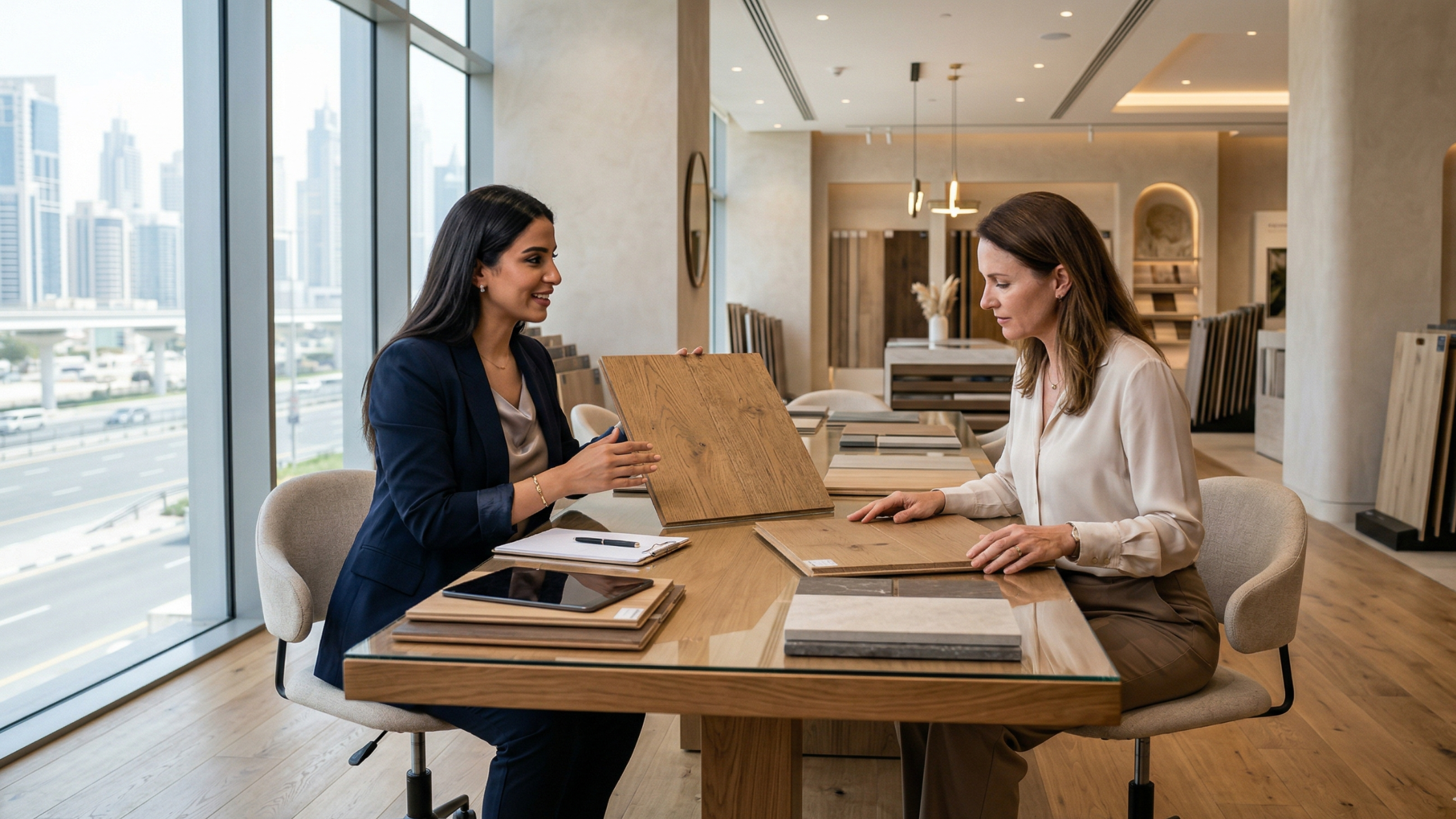
Search “flooring companies in Dubai” and you’ll find dozens of lists – names, taglines about “premium quality” and “professional installation.” What you won’t easily find is honest guidance on how to tell them apart.
This guide walks you through the practical framework. Not which company to pick, but how to evaluate any company you’re considering.
Supplier vs Contractor vs Full-Service Company – Know What You’re Hiring
This distinction matters more than most buyers realise, and almost no flooring guide in Dubai explains it.
Flooring suppliers sell products. They may stock engineered wood, vinyl, parquet, and rigid core options in a showroom, but installation is either not offered or outsourced to independent fitters. If the installation fails, accountability gets complicated fast – the supplier points to the fitter, the fitter points to the product. Neither is your problem to referee.
Flooring contractors do the opposite. They install, but they don’t always hold their own stock. They source materials from wherever is cheapest at the time, which means product quality is variable and warranty documentation is thin or non-existent.
Full-service companies supply and install under one roof – and more importantly, under one warranty. The same company that recommends the material is responsible for how it performs after installation. That unified accountability is what you’re really paying for, and it’s the structure that protects you if something goes wrong six months later.
For most Dubai homeowners and commercial buyers, a full-service flooring company is the lower-risk choice. Before you request any quote,
ask directly: do you supply the products you install, and does your warranty cover both?
What Dubai’s Climate Actually Demands from a Flooring Company
Most flooring guides mention Dubai’s heat as a footnote. It’s not a footnote – it’s the central design constraint, and it should shape how you evaluate every company you talk to.
The subfloor problem. The vast majority of Dubai properties sit on concrete slabs. Concrete transmits moisture upward and retains heat, which means the underside of your flooring is constantly exposed to conditions that can delaminate adhesives, cause buckling in wood, or create hollow spots under rigid flooring. A competent company assesses the substrate before recommending any material. If a company is ready to quote without visiting the site, that’s your first warning sign.
Temperature cycling. Air-conditioned Dubai interiors typically run at 20–23°C. Step outside and that becomes 40°C+. Rooms near windows, balconies, and building entrances experience greater variance. Materials that are dimensionally stable – SPC, LVT – handle this movement. Solid wood , semi solid wood flooring, and laminate flooring are more vulnerable to expansion gaps and surface lifting if specified incorrectly or installed without adequate expansion allowances.
Humidity variance. Coastal areas of Dubai – Dubai Marina, JBR, Palm Jumeirah – carry higher ambient humidity. A company that gives you the same specification regardless of your building’s location and orientation isn’t giving you expert advice.
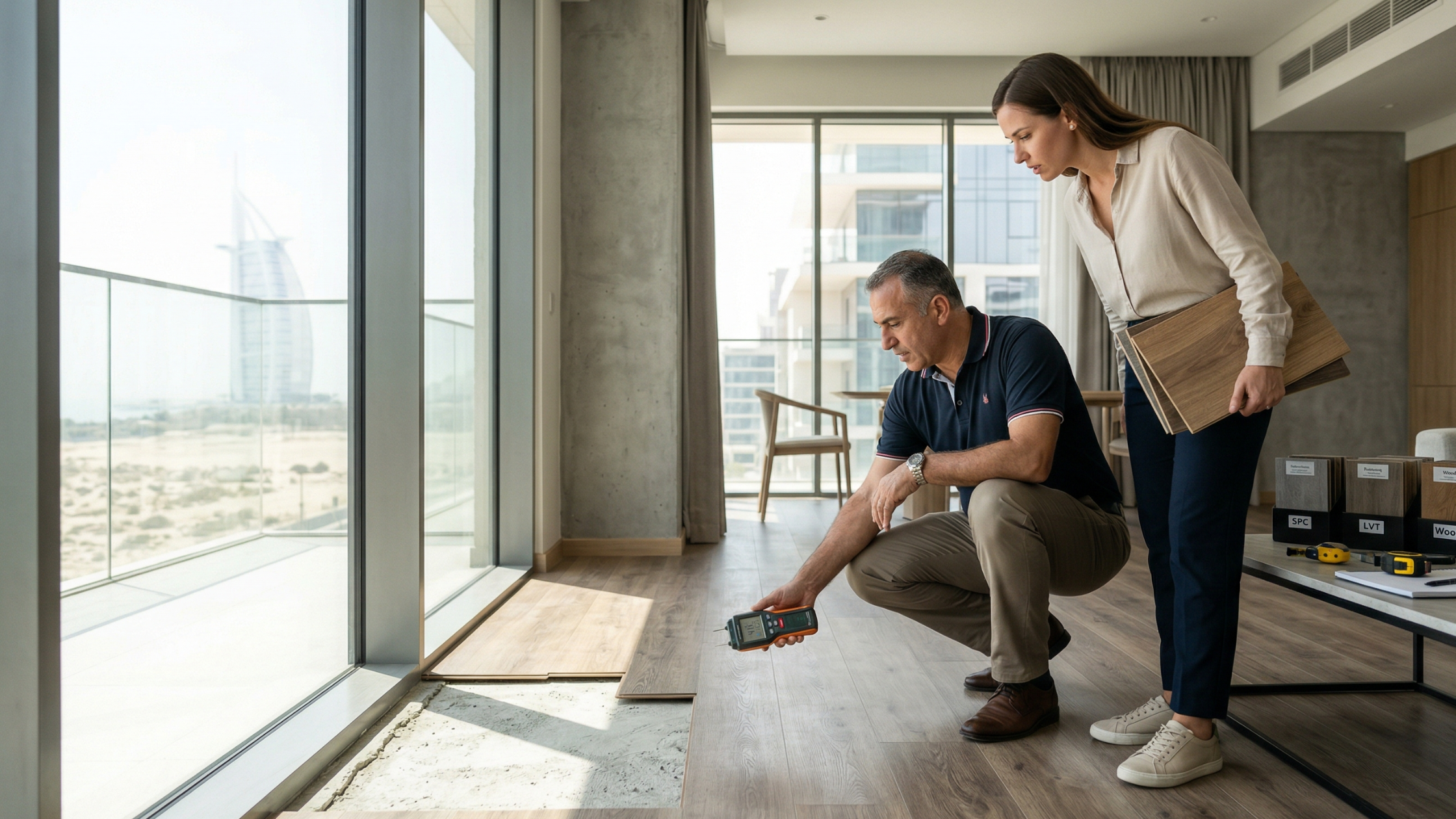
The practical test: ask any company you’re considering how they adjust product recommendations for your specific location and space. Vague answers reveal whether climate knowledge is genuine or just marketing language.
6 Questions to Ask Any Flooring Company Before You Hire
These six questions are more useful than reading any number of company reviews. The quality of the answers tells you what no testimonial can.
1. Do you carry out a site visit and moisture test before recommending materials?
Moisture testing of the concrete subfloor is a basic step in professional flooring installation. It takes minutes and affects everything – adhesive selection, underlay choice, whether wooden flooring products need a moisture barrier. Companies that skip it are either cutting corners or don’t know why it matters.
2. Who performs the installation – your own team or subcontractors?
Many Dubai flooring companies outsource installation to third-party labourers. This isn’t automatically bad, but it means the company has less direct control over workmanship quality, and your relationship with the installer is indirect. Ask specifically whether the installation team is employed by the company or sourced separately per project.
3. Can you show me completed projects similar to mine, with references I can contact?
Photos are easy to curate. Actual project references – clients you can call – carry real weight. A company that can’t or won’t provide them either hasn’t done comparable work or has done work they’d rather you not inspect.
4. What does your warranty cover – product defects only, or installation problems too?
These are two separate warranties. The product warranty comes from the manufacturer and typically covers material defects for anywhere between 5 and 25 years, depending on the product. The installation warranty comes from the company and should cover problems caused by how the floor was fitted – debonding, lifting, hollow spots, expansion issues. You need both in writing. A company offering only manufacturer warranty is leaving you exposed to the most common category of failure.
5. What adhesives and underlays do you use, and are they appropriate for Dubai’s concrete subfloors?
Adhesive chemistry matters more in Dubai than most buyers expect. Two-component polyurethane flooring adhesives and moisture-resistant systems perform significantly better on Dubai’s concrete slabs than standard water-based adhesives. A company that uses whatever is cheapest at the time will give you a vague answer here. One that knows their craft will explain the specific system and why.
6. How do you handle problems that appear three to six months after installation?
This is where you find out how accountable a company really is. Many flooring issues – expansion gaps, delamination, hollow spots – don’t appear immediately. They show up after seasonal temperature changes or after the first summer cycle. Ask directly what the process is, who to contact, and what the company’s documented response time is. If the answer is a phone number and a verbal promise, that’s not a warranty – it’s hope.
The Red Flags – What a Poor Flooring Company Looks Like
Dubai’s flooring market has no shortage of operators who cut corners. These are the patterns worth watching for.
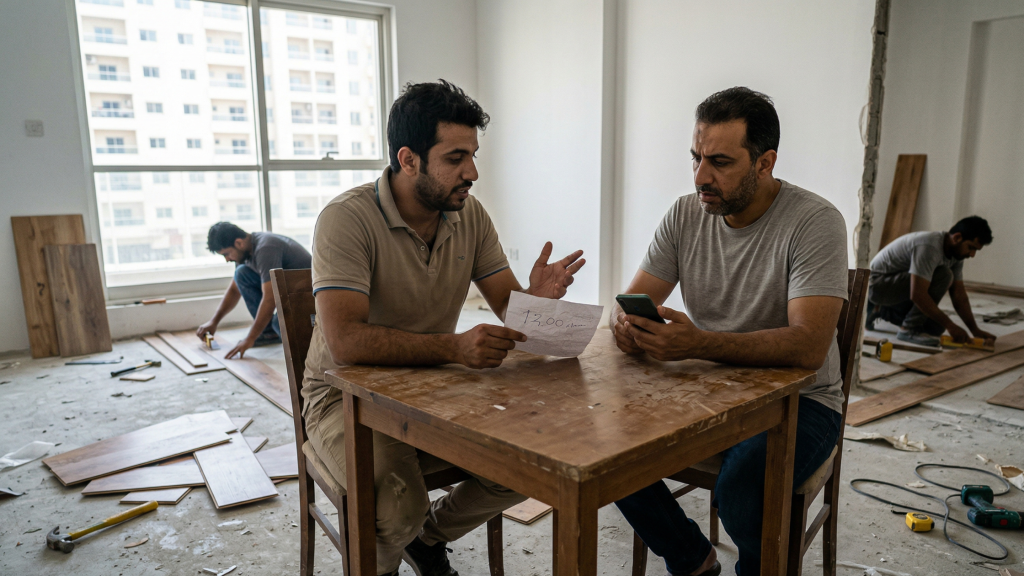
A quote significantly lower than all the others. Low quotes usually mean one of three things: a cheaper product has been substituted for what was specified, subfloor preparation has been stripped out of scope, or the installation labour is inexperienced and unaccountable. Flooring is not a category where the cheapest bid saves money in the long run.
No physical address or showroom in Dubai. A company operating entirely through WhatsApp, Instagram, or a single phone number has minimal accountability. If something goes wrong, your ability to escalate is severely limited. Established flooring companies in Dubai have a physical presence – a showroom where you can see products in person and return if there’s a problem.
Reluctance to provide written warranty documentation before you commit. Any company confident in their work has no reason to avoid putting the warranty terms in writing before installation begins. Verbal assurances are unenforceable.
Vague or defensive answers to the six questions above. A company that genuinely understands flooring in Dubai won’t find these questions difficult. They’ll have clear, specific answers because they’ve thought through these issues on every project.
No evidence of commercial or high-specification experience for commercial projects. For offices, retail, and hospitality projects, you need a company that understands commercial-grade specifications – wear layer ratings, performance standards for sports flooring, compliance documentation for hospitality projects. Consumer-focused companies often lack this knowledge.
Residential vs Commercial – the Evaluation Criteria Differ
The checklist for choosing a flooring company for your apartment is not the same as the checklist for a gym or a hotel lobby.
For residential projects – apartments, townhouses, villas – the priorities are climate suitability per room, finish quality and aesthetic range, and post-installation support. You’ll be living with this floor daily, which means minor issues become major annoyances. The company’s responsiveness after handover matters as much as the installation itself.
For commercial projects – offices, retail spaces, restaurants, gyms, schools, hotels – the evaluation shifts. You need wear layer specifications (typically 0.5mm or above for commercial vinyl; 0.7mm+ for heavy commercial), product certifications, installation timelines that minimise operational downtime, and proven experience at comparable project scale. Sports facilities add a further layer for shock absorption, slip resistance ratings specific to the sport, and zone-appropriate material selection.
This table helps map project type to the criteria that matter most:
|
Project Type |
Primary Criteria |
| Apartment renovation | Climate stability, finish options, post-installation responsiveness |
| Villa fit-out | Species and finish range, solid vs engineered guidance, subfloor expertise |
| Office or retail space | Commercial wear specs, performance certifications |
| Gym or sports facility | zone-specific materials, shock absorption ratings |
| Hospitality project | Scale delivery capability, product documentation, dual warranty coverage |
| School or healthcare | Hygiene properties, slip resistance, antimicrobial options |
What Good Warranty Documentation Actually Contains
Most flooring warranties in Dubai are delivered verbally, or as a vague line item in a quotation. That’s not a warranty – it’s a statement of intent with no enforceability.
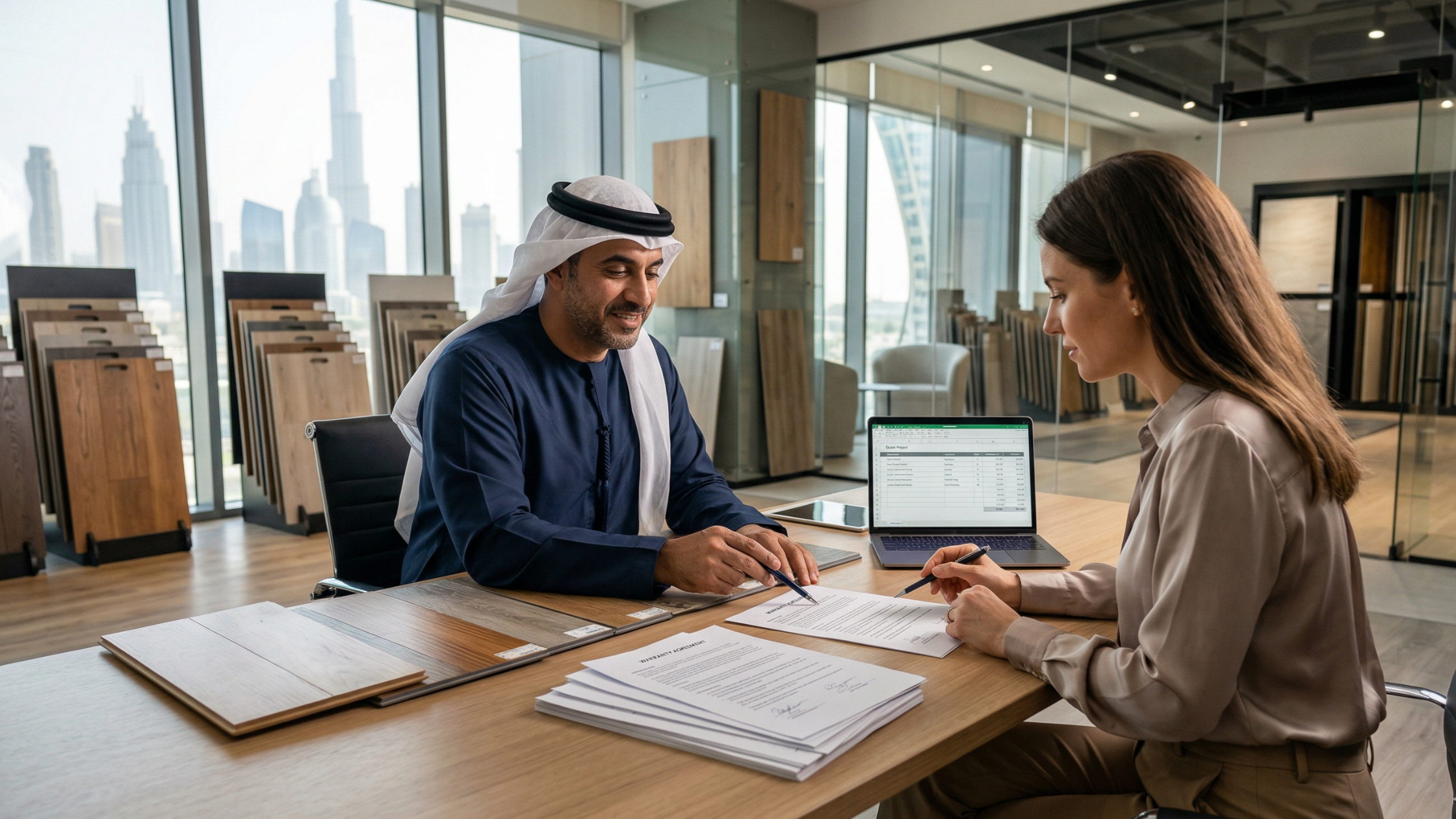
Warranty documentation worth having contains: the scope of coverage (what is and isn’t included), the duration, the process for making a claim, who the responsible party is (manufacturer vs installation company), and what conditions void the warranty.
Conditions that typically void wood flooring warranties include: moisture exposure beyond specified levels, use of incorrect cleaning products, subfloor preparation that was outside the specified scope, and modifications made after installation. A reputable company explains these limitations before installation, not after a problem appears.
As a baseline, look for: manufacturer product warranty of at least five years, written installation defects liability of at least one year from the installation company, and a documented escalation process if issues arise.
Product warranty duration varies considerably by material. Quality engineered wood products from established European manufacturers often carry 15–30 year residential warranties. Commercial vinyl from reputable brands typically offers 15–25 years with professional installation. Shorter warranties on similar-sounding products are usually a signal that the product quality doesn’t match the marketing.
A Note on Sustainable and Certified Products
An increasing number of Dubai buyers – particularly on developer and hospitality projects – are asking about sustainable wood flooring options. This is worth knowing about before you have the conversation with a supplier.
FSC (Forest Stewardship Council) certification is the most credible international standard for responsible wood sourcing. It verifies that the timber was harvested from forests managed for environmental and social sustainability, with documented chain of custody from forest to product. PEFC (Programme for the Endorsement of Forest Certification) is a comparable European framework. Both are legitimate; FSC tends to be more widely recognised on Gulf projects targeting LEED or other green building ratings.
Low-VOC (volatile organic compound) adhesives and finishes matter in Dubai specifically because of sealed, air-conditioned environments. Unlike naturally ventilated buildings, AC-only interiors trap off-gassing from flooring products and adhesives for longer periods. Ask for the product data sheet, not just a verbal assurance.
FAQ
What should I look for when comparing flooring companies in Dubai?
Start with whether they offer a full-service model (supply + installation + warranty under one roof), whether they do a proper site assessment before recommending products, and whether their installation team is directly employed. Product range and aesthetics matter too, but accountability structure is the more important variable.
Is it worth paying more for a reputable flooring company in Dubai?
Generally yes, and the reason is specific to Dubai. Flooring failures here – lifting, buckling, debonding – often trace back to inadequate subfloor preparation or wrong adhesive selection rather than poor-quality products. These failures are expensive to remedy and usually aren’t covered if the original company cuts corners. The premium for a company that does the job properly is lower than the cost of fixing it once.
How long does flooring installation take in Dubai?
A single room (30–50 sqm) typically takes one to two days. Larger projects, or those requiring moisture barrier installation or levelling compounds, take longer. Timeline should be confirmed in writing as part of the project scope.
What flooring is best for Dubai apartments?
Engineered wood is the most widely recommended choice for Dubai apartments where a wood look is desired – it handles temperature and humidity variation better than solid wood while retaining the appearance of natural timber. For kitchens, and utility areas, LVT or SPC is more practical. The right answer depends on the specific room, orientation, and use.
Do flooring companies in Dubai provide warranties?
The better ones do – both a manufacturer product warranty and a separate installation defects warranty. Always ask for both in writing before work begins. A company that only offers the manufacturer warranty is not covering the most common source of post-installation problems.
What’s the difference between engineered wood and solid wood flooring for Dubai properties?
Solid wood is a single piece of natural hardwood – it ages beautifully and can be refinished multiple times, but it’s sensitive to temperature and humidity changes and requires careful climate management in Dubai. Engineered wood uses a real hardwood veneer over cross-ply layers that resist dimensional movement – it’s more stable in Dubai’s AC environments and generally a safer long-term choice for most applications. For a detailed comparison, see our engineered wood flooring Dubai guide.
Conclusion
Choosing a flooring company in Dubai comes down to one thing more than any other: accountability. Not price, not the showroom aesthetic, not how polished the brochure looks. The company that assesses your subfloor properly, uses the right adhesive for Dubai’s concrete slabs, employs their own installation team, and puts both product and installation warranties in writing is the company that protects you when something goes wrong – and in Dubai’s climate, the risk of something going wrong is real.
Use the six questions in this guide before you commit to anyone. The answers will tell you more than any review site can.
If you’re ready to speak with a team that covers the full process – supply, installation, and warranty – under one roof, Floor Concepts offers free consultations for both residential and commercial projects across Dubai.
Visit the showroom at Oasis Mall!