
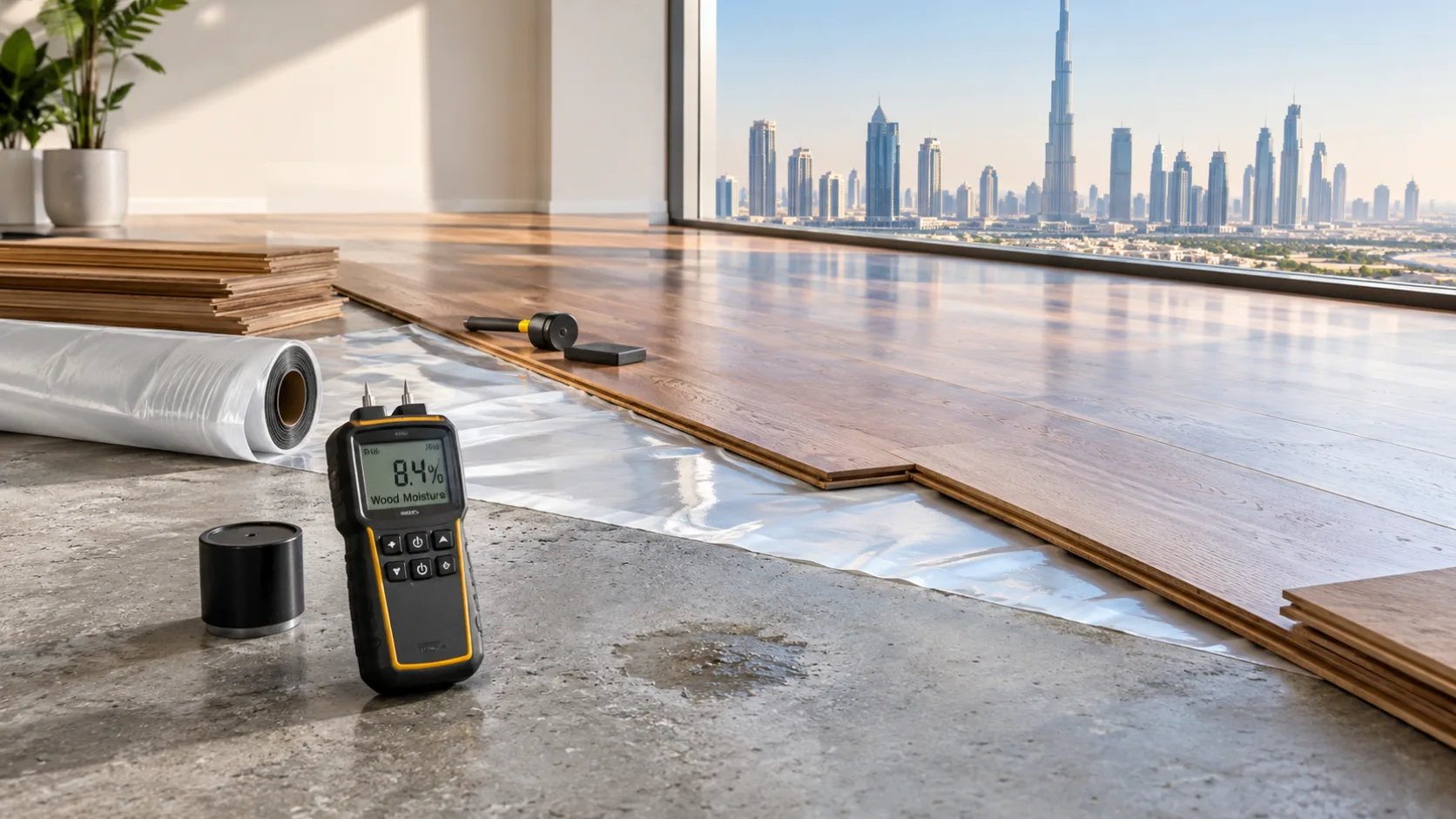
Solid timber is still the benchmark for buyers comparing the hardwood flooring Dubai suppliers offer. It can be sanded and refinished many times, and it ages beautifully. The catch is what sits underneath it. Most Dubai villas, apartments and offices are built on concrete, and concrete holds more moisture than it looks like it does.
Wood reacts to that moisture. A damp slab under solid boards can cause cupping, gaps, buckling or a failed adhesive bond. These problems usually appear months after handover, when the only fix is to lift the floor.
This guide explains how to test the slab, which barrier to use, and the rules professionals follow on solid wood flooring installation Dubai projects, so you can ask the right questions before work starts.
Yes, you can install solid wood flooring over concrete in Dubai, but not directly onto a bare slab and not without testing first. The slab must be at or above ground level, pass moisture testing, and be protected by a moisture barrier. The boards then go over a plywood subfloor or are bonded with an approved adhesive. If the slab fails the test, choose engineered wood instead.
Key Takeaways
- Solid wood flooring over concrete works when the slab is dry, on or above grade, and properly prepared.
- Concrete subfloor moisture testing with in-situ RH probes (ASTM F2170) is the most reliable method. Many wood flooring adhesives set the limit at 75% RH.
- A wood flooring moisture barrier protects the floor, but it will not cure a slab that is actively wet.
- Traditional 3/4-inch solid strip and plank flooring cannot be nailed straight into concrete. It needs a wood subfloor.
- Solid wood should not go below grade. Use engineered wood or SPC there.
- Follow the solid wood flooring installation rules below and keep your test records for the warranty.
Why Solid Wood and Concrete Are a Tricky Match
Solid wood is a single piece of timber. It swells as it absorbs moisture and shrinks as it dries. Concrete keeps releasing water vapour long after it has set, and the moisture is not evenly spread. There is less near the surface and more deeper down. Once a floor covering seals the top, that deeper moisture moves upward, and the wood is the first thing it meets.
That is why a slab can look fine on test day and still damage a floor later.
What Makes Dubai Different
Dubai conditions add risks that generic flooring guides miss:
- Humid summers and constant air-conditioning. Indoor humidity can swing quickly when cooling is switched on or off, and wood follows those swings.
- Fast handovers. New slabs, screeds, plastering, tiling and paint all add water to a building. Floors laid before those trades have dried meet a wetter slab than the plan assumed.
- Ground-floor villas. A slab on grade sits in contact with the ground, and moisture can rise through it.
- Vacant units with the AC off. A closed-up apartment can turn humid quickly, which is often where timber gets stored before installation.
- Imported timber. Boards shipped from other climates need time to adjust to Dubai indoor conditions.
None of this rules out solid wood flooring Dubai projects. It means testing and planning matter more here, not less.
When Solid Wood Flooring Over Concrete Works (and When It Doesn’t)
| Situation | Solid wood suitable? | What to do |
|---|---|---|
| Above-grade slab, dry, passes tests | Yes | Plywood subfloor with barrier, or an approved adhesive system |
| Ground-floor slab on grade, passes tests | Possible, higher risk | Barrier is essential. Consider engineered wood for stability. |
| Basement or below-grade slab | No | Choose engineered wood or SPC |
| Slab fails the moisture test | Not yet | Find the source, dry the slab, re-test, or change product |
| Kitchen, laundry or bathroom | Not recommended | Use waterproof flooring |
| Slab with leaks or water pressure from below | No | Fix the source first |
Concrete Subfloor Moisture Testing: What to Test and Which Numbers Matter
Concrete subfloor moisture testing tells you whether the slab is dry enough to receive timber. Skip it and every later step is guesswork. These are the four methods you will hear about:
| Test | What it measures | Common limit for wood flooring | How far to trust it |
|---|---|---|---|
| In-situ RH probes (ASTM F2170) | Relative humidity inside the slab, at depth | 75% RH for standard adhesives | Highest. Preferred by the industry. |
| Calcium chloride test (MVER) | Vapour leaving the surface over 24 hours | 3 lb per 1,000 sq ft per 24 hrs (about 1.4 kg per 93 sq m) | Medium. Reflects the surface only. |
| Surface moisture meter | Relative readings across the slab | No pass/fail limit | Screening only. Use it to find damp spots. |
| Plastic sheet test | Condensation under taped polyethylene after 12 to 24 hours | Any moisture is a fail | Quick pre-check, never a replacement |
Limits vary by flooring and adhesive manufacturer. Follow the stricter number and get it in writing.
Why a Wood Moisture Meter Cannot Test Concrete
Pin and pinless meters are calibrated for timber. On concrete they show numbers that look precise but mean nothing. Slabs need RH probes or calcium chloride kits.
How Many Tests, and Where?
Standards typically call for at least three test locations in the first 1,000 sq ft (about 93 sq m) and one more for each additional 1,000 sq ft. Test near external walls, columns, wet rooms and any stained area. RH probes also need settling time before reading, typically 72 hours with the air-conditioning running at normal service conditions.
Do Not Forget the Wood
Test the boards too. Solid hardwood is typically installed at around 6 to 9% moisture content, depending on region and species. Over a plywood subfloor, its moisture content should sit within about 2 to 4% of the boards. Measure in the finished, air-conditioned room, not in the warehouse.
What If the Slab Fails?
- Stop. Do not deliver or open the timber.
- Find the source: leaking pipes, wet screed, poor drainage or ground moisture.
- Dry the building: close it in, run AC and dehumidifiers, and allow time.
- Re-test with the same method and locations.
- Consider a liquid membrane or moisture-control adhesive rated for your readings.
- Switch product if numbers stay high. Engineered wood or SPC is the sensible fallback.
Many adhesive makers also want the slab to be at least 60 days old. Age alone does not prove it is dry. Only a test does.
Wood Flooring Moisture Barrier: Your Options on Concrete
A wood flooring moisture barrier slows vapour moving from the slab into the timber. It is insurance for a dry slab or a controlled fix for a borderline one. It is not a cure for a wet slab.
| Barrier | How it works | Best for | Watch out for |
|---|---|---|---|
| 6-mil polyethylene film under plywood | Vapour retarder laid on the slab, plywood fixed over it | Nail-down installs on dry slabs | Not for high readings. Joints must be lapped and taped. |
| Liquid-applied membrane (epoxy or urethane) | Roll-on coating bonded to prepared concrete | Borderline slabs and glue-down installs | Needs a clean, profiled slab and a rating that matches your test results |
| Moisture-control wood flooring adhesive | Bonds the boards and limits vapour | Approved glue-down systems | Ratings differ. Some products list up to 12 to 15 lb or 85% RH, but the flooring brand must approve the pairing. |
A plywood subfloor on its own is not a barrier. It lifts the boards off the slab and gives you something to fasten into. Mixing products from different manufacturers can void warranties, so ask your supplier for a complete system. Our range of flooring adhesive is a good starting point.
Solid Wood Flooring Installation Rules: 10 Checks Before and During the Job
- Complete concrete subfloor moisture testing before you order. Keep the report.
- Confirm the slab is on or above grade. Solid wood does not belong below ground level.
- Close in the building first. Windows fitted, AC running, plastering, tiling and painting finished and dry.
- Acclimate the boards on site, in the conditioned room, per the manufacturer. Verify with a moisture meter, not the calendar.
- Prepare the slab. Clean, flat to the manufacturer’s tolerance, and free of dust, curing compounds and old sealers.
- Install the barrier before plywood or adhesive, never after.
- Choose the method before ordering. Solid hardwood flooring installation over concrete is normally nail-down over plywood. Glue-down needs the flooring brand’s approval.
- Leave an expansion gap at every wall. Solid wood commonly needs roughly 15 to 19 mm, hidden under skirting. Follow the manufacturer, and allow more for wide planks.
- Keep indoor humidity steady after installation. Roughly 35 to 55% RH is a common range, but manufacturers vary.
- Keep the paperwork: test results, product data sheets and warranty terms.
Solid Hardwood Flooring Installation Methods Over Concrete
Method 1: Plywood Subfloor and Nail-Down (most widely accepted)
This is the traditional route, because 3/4-inch solid boards need a wood base to fasten into.
- Test the slab and fix any moisture problems.
- Clean and level the surface.
- Lay 6-mil polyethylene with overlapped, taped joints.
- Fix plywood to the slab with concrete fasteners. Many installers use two layers, the second laid at 45 degrees.
- Check the plywood moisture content against the boards.
- Nail or staple the boards, leaving the expansion gap.
- Sand and finish on site if the boards are unfinished.
Trade-offs: it adds floor height, so check door clearances, and it takes more labour. It has the widest manufacturer acceptance.
Method 2: Glue-Down
Modern MS-polymer and moisture-cure urethane adhesives made gluing solid wood to concrete more common. It remains the higher-risk option. It suits narrower or more stable (often quartersawn) boards, and only with the flooring manufacturer’s approval and a slab that passes testing.
Method 3: Floating
Floating installs are designed for engineered and rigid-core products, not typical solid boards. If you want a glue-free, fast install, ask about engineered wood.
Solid Wood vs Engineered Wood vs SPC on Concrete
| Solid wood | Engineered wood | SPC | |
|---|---|---|---|
| Reaction to humidity | Moves the most | Moves less (layered core) | Dimensionally stable rigid core |
| Glue-down on concrete | Higher risk, limited products | Widely used | Glue-down or floating, per product |
| Floating install | Not typical | Some products | Common |
| Sand and refinish | Many times | Limited by wear layer | No |
| Best for | Dry, air-conditioned, above-grade rooms | Most living areas, including ground floors | Busy or moisture-prone areas |
| Height build-up | Higher with plywood | Low | Low |
For wooden flooring Dubai projects where the slab is the weak link, engineered boards give the same look with more stability. For hardwood flooring Dubai clients who still want solid timber, the answer is a tested slab, a proper barrier and a climate-controlled home.
Where SPC Flooring Dubai Projects Fit
SPC Flooring Dubai buyers often choose it for kitchens, laundries and high-traffic rooms, because the rigid core is dimensionally stable and the surface is generally water-resistant. It still needs a flat, clean slab and expansion allowances, so it does not excuse skipping the slab test. See our SPC flooring range.
Common Mistakes to Avoid
- Using a wood meter on concrete, or testing only one spot.
- Installing before the building is closed in and the AC is running.
- Nailing or gluing solid boards straight onto bare concrete.
- Treating polyethylene film as a fix for a wet slab.
- Ignoring the expansion gap, which leads to buckling in humid months.
- Specifying solid wood below grade or in wet rooms.
- Hiring on price alone. Solid wood flooring installation Dubai quotes can look similar on paper while leaving out the testing and barrier.
- Treating wood flooring Dubai projects like tiling jobs. Timber needs conditioned air and moisture records.
- Solid hardwood flooring installation without paperwork, which makes warranty claims harder.
Maintenance After Installation
- Keep indoor humidity steady. Avoid leaving a unit shut up with the AC off for weeks.
- Wipe spills promptly and use cleaners recommended for your finish.
- Use felt pads and entrance mats to limit scratches from sand and grit.
- Plan a refresh when the finish wears. Our wooden polishing and hardwood floor refinishing services cover this.
Good habits matter as much as installation for wooden flooring Dubai owners, because the climate indoors is what the wood actually lives in.
Solid Wood Flooring Installation Dubai With Floor Concepts
Floor Concepts supplies and installs wood, engineered wood, parquet, SPC, vinyl and specialist flooring for homes and commercial projects across Dubai, with over a decade of experience in the UAE. A site assessment before you choose a product is the safest way to decide between solid and engineered wood.
- Explore our solid wood flooring Dubai collection
- Compare engineered wood flooring for ground-floor slabs
- Browse SPC Flooring Dubai for moisture-prone rooms
- See completed projects
For professional flooring installation Dubai homeowners and contractors can trust, contact our team, call +971 4 665 2211 or email sales@floorconcepts.ae. Showroom: Oasis Mall, Level 3, Suite 103, Sheikh Zayed Road, Al Quoz 1, Dubai.
Follow these solid wood flooring installation rules, test before you commit, and a solid timber floor can perform well on a Dubai slab for years.
Frequently Asked Questions
Can solid wood flooring be installed directly on concrete?
Not by nailing. Traditional 3/4-inch solid strip and plank flooring needs a wood subfloor over the slab so it can be fastened. Some solid boards, usually narrower or quartersawn ones, can be glued down with an approved moisture-cure or MS polymer adhesive, but only after the slab passes testing and the flooring manufacturer approves it.
What moisture level is acceptable in concrete before installing wood flooring?
Many manufacturers and adhesive makers cite 75% relative humidity on an in-situ probe test (ASTM F2170) or 3 lb per 1,000 sq ft per 24 hours on a calcium chloride test. Your flooring and adhesive manufacturer’s limit always takes priority. A wood moisture meter cannot measure concrete.
Do I need a wood flooring moisture barrier on concrete in Dubai?
In most cases, yes. A moisture barrier such as 6-mil polyethylene under plywood, or a liquid membrane or moisture-control adhesive system, protects solid wood from slab vapour. It does not fix a slab that is actively wet, so the source must be corrected first.
Is engineered wood better than solid wood over concrete in Dubai?
Often, yes. Engineered boards have a layered construction that moves less with humidity, which makes them easier to install on concrete. For many hardwood flooring Dubai projects, engineered wood is the safer choice, while solid wood suits dry, air-conditioned, above-grade spaces where its long refinishing life matters.
Can I install solid wood on a ground-floor villa slab in Dubai?
It is possible but riskier. A ground-floor slab is in contact with the ground, so test thoroughly and use a proper barrier. Solid wood flooring Dubai villa projects should never go below grade, and engineered wood is often more forgiving on ground-floor slabs.
How long should solid wood flooring acclimate before installation?
Follow the manufacturer’s instructions. The time depends on species, starting moisture content and room conditions. Acclimate in the finished, air-conditioned room and confirm with a moisture meter that the boards have reached the target, rather than relying on the calendar. Exotic species may need longer.
What are the main solid wood flooring installation rules over concrete?
Test the slab, confirm it is on or above grade, install a moisture barrier, use a plywood subfloor or approved adhesive, acclimate the boards, leave an expansion gap and keep indoor humidity steady. The full checklist is above.
Is SPC a better option if my slab is too damp?
SPC has a rigid, dimensionally stable core and a generally water-resistant surface, and SPC Flooring Dubai collections are popular for busy and moisture-prone rooms. It still needs a flat, clean, reasonably dry slab, so a very wet slab should be corrected first.