
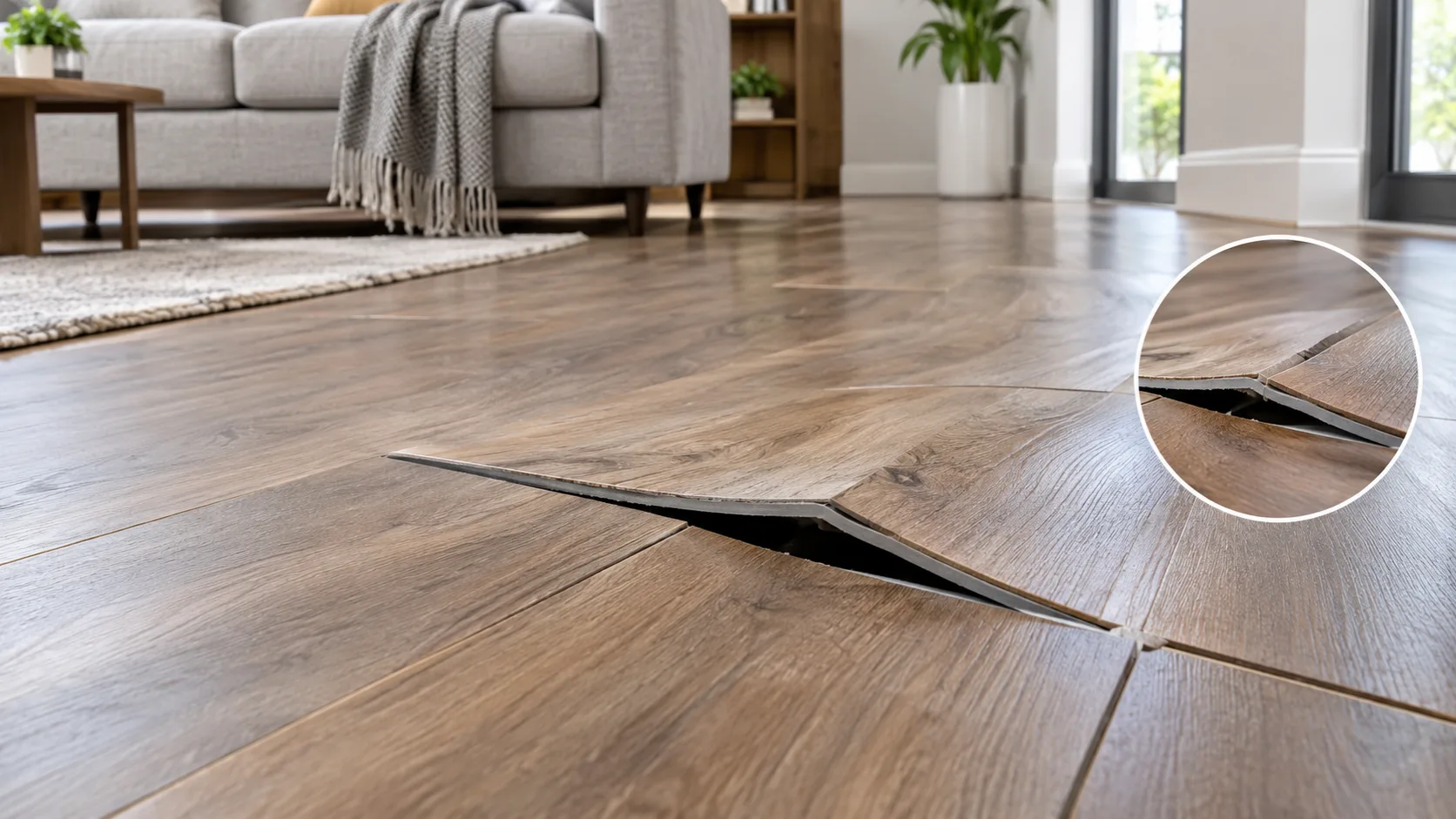
People choose SPC flooring Dubai wide because it is waterproof, tough and looks like timber or stone. So it is frustrating when planks start peaking at the joints or rising along a wall. The good news is that most SPC flooring problems of this kind come from how the floor was installed or from site conditions, not from the material itself.
This guide covers the 10 causes, how to confirm yours, what you can safely fix, and when to stop and call a professional.Quick Answer
SPC flooring lifts or buckles when the planks cannot expand freely, or when something underneath pushes them up. In Dubai, the usual causes are missing expansion gaps, heat through glass, uneven or damp slabs, and fixed objects pinning the floor. Find the cause first. Replacing one plank rarely solves it.
What Does SPC Buckling Look Like?
- Peaking: two planks rise into an upside-down “V” at a joint.
- Edge lifting: planks rise along a wall, door or cabinet.
- Waves or ripples: a soft undulation across a large area.
- Hollow or clicking sound: planks flex when you walk on them.
- Opening gaps: joints separate, often after the floor cools or after a lift.
Common SPC Flooring Problems at a Glance
| What you see | Most likely cause | First thing to check |
|---|---|---|
| Peaks at joints, whole room | No expansion gap, or heat expansion | Gap behind skirting, sun exposure |
| Lifting along one wall | Skirting or fixed item pinning the floor | Gap and fixings at that wall |
| Lifting only near a doorway | Missing threshold gap | Door frame and T-moulding |
| Soft or bouncy zones | Uneven subfloor or double underlay | Flatness with a straightedge |
| Lifting plus musty smell | Moisture from slab or leak | Moisture test, nearby plumbing |
| One plank lifted, locks open | Weak or damaged locking profile | Plank edges and batch quality |
| Floor moved after kitchen island fitted | Heavy fixed item on floating floor | Fixings and load points |
Why Does SPC Flooring Buckle at All?
SPC (stone plastic composite) is a type of rigid core flooring. It has a dense limestone and PVC core with a vinyl wear layer on top. Most SPC is installed as a floating floor: planks click together and rest on the subfloor without being fixed to it. That design only works if the floor is free to move. SPC resists moisture swelling, but it still expands when heated and contracts when cooled. If the floor is pinched, the pressure has nowhere to go except up. Manufacturer installation guides agree on the basics: a perimeter expansion gap (commonly 6 to 10 mm, or 1/4 to 3/8 inch), a flat and dry subfloor, and no screws through the planks. Always follow the guide for your exact product, because specifications differ by brand.10 Causes of SPC Flooring Lifting or Buckling (and How to Fix Each)
1. Missing or Too-Small Expansion Gap
Why it happens: Planks are pushed tight against walls, pipes, columns or door frames, so the floor cannot expand. Signs: Peaking across the room, or lifting along the walls. Fix: Remove the skirting and trim. Cut the planks back to restore the gap your manufacturer specifies, then refit skirting so it covers the gap without touching the floor. Remember pipes, door frames and columns. This is the single most common cause.2. Uneven Subfloor
Why it happens: Dips and humps under the floor stop the click-lock from sitting properly. Many guides allow only a few millimetres of variation over 3 metres. Some specify about 2 mm, others closer to 5 mm. Signs: Soft spots, clicking sounds, joints that open or peak. Fix: Lift the affected area, grind high spots and fill low spots with a levelling compound, then relay. Laying a longer straightedge across the slab before installation avoids this entirely. Good Flooring Installation Dubai crews check flatness room by room.3. Moisture From the Slab or a Leak
Why it happens: SPC itself is waterproof, but it is not a moisture barrier. Damp screed, rising moisture or a hidden leak can trap moisture under the floor. That can lift glued planks, cause odours and create pressure. Signs: Musty smell, cold damp patches, lifting near bathrooms, kitchens, balconies or AC drain points. Fix: Find and stop the source first. Dry the slab, test moisture with a calibrated meter, and install a suitable moisture barrier if the manufacturer calls for one. Relaying over a damp slab only repeats the failure.4. Heat and Direct Sunlight
Why it happens: Sun through floor-to-ceiling glass can heat a floor far above room temperature. Manufacturers warn that direct sunlight causes thermal expansion and fading. Signs: Peaking in sunlit zones that settles back at night or when the AC runs. Fix: Add solar-control film or blinds to glazing. Check that the gap near the window is generous. If the problem persists, ask your supplier whether a thicker or heat-stable product is better for that zone.5. Skipping Acclimatisation
Why it happens: Boxes delivered from a hot warehouse or truck are installed straight away. The planks then change size once the room reaches normal AC temperature. Wooden Flooring needs this step most, but SPC guides also ask for it. Signs: Gaps or peaks that appear within the first days or weeks. Fix: Let boxes rest in the room, at the intended temperature, for the time the manufacturer specifies. If the floor is already installed, correct the gap and relay the affected rows.6. Floor Pinned Down by Screws, Cabinets or Heavy Fixed Items
Why it happens: A floating floor must stay free. Screwing through planks, fixing a kitchen island or built-in wardrobe over the floor, or fixing skirting into the planks locks it in place. Signs: Lifting that starts beside a fixed item, or only in one section. Fix: Remove fixings through the floor. Fix skirting to the wall, not the planks. Install fixed units on the subfloor and cut the SPC around them with a gap, unless the manufacturer permits another method.7. Long Runs With No Expansion Breaks
Why it happens: Big open-plan rooms and long corridors laid as one continuous floor accumulate movement. Some guides ask for expansion joints at doorways and in runs over about 12 m (40 ft). Others set different limits. Signs: Buckling in the middle of a large area, or at the end of a long corridor. Fix: Cut an expansion break at the doorway or threshold and cover it with a T-moulding fixed to the subfloor, never into the planks.8. Wrong or Doubled Underlay
Why it happens: Many SPC planks come with underlay attached. Adding a second, thicker or softer underlay can make the floor spongy and stress the locking system, unless the manufacturer allows it. Signs: Bounce underfoot, locks separating, peaks at joints. Fix: Check your product specification. Remove unapproved underlay and relay on the recommended system.9. Wrong Substrate (Old Tiles, Carpet, Timber)
Why it happens: Installing over deep grout lines, loose tiles, carpet or an unstable timber subfloor lets the surface telegraph through or move. Signs: Visible grout lines, hollow spots, or lifting where old tiles are loose. Fix: Remove carpet. Fix or replace loose tiles. Fill grout lines with a suitable levelling compound or overlay the area with an approved board. Do not assume every old floor is a suitable base.10. Low-Quality Planks or the Wrong Specification
Why it happens: A weak click profile, thin core or inconsistent batches can fail under normal use. A residential grade used in a busy commercial space will also wear and separate sooner. Signs: Several planks failing in different places, broken lock tabs, or joints that never sat tight. Fix: Replace the affected planks with the same batch where possible. For a full refit, buy from a reliable SPC flooring supplier in Dubai who can show core thickness, wear layer, locking system and warranty terms in writing.Why Do SPC Floors Fail More Often in Dubai?
SPC flooring Dubai projects face tougher site conditions than many guides assume:- Heat and glass: Large glazed areas and strong sun make thermal movement a real design factor.
- AC cycling: Vacant units, holiday homes and fit-outs often run with AC off. The room swings from very hot to cool, and floors move with it.
- New-build slabs: Fresh screed may still hold moisture when the floor goes down.
- Ground-floor villas and wet areas: Slab moisture and leaks from kitchens, bathrooms and AC drains are common.
- Rushed fit-out sequences: Flooring goes in before wet trades finish, or before the subfloor is signed off.
Can I Fix Buckled SPC Flooring Myself?
You can try it if: the lifting is minor, limited to one wall or doorway, and caused by a missing gap. Remove the skirting, trim the planks, refit the skirting and check the result. Do not:- Screw or nail the planks down.
- Spot-glue a floating floor.
- Cut random relief slits in the middle of the floor.
- Relay over a damp or uneven slab.
SPC Flooring Installation Dubai: A Prevention Checklist
Use this list before any SPC flooring installation Dubai project starts:- Test slab moisture and record the readings.
- Check flatness with a straightedge and level problem areas.
- Confirm the product has an attached underlay, or choose the approved one.
- Acclimatise boxes in the room.
- Leave the manufacturer’s gap at every wall, pipe, column and door frame.
- Plan breaks at doorways and in long runs.
- Never fix through the planks. Fix skirting to the wall.
- Shield sun-exposed zones with film or blinds.
- Keep the AC running at a stable temperature after installation.
- Keep the installer’s checklist and moisture records with your warranty.
SPC vs Other Flooring: Which Is Less Likely to Lift in Dubai?
| Floor type | Water tolerance | Reaction to humidity | Reaction to heat | Lift risk if installed badly |
|---|---|---|---|---|
| SPC (rigid core flooring) | High, core is waterproof | Very low movement | Moderate thermal expansion | Medium: gaps, flatness, fixings |
| Laminate | Low to medium, core can swell | Medium | Low to moderate | Higher near water |
| Engineered or solid Wooden Flooring | Low | Highest, wood moves with humidity | Moderate | Higher, needs climate control |
| Glue-down vinyl | High | Low | Low to moderate | Depends on slab moisture and adhesive |
How to Choose the Right Installer and Supplier
Searching for flooring companies in Dubai gives a long list. Ask each one these questions before you commit:- Do you test slab moisture and check flatness before installing?
- What expansion gap and break layout will you use in my rooms?
- Is the plank core thickness, wear layer and click system stated in writing?
- Is the underlay attached or separate, and is it approved by the manufacturer?
- Who is responsible if the floor lifts within the warranty period?