
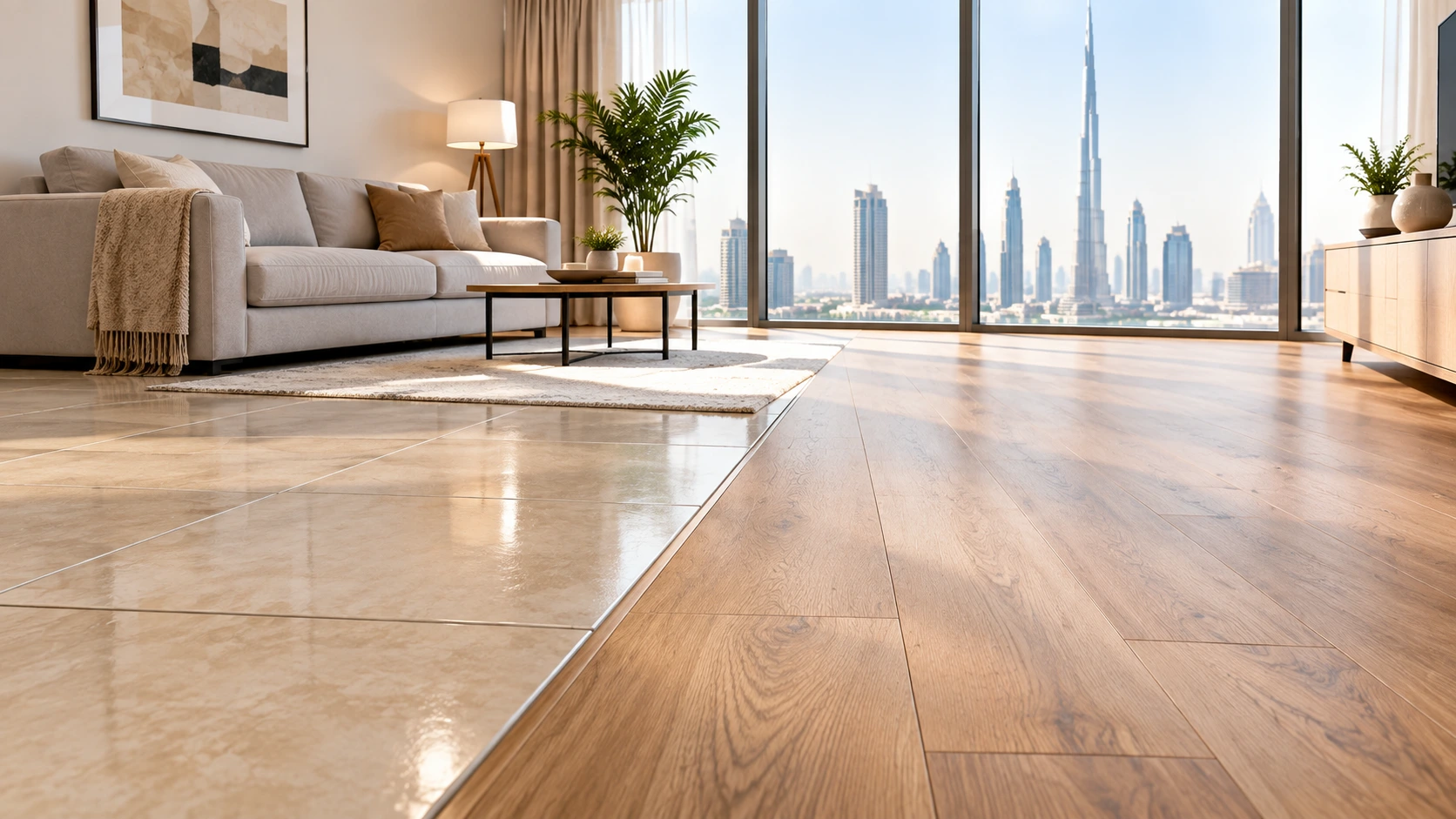
If you’re renting in Dubai and staring at cold, chipped, or outdated tiles, you’ve probably wondered whether it’s worth spending on flooring Dubai landlords technically own. After 15+ years supplying and installing flooring across Dubai’s villas, apartments, and towers — from Marina towers to JVC and Al Barsha — we get this question from tenants every single week. Here’s the honest, practical answer, not a sales pitch.
For most tenants on a 2-year-plus lease with landlord approval, vinyl flooring Dubai installations can be worthwhile for improved comfort and appearance, particularly with click-lock SPC flooring, which can potentially be lifted and reused when you move.
For short 12-month leases without landlord sign-off, installation is generally less practical because of the installation expense and the potential risk to your security deposit.
Best Rental-Friendly Option:
Click-lock SPC flooring can be a practical choice because it is installed as a floating floor without permanent adhesive and may be easier to remove when the tenancy ends.
Expert Tip:
Always obtain written landlord approval before installing flooring in a rental property and confirm whether the original flooring must be restored when you move out.
Why Tenants in Dubai Are Asking This Question
Most Dubai apartments come with either ceramic tiles or basic laminate. Tiles feel cold underfoot for most of the year (except summer), show every hairline crack, and can’t be changed without the landlord’s approval and a proper renovation permit. Tenants who want warmth, better acoustics, or simply a fresher look are increasingly turning to vinyl and SPC flooring Dubai solutions because — unlike tiling — they don’t require demolition.
That single fact is the whole reason this question even exists: vinyl and SPC can be installed over your existing floor, without breaking anything, and (in most cases) removed later. That changes the entire financial equation compared to permanent renovations.
Is Vinyl Flooring Worth It for a Rented Apartment? The Honest Answer
It depends on three things, in this order:
- How long you’re staying. Under 12 months, it’s rarely worth it financially. 18–36 months or longer, it usually is.
- Whether your landlord approves it. Never install without written permission — more on this below.
- Which installation method you choose. Click-lock (floating) is reversible and rental-friendly. Glue-down is permanent and should be avoided in a rental unless the landlord specifically agrees to keep it.
If all three line up, vinyl flooring Dubai tenants install is genuinely one of the best value upgrades available — better comfort, better looks, and (with click-lock) a floor you can take with you.
What You Gain by Installing Vinyl Flooring in a Rental
- Warmth and comfort underfoot, especially in bedrooms — a real upgrade from cold porcelain tile.
- Noise reduction. Vinyl with an underlay layer cuts down on footstep echo, which matters in towers with tile-on-concrete floors.
- Instant visual upgrade without a full renovation — ideal before photographing the unit for a sublet, or simply to enjoy the space yourself.
- Protection for the original floor. A floating vinyl or SPC layer actually protects the landlord’s tiles underneath from scratches, so you’re less likely to face deposit deductions for floor damage.
- Portability. Click-lock SPC planks can be uninstalled, packed, and reinstalled in your next rented apartment — something no other flooring type in Dubai offers as easily.
What You Risk (Read This Before You Buy)
- Landlord disputes. Installing any permanent change without written approval can put your security deposit at risk, even if the result looks better than before.
- Glue-down installs are not reversible. If you use adhesive-fixed vinyl or SPC, you cannot remove it cleanly when you leave — treat this as a permanent investment, not a rental one.
- Poor subfloor prep = wasted money. Installing over uneven or damp tile without proper underlayment leads to visible seams, hollow sounds, and lifting within months.
- Cheap, uncertified vinyl can fade or warp in direct sunlight, which is common in Dubai’s floor-to-ceiling window apartments.
Vinyl Flooring Dubai: What It Actually Costs
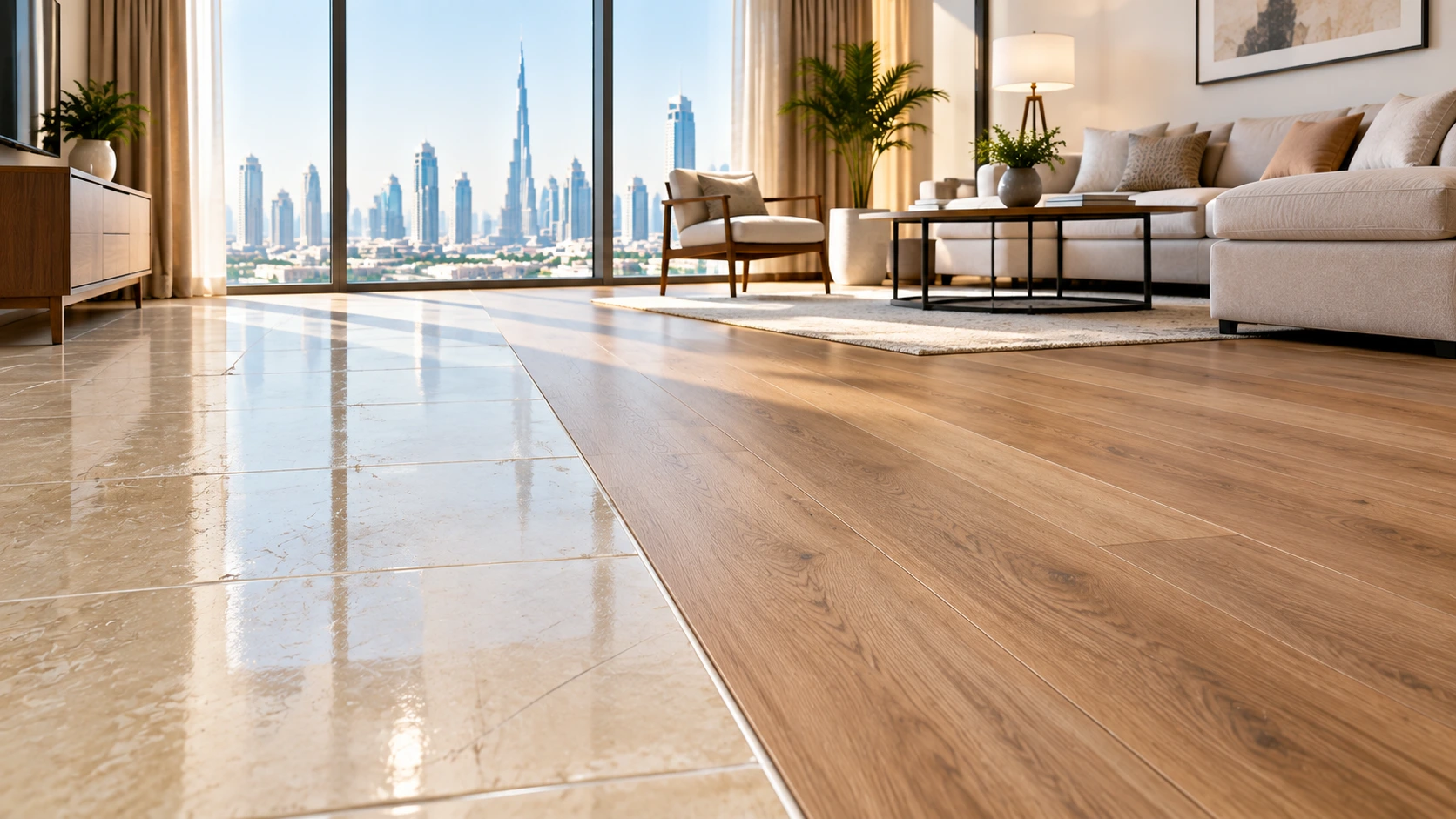
Prices vary by material grade, thickness, and installation complexity, but here’s a realistic range for flooring installation Dubai projects based on current market rates:
| Flooring Type | Approx. Cost (AED/sq.ft, supply + install) | Reversible for Rentals? | Best For |
|---|---|---|---|
| Basic click vinyl (LVT) | 8 – 15 | Yes (click-lock) | Short-to-mid term rentals, bedrooms |
| SPC Flooring Dubai (rigid core) | 15 – 28 | Yes (click-lock) | High-traffic areas, kitchens, living rooms |
| Glue-down luxury vinyl | 18 – 30 | No | Owned property or long-term (5yr+) tenancies with landlord sign-off |
| Wood Flooring Dubai (engineered) | 35 – 70+ | Rarely | Owned property, premium finish |
| Laminate flooring | 10 – 20 | Partially | Budget upgrades, low-moisture rooms |
Costs are indicative and depend on apartment size, subfloor condition, and finish grade. Always request a site-measured quote.
Why SPC often wins for rentals: SPC flooring Dubai products use a rigid limestone-composite core, making them more dimensionally stable in Dubai’s heat and AC-driven humidity swings than standard LVT — and because they click together, they’re the easiest of all options to lift and reinstall elsewhere.
Click-Lock vs Glue-Down: The Decision That Matters Most for Tenants
This is the single most important technical decision for anyone renting in Dubai, and it’s the part most guides skip entirely.
Click-lock (floating) vinyl/SPC:
- Installed over an underlayment, no adhesive on the original floor
- Can be fully removed and reused in a new home
- Faster installation, less mess, no curing time
- Slightly higher material cost, but far lower long-term risk
Glue-down vinyl:
- Bonded permanently to the subfloor
- Cannot be removed without damaging both the vinyl and the original tile
- Feels marginally more solid underfoot, slightly cheaper installation labor
- Only appropriate if you own the property, have a very long lease with landlord approval to leave it permanently, or the landlord is funding the upgrade themselves
Our recommendation for tenants: unless you have signed, long-term written agreement stating otherwise, always choose click-lock. It’s the only option that protects both your deposit and your investment.
Do You Need Landlord Permission? (Yes — Here’s How to Get It Right)
Under standard Dubai tenancy contracts, tenants are generally not permitted to make permanent alterations without the landlord’s written consent. Flooring changes fall into a grey area — floating floors are usually low-risk, but you should still:
- Get written approval by email or WhatsApp, even if the conversation started verbally. This protects your deposit at move-out.
- Clarify who removes it at the end of the tenancy — you, or does the landlord want to keep it?
- Confirm building management rules. Some towers require an NOC (No Objection Certificate) or notify security/facilities before any flooring work, especially if it involves moving furniture through shared lobbies or lifts.
- Keep photos of the original tile floor before installation, as proof of its condition.
A reputable vinyl flooring supplier in Dubai will usually help you understand what’s low-risk (click-lock) versus what needs explicit landlord sign-off (glue-down), so ask before you commit.
Installation Guidance: What a Proper Job Looks Like
Good flooring installation Dubai work follows this sequence, and it’s worth confirming your installer does the same:
- Site survey and subfloor check — moisture levels matter in ground-floor and older buildings.
- Leveling — any dips or ridges in the existing tile are filled or sanded so the new floor doesn’t telegraph imperfections.
- Underlayment fitting — for acoustic insulation and to protect against minor floor irregularities.
- Click-lock plank installation, starting from the longest wall, with expansion gaps left at room edges (critical in Dubai’s AC-driven temperature swings).
- Skirting/trim finishing to hide expansion gaps neatly.
- Final inspection for seam alignment and edge finishing.
A rushed job (skipping leveling or underlayment) is the #1 cause of vinyl flooring complaints in Dubai rentals — hollow sounds, visible seams, and lifted edges usually trace back to this step being skipped.
Maintenance Tips for Rented Apartments
- Use felt pads under furniture legs — this protects both the vinyl and your deposit.
- Sweep or vacuum (no beater bar) regularly; Dubai’s sand and dust are abrasive over time.
- Wipe spills immediately — while SPC and quality vinyl are water-resistant, standing water at seams can still cause issues over months.
- Avoid steam mops — heat and moisture together can loosen click-lock seams.
- Use curtains or UV window film in west-facing units to reduce prolonged direct sun exposure on the flooring.
Common Mistakes Tenants Make
- Choosing glue-down “because it’s cheaper” — then losing the entire investment (and risking deposit deductions) when they move out early.
- Skipping landlord approval and assuming “it’s an improvement, they won’t mind.”
- Buying flooring online without a site visit, resulting in incorrect quantities or a mismatch with the room’s actual condition.
- Ignoring underlayment to save a small amount, then dealing with noise complaints from neighbors below.
- Not asking whether the flooring can be reinstalled in their next apartment — most SPC click systems can be, but not all suppliers disclose this upfront.
Vinyl vs SPC vs Wood Flooring Dubai: Which Should You Choose?
| Factor | Vinyl (LVT) | SPC Flooring Dubai | Wood Flooring Dubai (Engineered) |
|---|---|---|---|
| Rental-friendliness | High (click-lock) | Highest | Low (usually permanent) |
| Water resistance | Good | Excellent | Moderate |
| Cost | AED 8–18/sq.ft | AED 15–28/sq.ft | AED 35–70+/sq.ft |
| Heat/humidity stability (UAE) | Good | Excellent | Requires acclimatization |
| Feel underfoot | Soft, warm | Firm, stable | Premium, natural |
| Best for tenants | Bedrooms, budget upgrades | Whole apartment, high traffic | Only with landlord approval |
For most Dubai renters, SPC flooring Dubai products offer the best balance of cost, durability, and reversibility. Wood flooring Dubai remains the premium choice — better suited to homeowners or tenants on long, landlord-approved leases who want a natural, high-end finish.
How to Choose the Right Vinyl Flooring Supplier in Dubai
Not every supplier will be upfront about rental-specific concerns. When comparing a vinyl flooring supplier in Dubai, ask:
- Do you offer click-lock (floating) systems specifically suited to rentals?
- Can your team do a free site visit and accurate measurement before quoting?
- What warranty applies to materials and to installation labor separately?
- Do you provide before/after documentation I can share with my landlord or building management?
- Can this flooring be uninstalled and reused if I move within Dubai?
A supplier that answers these clearly and doesn’t push glue-down as the default is one that understands the realities of renting in Dubai.
Final Verdict
If you’re renting in Dubai and considering vinyl flooring Dubai installation, the decision comes down to lease length, landlord approval, and installation method. Get those three right — long enough lease, written permission, and click-lock installation — and it’s genuinely one of the smartest, most cost-effective upgrades a tenant can make.
Floor Concepts LLC has supplied and installed flooring across Dubai’s rented apartments, villas, and commercial spaces for over 15 years. If you’d like a free site visit, honest advice on whether it makes sense for your specific lease, and a transparent quote, get in touch with our team.
FAQs
Is vinyl flooring worth it in a Dubai rental apartment?
Yes, for tenancies of 18 months or longer with landlord approval, especially using click-lock SPC or vinyl that can be removed and reused. For short-term leases without approval, it’s usually not worth the cost.
Do I need landlord permission to install vinyl flooring in my rented apartment?
In most Dubai tenancy contracts, yes — get written approval before installation, even for floating (click-lock) systems, to protect your security deposit.
Can vinyl flooring be removed when I move out?
Click-lock vinyl and SPC flooring can generally be lifted and reinstalled elsewhere. Glue-down vinyl cannot be removed without damage and should be treated as a permanent installation.
What’s the difference between vinyl and SPC flooring for a rental?
SPC Flooring Dubai has a rigid limestone-composite core, making it more stable in heat and moisture than standard vinyl (LVT), and generally more durable for high-traffic rental use — though it typically costs slightly more.
How much does vinyl flooring cost in Dubai?
Basic click vinyl starts around AED 8–15 per sq.ft supply and install, while SPC flooring ranges roughly AED 15–28 per sq.ft, depending on thickness, finish, and the complexity of the installation.
Will vinyl flooring damage my apartment’s original tiles?
No — click-lock vinyl and SPC are installed over an underlayment without adhesive on the original floor, which actually helps protect the existing tiles from scratches during your tenancy.
Is SPC or laminate better for a Dubai apartment?
SPC generally outperforms laminate in humidity and water resistance, both important in Dubai kitchens, bathrooms, and balcony-adjacent rooms, making it the more rental-durable choice.
Pingback: Low-VOC Flooring: Safer, Sustainable Choices for Home
Pingback: Commercial Vinyl Flooring Dubai | Offices & Retail
Pingback: SPC Flooring Lifting or Buckling? 10 Causes & Fixes