
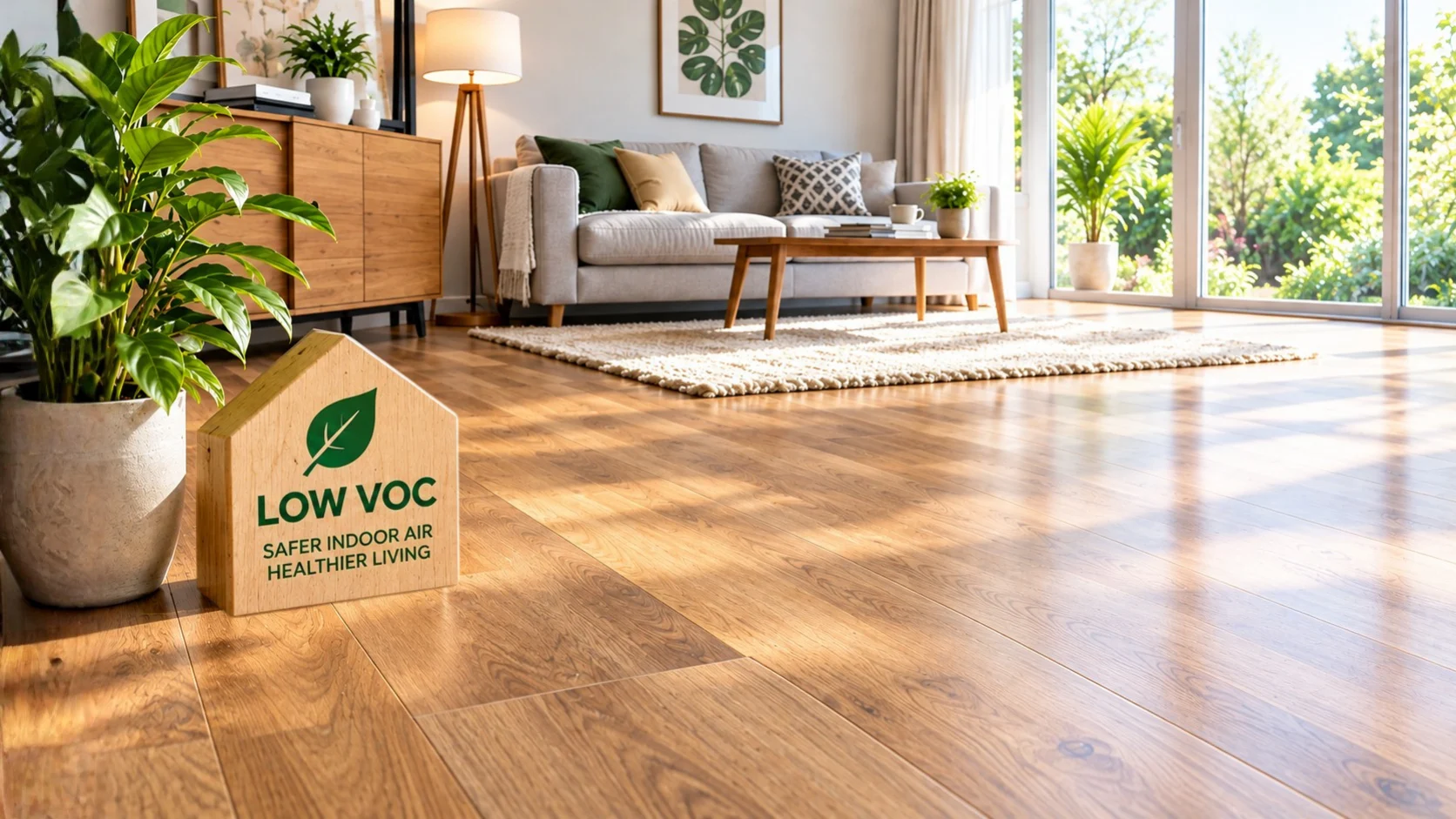
If you’ve ever walked into a newly floored room and noticed a sharp, chemical-like smell, you’ve smelled VOCs off-gassing. In Dubai homes and offices — where windows stay closed for months at a time because of the AC — that smell doesn’t just fade away outdoors. It builds up indoors, in the same air you and your family breathe every day.
At Floor Concepts, we get asked about this almost every week, usually by parents renovating a nursery, by clients with asthma or allergies, or by designers working on LEED or Al Sa’fat-compliant projects. This guide answers the question properly: what low VOC flooring actually means, why it matters more in the UAE than most guides admit, and how to choose eco friendly flooring and sustainable wood flooring without guessing.
Low-VOC flooring is flooring that releases very small amounts of volatile organic compounds (VOCs) — gases that can come from adhesives, finishes, and core materials — into the air after installation.
When choosing low-VOC flooring, look for certifications such as FloorScore and GREENGUARD Gold, or products with E0/E1 ratings. Ask the manufacturer for an emissions data sheet and consider water-based adhesives and finishes.
Why It Matters:
VOC emissions can be more noticeable during the first 72 hours after installation. Good ventilation is particularly important in a sealed, air-conditioned environment such as Dubai.
Expert Tip:
Don’t rely only on the words “eco-friendly” or “low-VOC” on product packaging. Ask for the manufacturer’s actual emissions documentation and certification before making your flooring selection.
What Does “Low VOC” Actually Mean?
VOCs, or Volatile Organic Compounds, are carbon-based chemicals that evaporate easily at room temperature. In flooring, they come from several places, not just one:
- Adhesives used to bond planks or glue-down vinyl and SPC
- Finishes and lacquers applied to wood surfaces
- Core materials, especially certain laminates and lower-grade composite boards
- Underlays and sealants
That “new floor smell” is largely VOCs off-gassing. It’s not dangerous in every case, but it’s a signal — and in poorly ventilated spaces, prolonged exposure to higher concentrations has been linked to eye, nose, and throat irritation, headaches, and discomfort, with people who have asthma or chemical sensitivities being more affected.
Low VOC flooring is simply flooring engineered and finished to release far less of this off-gassing — through better core materials, water-based (rather than solvent-based) adhesives, and UV-cured or low-emission finishes.
Why VOC Levels Matter More in Dubai Than Almost Anywhere Else
This is the part most flooring guides — written for the UK, US, or Europe — completely miss.
- Homes and offices are sealed for most of the year. With outdoor temperatures regularly above 40°C for months, windows stay shut and the AC runs constantly. That means far less natural air exchange to dilute and clear indoor VOCs compared to a climate where people open windows daily.
- Heat accelerates off-gassing. VOC emission rates rise with temperature and humidity. Flooring stored in a hot warehouse, or installed in a space that gets warm before the AC stabilizes, can off-gas faster and more intensely than the same product would in a cooler climate.
- New-build volume is high. Dubai has a constant cycle of new villas, apartments, and fit-outs, which means a constant cycle of fresh adhesives, finishes, and flooring materials curing indoors — often while families or staff are already occupying the space.
- Green building rules are tightening. Dubai Municipality’s Al Sa’fat green building system and broader UAE sustainability targets increasingly reference low-emission materials and certified sourcing, especially for hospitality, healthcare, education, and government-linked commercial projects.
Put simply: the same “low VOC flooring” question that’s a nice-to-have in a cooler, naturally ventilated climate is a genuinely practical health and compliance issue in the UAE.
Low VOC Flooring vs. Eco-Friendly Flooring vs. Sustainable Flooring — What’s the Difference?
These terms get used interchangeably, but they’re not identical. Understanding the difference helps you ask suppliers the right questions.
- Low VOC flooring is about emissions — what the flooring releases into your indoor air after it’s installed.
- Eco friendly flooring is a broader term covering the environmental footprint of the product — materials, manufacturing energy, recyclability, and packaging, as well as emissions.
- Sustainable flooring (including sustainable wood flooring) focuses on how the raw material was sourced and whether it can be responsibly replenished — this is where FSC certified wood flooring comes in.
A product can technically be low VOC without being especially sustainable (e.g., sourced from unmanaged forests), and a sustainably sourced wood floor can still have a high-VOC adhesive or finish. The best flooring choices — which is what we specify at Floor Concepts — tick both boxes at once.
FSC Certified Wood Flooring: Why the Label Actually Matters
FSC (Forest Stewardship Council) certification verifies that the wood in your flooring was harvested from responsibly managed forests — ones that are replanted, protect biodiversity, and respect the rights of local and indigenous communities. For sustainable wood flooring and engineered wood flooring, this is the single most credible label to look for.
When you’re comparing suppliers, ask specifically:
- Is the top wear layer (the visible timber) FSC certified, or only the core?
- Can the supplier provide a chain-of-custody certificate, not just a logo on a brochure?
- Is the certification current — FSC certificates are audited and can lapse?
At Floor Concepts, we work with FSC certified wood flooring ranges specifically because our clients — from private villas to hospitality projects — increasingly expect sourcing transparency, not just a nice grain pattern.
How to Identify Genuinely Low-VOC, Eco-Friendly Flooring
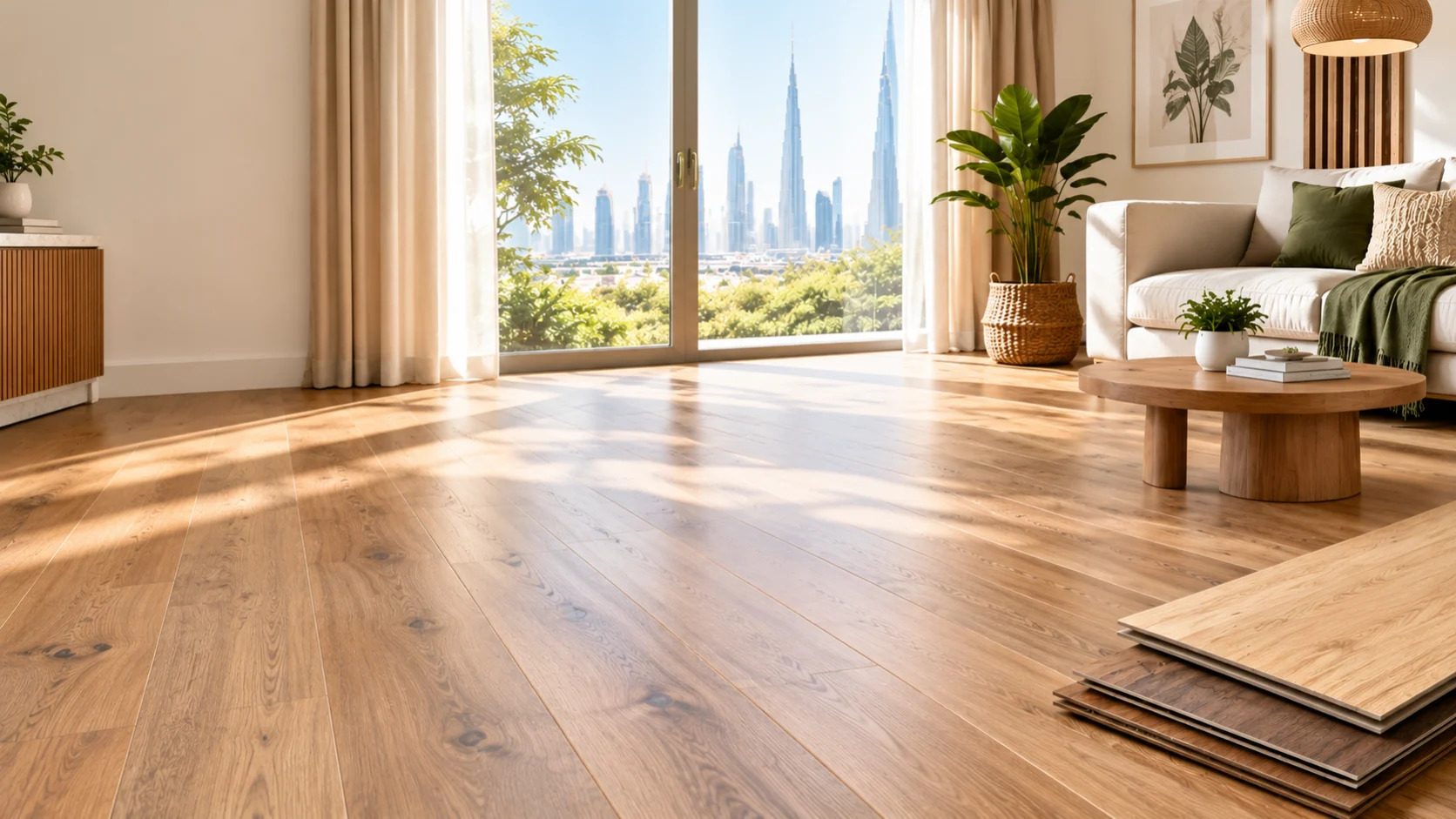
Marketing claims like “natural,” “green,” or “eco” are unregulated and mean very little on their own. Here’s what to actually check:
- Ask for the emissions certificate, not just the marketing sheet. Recognised marks include FloorScore, GREENGUARD Gold, and the European E0/E1 formaldehyde emission class.
- Check the adhesive and finish separately from the core material. A low-VOC board installed with a solvent-heavy adhesive is not a low-VOC installation.
- Ask about formaldehyde class specifically. Formaldehyde is one of the most common and most scrutinised VOCs in engineered wood and laminate cores — E0 or E1-rated cores are significantly safer than uncertified boards.
- Look for FSC certification if sourcing and sustainability matter to you as much as emissions.
- Request a sample and let it sit in a closed room for a day. A strong, lingering chemical smell is a practical, low-tech warning sign, even before lab data.
- Prefer glue-free, click-lock installation where the flooring type allows it — this removes one entire source of VOCs from the equation.
Comparison Table: VOC & Sustainability Profile by Flooring Type
| Flooring Type | Typical VOC Risk | Sustainability Notes | Best For |
|---|---|---|---|
| Engineered Wood Flooring | Low–Medium (depends on adhesive/finish) | Available FSC certified; uses less raw timber than solid wood | Living areas, bedrooms, villas |
| Solid Parquet | Low (if finished on-site with water-based lacquer) | High timber use; FSC availability varies by species | Feature areas, premium residential |
| SPC Flooring | Low (glue-free click systems widely available) | Not wood-based; check FloorScore/GREENGUARD certification | Kitchens, bathrooms, high-traffic commercial |
| Laminate Flooring | Medium (core board formaldehyde varies) | Look for E0/E1-rated cores | Budget-conscious residential |
| Luxury Vinyl (LVT) | Low–Medium | Increasingly low-VOC formulations available; check certification | Offices, retail, residential |
| Homogeneous Flooring | Low (commercial-grade, usually certified) | Long lifecycle reduces replacement waste | Hospitals, schools, labs, commercial |
(Ranges vary by manufacturer and specific product line — always request the specific emissions data sheet for the exact SKU you’re buying, not the category average.)
Buying Advice: Questions to Ask Before You Purchase
- “Can I see the FloorScore, GREENGUARD, or E0/E1 certificate for this exact product?”
- “Is the adhesive you’re recommending water-based or solvent-based?”
- “What’s the formaldehyde emission class of the core board?”
- “Is the timber layer FSC certified, and can you show the chain-of-custody number?”
- “Do you have this in a glue-free, click-lock format?”
- “What ventilation do you recommend during and after installation?”
A supplier who can answer these confidently and provide documentation — not just reassurance — is one you can trust with eco friendly flooring.
Installation Guidance for Low-VOC Flooring in Dubai
Even the best low-VOC product can be undermined by poor installation practice. When arranging flooring installation in Dubai, insist on the following:
- Water-based adhesives only, specified in writing on your quote — not “standard adhesive.”
- Acclimatisation before fitting. Flooring, especially engineered wood and parquet, should sit in the installation room for the period the manufacturer recommends (commonly 48–72 hours) so it adjusts to indoor temperature and humidity before fitting.
- Ventilate during and immediately after installation. Run the AC fan or open windows briefly where possible for the first 24–72 hours to help residual VOCs clear faster.
- Avoid moving in immediately. Where practical, schedule installation a few days before occupants (especially babies, elderly residents, or anyone with respiratory conditions) return to the space.
- Confirm skirting, underlay, and levelling compounds are also low-emission — these are easy to overlook, but they’re part of the same room.
Maintenance Tips to Keep VOC Exposure Low Long-Term
VOCs aren’t only a “day one” concern — some ongoing exposure comes from what you clean your floor with.
- Use pH-neutral, low-VOC or fragrance-free floor cleaners rather than heavily scented or solvent-based products.
- Avoid harsh strippers or ammonia-based cleaners on engineered wood and parquet finishes — they can damage the sealed surface and shorten its protective life.
- Re-seal or re-lacquer wood floors using water-based finishes when the time comes, not solvent-based lacquers.
- Vacuum or dry-mop regularly to reduce dust, which can carry other indoor pollutants alongside any residual VOCs.
- Keep humidity in a stable range (Dubai’s AC-driven dryness can be extreme) — very dry air can cause gaps and finish stress on solid and engineered wood over time.
Common Mistakes to Avoid
- Trusting the word “eco” on a brochure without asking for a certificate. It’s an unregulated term.
- Choosing the cheapest adhesive to save cost, unaware it’s the main VOC source in many installations — not the flooring itself.
- Skipping acclimatisation to rush installation, which increases the risk of both VOC concentration and future warping in Dubai’s climate.
- Ignoring the core board and only checking the surface veneer for certification — the core is often where formaldehyde content matters most.
- Assuming all engineered wood is equal. Emission standards, adhesive type, and FSC status vary significantly between manufacturers and even between product lines from the same brand.
- Not ventilating after installation, especially in a sealed, air-conditioned apartment.
Floor Concepts’ Recommendation for Dubai Homes and Businesses
For most Dubai villas and apartments, we recommend FSC certified engineered wood flooring with a water-based, low-VOC finish and glue-free or water-based-adhesive installation — it balances the warmth of real timber with dimensional stability suited to the local climate, plus verifiable sustainability credentials.
For wet or high-traffic areas (kitchens, bathrooms, commercial spaces), certified SPC flooring with a click-lock system is a strong low-VOC, low-maintenance alternative.
For hospitals, schools, labs, and other commercial environments, certified homogeneous flooring offers the emissions control and durability these settings demand.
As a Dubai-based flooring supplier and installer, we hold physical samples of certified low-VOC ranges in our showroom, so you can smell and inspect the product yourself before committing — not just read a spec sheet.
Final Thoughts
Choosing low VOC flooring isn’t about chasing a trend — in Dubai’s sealed, air-conditioned environment, it’s a practical decision that affects the air your household or staff breathe every day. Combine an emissions certificate (FloorScore, GREENGUARD, or E0/E1) with FSC-certified sourcing and a professional, water-based installation, and you get flooring that’s genuinely safer and more sustainable — not just labelled that way.
If you’re planning a renovation or new fit-out, Floor Concepts can walk you through certified, low-VOC, FSC-certified wood flooring options suited to your space and budget, with a free site visit and sample viewing at our Dubai showroom.
[Request a Free Consultation & Site Visit →Floor Concepts]