
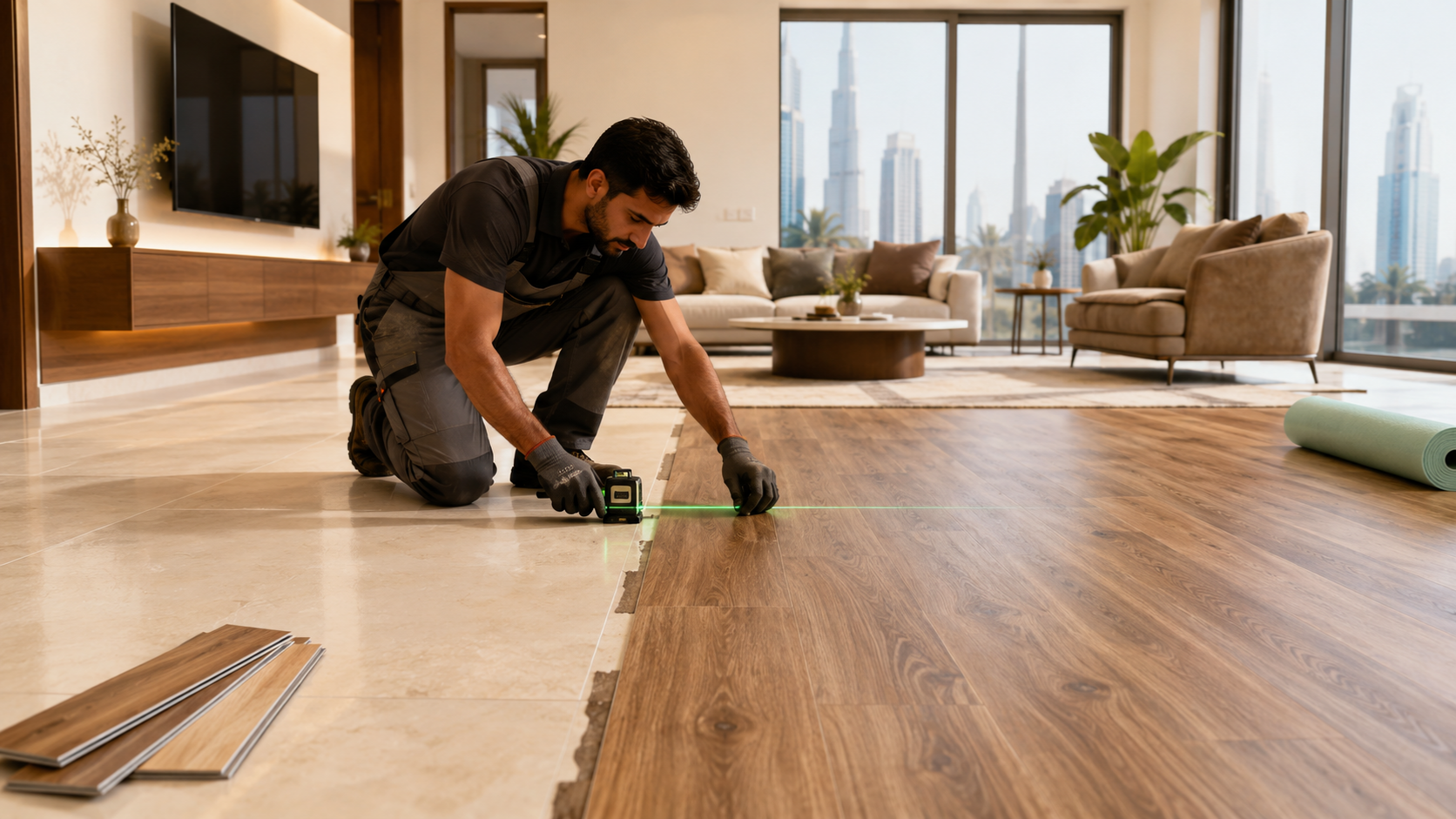
If you’re renovating a villa or apartment in Dubai and your floors are already tiled, ripping everything out before laying new vinyl flooring can feel like an unnecessary amount of dust, noise, and cost. It’s a fair question to ask before committing to any product: can the new floor simply go on top? The answer depends on a handful of specific checks a professional installer runs before quoting the job — not on guesswork or what worked in someone else’s home. This guide walks through exactly what those checks are, when vinyl over tile works well in Dubai’s climate and building conditions, and when it’s genuinely better to remove the tile first.
Yes — in most Dubai homes and offices, vinyl flooring can be installed directly over existing tiles, without breaking them out. It works when the tile surface is flat, firmly bonded to the slab, free of hollow or cracked pieces, and the grout lines aren’t too deep to telegraph through the new floor. It does not work well when tiles are loose, badly uneven, or when the added height would jam doors, sliding wardrobes, or built-in thresholds — situations that are common in older Dubai villas and renovated apartments. A short site inspection settles the question in most cases.
That’s the short version. Below is what a flooring installer actually checks before saying yes, why it matters more in Dubai than in most other markets, and where homeowners commonly go wrong.
Why This Question Comes Up So Often in Dubai
Almost every villa and apartment in Dubai is handed over with tiled floors — usually porcelain or ceramic, sometimes marble in higher-end developments. When owners want to upgrade to a warmer, wood-look finish, the first instinct is to ask whether they really need to break out perfectly good tiles first.
The honest answer is: usually not. Removing tiles means noise, dust, disposal costs, and days of disruption in a building where neighbours and building management have opinions about all three. Installing vinyl flooring in Dubai directly over the existing tile is faster, cleaner, and — when the substrate qualifies — just as durable as starting from bare concrete. But “qualifies” is doing a lot of work in that sentence, which is why a proper site check matters more than the marketing copy on most vinyl boxes.
What Installers Check First (The Real Checklist)
A competent flooring installer doesn’t guess. They walk the space and check these points, roughly in this order.
1. Is the Tile Surface Flat and Level?
Vinyl — whether SPC (rigid core) or standard luxury vinyl tile (LVT) — is unforgiving of an uneven base. Installers use a long spirit level or laser level to check for dips, humps, or slope across the room. Vinyl manufacturers typically require the subfloor to fall within a tight flatness tolerance (commonly around 3mm over a 2-metre span, though this varies by product). In Dubai, older villa tiling and hand-laid mosaic floors often fail this test even when they look fine to the eye.
2. Are Any Tiles Loose, Hollow, or Cracked?
This is checked by tapping across the floor and listening for a hollow sound, or by walking the room slowly to feel for movement underfoot. A single loose tile under a floating vinyl floor will eventually telegraph as a soft spot or crack the vinyl above it. Loose tiles get re-bedded or removed and patched before anything else happens — this is non-negotiable.
3. How Deep Are the Grout Lines?
Wide, deep grout lines — common with large-format porcelain tiles used in many Dubai developments — can show through thinner vinyl over time, especially with glue-down installations. Installers either apply a self-leveling compound across the whole floor or use a thicker rigid-core product that bridges the lines without telegraphing.
4. Is There Moisture in the Slab?
Dubai’s high ambient humidity and the use of concrete slab construction make a moisture test a standard step, particularly on ground floors and in villas without a proper damp-proof membrane. Trapped moisture under an impermeable vinyl layer can lead to adhesive failure or mould at the edges. This is one area where cutting corners causes problems months later, not on installation day.
5. What’s the Tile Type and Finish?
Glossy, polished porcelain — very common in Dubai villa handovers — needs to be mechanically abraded or primed before glue-down vinyl will bond properly. Textured or matte tiles usually need less prep. Marble tiles are checked for sealant residue that can interfere with adhesion.
6. Will the Added Height Cause Clearance Problems?
This is the check homeowners most often forget. Adding even 4–6mm of vinyl on top of existing tile can be enough to jam a door, catch a sliding wardrobe track, or leave an awkward step at a threshold to a balcony or bathroom. Installers measure clearances at every door and fixed fitting before confirming the job — not after.
7. Floating vs. Glue-Down: Which Fits This Floor?
Once the tile passes inspection, the installer decides between a floating (click-lock) floor, which sits on top with an underlayment and isn’t fixed to the tile, or a glue-down installation, bonded directly to the surface. Floating floors are faster and more forgiving of minor imperfections; glue-down gives a firmer, quieter feel underfoot and suits high-traffic commercial spaces better. This decision depends on the tile condition, room size, and how the space will be used.
When Installers Will Recommend Removing the Tile Instead
Vinyl over tile isn’t always the right call. A straightforward, experience-based installer will recommend full tile removal when:
- The tile has widespread hollow spots or cracking, not just one or two tiles
- The floor slopes or dips beyond the vinyl manufacturer’s tolerance and levelling isn’t practical
- There’s active moisture ingress or a history of leaks under the tile
- Door and skirting clearances can’t accommodate the added height, and thresholds can’t be adjusted
- The client wants underfloor heating installed, which usually requires going back to the slab
Any flooring company that skips this conversation and says yes to every floor, regardless of condition, is optimising for the sale rather than the outcome.
SPC vs. Standard Vinyl Over Existing Tiles: Which Suits Dubai Better?
| Factor | SPC (Rigid Core) Flooring | Standard/Glue-Down LVT |
|---|---|---|
| Tolerance for uneven tile/grout lines | Higher — rigid core bridges minor imperfections | Lower — needs a flatter, leveled surface |
| Installation method | Usually floating/click-lock | Usually glued directly to tile |
| Best for | Villas with larger-format tile, DIY-friendlier projects, budget-conscious upgrades | Commercial spaces, high-traffic areas needing a firm underfoot feel |
| Moisture resistance | Very high — 100% waterproof core, well suited to Dubai humidity | Good, but adhesive bond can be affected by trapped moisture |
| Sound/feel underfoot | Slightly hollow unless a good underlayment is used | Firmer, quieter |
| Typical lead time | Faster — less floor prep in most cases | Slower if leveling compound is required |
For most Dubai homes with reasonably flat, secure tile, SPC flooring is the more forgiving and climate-appropriate choice. Glue-down vinyl remains a strong option for offices, retail, and spaces where a firmer surface underfoot matters more than installation speed.
What a Proper Installation Looks Like, Step by Step
- Site survey and moisture test — flatness, tile condition, and slab moisture are measured, not assumed.
- Deep clean of the tile surface — grease, wax, and dust are removed so nothing interferes with adhesion or the underlayment.
- Repair loose or cracked tiles — re-bedded or patched with a suitable filler.
- Level the floor if needed — a self-leveling compound is poured where grout lines or minor unevenness would otherwise show through.
- Lay underlayment (for floating floors) — manages minor sound transmission and adds a slight cushioning layer.
- Flooring Installation Dubai — click-lock or glued, following the manufacturer’s expansion gap requirements around the room’s perimeter.
- Fit transitions and finish thresholds — especially important at doorways where clearance was tight.
- Final inspection — doors, wardrobes, and skirting are checked for clearance before the job is signed off.
Common Mistakes to Avoid
- Skipping the moisture test because the tile “looks dry” — moisture problems in a Dubai slab aren’t always visible from the surface.
- Ignoring door and wardrobe clearance until after installation, when adjusting a threshold is far more disruptive.
- Choosing the cheapest vinyl without checking its flatness tolerance — thin, budget products show every imperfection in the tile below.
- Gluing vinyl onto glossy, unprimed porcelain — a weak bond here leads to lifting edges within months, not years.
- Leaving no expansion gap at the room’s perimeter — vinyl expands and contracts with temperature, and Dubai’s AC-to-outdoor temperature swings make this more relevant, not less.
Maintenance Tips After Installation
- Use felt pads under furniture legs to prevent indentation, especially on SPC floors.
- Sweep or vacuum regularly — sand and grit from outdoor areas are more abrasive on vinyl than on tile.
- Avoid steam mops; they can force moisture into seams and affect the adhesive bond over time.
- Wipe spills promptly, even though most vinyl flooring is water-resistant at the surface — standing water at seams is still worth avoiding.
- Keep blinds or UV film in place in west-facing rooms to reduce colour fading from direct sun exposure, which is more pronounced in Dubai’s light conditions than in temperate climates.
Why Work With a Professional Flooring Installer in Dubai
The information above explains why the checks matter, but the checks themselves require tools most homeowners don’t own — moisture meters, laser levels, and experience reading how a specific tile and slab combination will behave over time. This is the difference between flooring installation in Dubai done by a specialist and a rushed job that looks fine on handover day and fails within a year.
When comparing flooring companies in Dubai, ask specifically whether they carry out a moisture test and flatness check before quoting — not after signing the contract. A reliable vinyl flooring supplier in Dubai will also be able to show you real project photos of vinyl-over-tile installations, not just product catalogues.
Floor Concepts LLC has handled vinyl and SPC installations over existing tile across Dubai villas, apartments, and commercial fit-outs, backed by manufacturer warranties and a one-year installation defects liability period. If you’re weighing this decision for your own space, book a free site inspection and get a straight answer before you commit to a product.
Conclusion: Get an Honest Answer Before You Choose a Product
Most tiled floors in Dubai can take a new vinyl floor on top, but “most” isn’t “all,” and the difference comes down to a handful of checks — flatness, tile condition, grout depth, moisture, and clearance — that no product listing can tell you. Skipping them is how homeowners end up with a floor that looks fine on handover day and shows problems within a year. Getting them right the first time is what makes vinyl flooring in Dubai a genuinely faster, cleaner alternative to tile removal, rather than a shortcut that costs more to fix later.
If you’re still unsure whether your floor qualifies, the fastest way to find out is a short site visit rather than more research. A specialist can tell you within minutes of walking the room, and you’ll walk away with a straight answer and an accurate quote — not a guess.
Considering vinyl flooring for your home or office? Contact Floor Concepts for a free, no-obligation site inspection — our team will tell you honestly whether your existing tiles qualify before recommending any product.
FAQs
Can vinyl flooring be installed directly over ceramic tiles in Dubai?
Yes, in most cases, provided the tiles are firmly bonded, not cracked or hollow, and the floor is within an acceptable flatness range. A short site inspection confirms this before installation.
Does SPC flooring work better than regular vinyl over tiles?
For most Dubai homes, yes. SPC’s rigid core is more forgiving of minor unevenness and grout lines, and its waterproof core suits the region’s humidity better than some glue-down products.
Do I need to remove grout lines before installing vinyl over tile?
Not always. Shallow grout lines are usually fine under a rigid-core product. Deeper or wider grout lines typically need a self-leveling compound first to prevent them from showing through.
Will vinyl flooring make my doors too tight to close?
It can. Adding even a few millimetres of height is enough to catch doors, wardrobe tracks, or thresholds in some Dubai apartments. This is checked and measured before installation, not after.
Is a moisture test really necessary in Dubai’s climate?
Yes. Dubai’s humidity and concrete slab construction make trapped moisture a realistic risk, particularly on ground-floor villas. Installing an impermeable vinyl layer over a damp slab without testing first can cause adhesive failure or mould later.
How long does vinyl flooring installation over tile take in Dubai?
For a standard room, installation is typically completed within a day once the site survey and any leveling work are done. Larger villas or spaces needing extensive leveling take longer — an accurate timeline comes from an on-site assessment.
Is it cheaper than removing the tiles first?
In almost every case, yes — because there’s no demolition, disposal, or downtime for re-tiling. The exact saving depends on the tile condition and room size, which is best confirmed with a site visit and quote.