
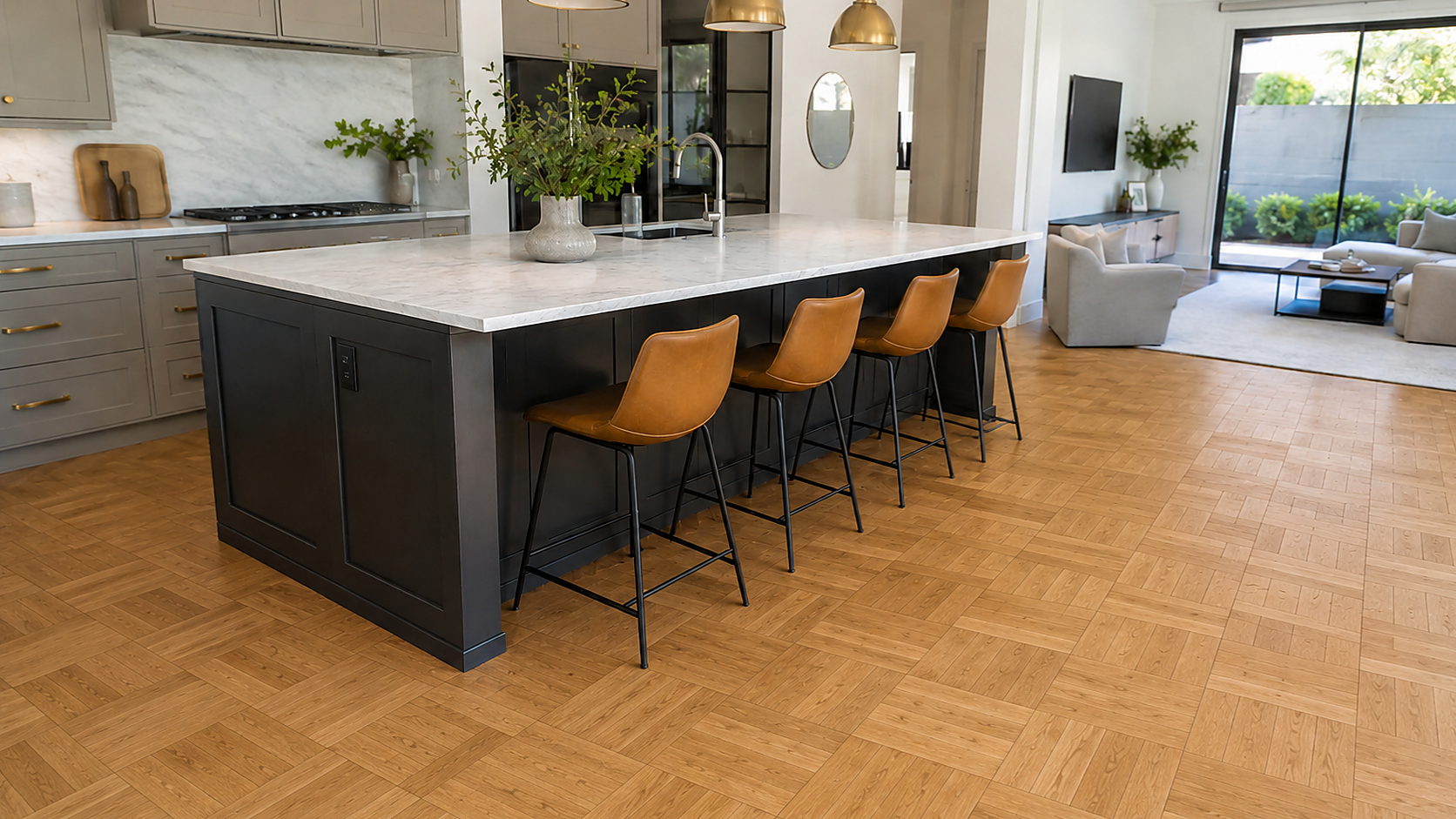
Kitchen islands have become the centrepiece of almost every modern Dubai home, from Downtown apartments to Arabian Ranches villas. But the flooring around that island works harder than flooring anywhere else in the house — it deals with spills, hot pans, dragging stools, and constant foot traffic, all in one small area. If you love the warmth and character of parquet flooring but aren’t sure it can handle that kind of daily pressure, you’re asking the right question before you commit, not after. This guide breaks down exactly what holds up, what doesn’t, and how to get it right the first time.
Yes, parquet flooring works well around a kitchen island in Dubai — as long as you use engineered wood (not solid), a properly sealed finish, and correct expansion gaps at the island’s base.
Solid wood without protection is the main reason kitchen-island parquet fails.
If you’re planning a kitchen renovation or a new villa build and want the warmth of parquet flooring Dubai buyers love — without water stains, gaps, or cupped boards around your island in a year or two — this guide covers exactly what to check before you commit.
Why Kitchen Islands Change the Rules for Flooring
A kitchen island isn’t just another piece of furniture sitting on the floor. It concentrates almost every risk factor that wood flooring is naturally sensitive to:
- Water and spills from the sink, dishwasher, or prep area right next to or built into the island
- Heat from nearby hobs, ovens, or hot cookware set down near the edge
- Point loads from heavy stone countertops and cabinetry pressing down in a fixed spot
- Foot traffic concentration — people circle an island constantly, so the flooring around it wears faster than flooring elsewhere in an open-plan kitchen
- Stools and chair legs scraping and denting the surface at the same few contact points, day after day
In a standard living or bedroom area, none of these stack up together. Around a kitchen island, they all happen in the same one-metre radius, which is exactly why generic “parquet flooring is durable” advice doesn’t tell the full story for this specific zone.
Is Parquet Flooring Suitable for Kitchens in Dubai?
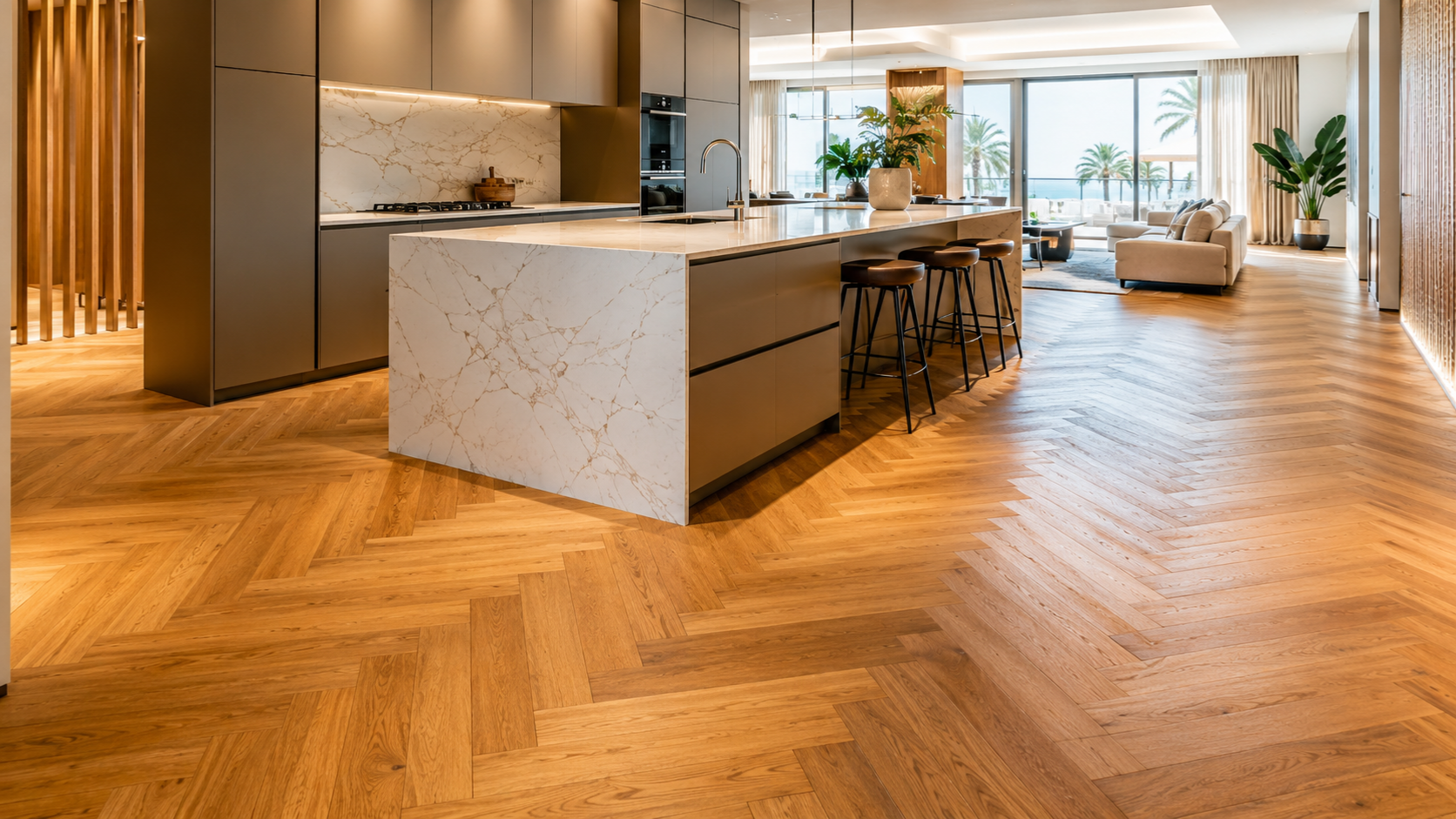
Short answer: yes, with the right product choice. The bigger question isn’t “parquet or not,” it’s “which type of parquet.”
Dubai’s indoor climate is actually more favourable to wood flooring than many people assume, because homes run air conditioning almost year-round, which keeps indoor humidity fairly stable compared to the outdoor climate. The real risks around a kitchen island come from liquid contact and heat, not ambient humidity alone — which is a controllable, design-level problem rather than a reason to avoid wood-look flooring altogether.
That said, not every parquet product is built for this. This is where most of the confusion (and most of the regret) comes from.
Solid Wood Parquet vs Engineered Wood Parquet vs SPC Wood-Look Around a Kitchen Island
| Factor | Solid Wood Parquet | Engineered Wood Flooring | SPC (Wood-Look Rigid Core) |
|---|---|---|---|
| Moisture resistance near island | Low — swells and cups if water sits on seams | Good — cross-layered core resists movement better | Very high — waterproof core |
| Heat tolerance (hobs, hot pans) | Moderate, can discolour | Good with quality lacquer/UV finish | Good, but can dent under sustained heat |
| Feel and warmth underfoot | Best — authentic solid timber | Very close to solid wood | Good, but slightly harder/cooler |
| Suitability for Dubai kitchens | Only with strict sealing and maintenance | Best all-round choice for most kitchen islands | Best choice if kitchen sees heavy spills or young kids |
| Repairability | Can be sanded and refinished multiple times | Can be sanded a limited number of times (depends on veneer thickness) | Cannot be sanded; panels are replaced |
| Typical recommendation | Avoid directly beside sinks/hobs unless well-sealed | Recommended for most Dubai kitchen-island projects | Recommended for very high-moisture or high-traffic kitchens |
Our take, based on installing flooring in Dubai kitchens for years: for most homeowners who want the genuine look and feel of parquet around a kitchen island, engineered wood flooring is the practical sweet spot — it keeps the authentic parquet character (including herringbone and chevron patterns) while handling Dubai’s AC-driven dryness and occasional spill exposure far better than solid wood. If the kitchen is very high-use — think large families, young children, frequent hosting — a wood-look SPC option next to the island (with real parquet continuing into the rest of the living space) is a smart hybrid.
Herringbone Flooring Dubai: Pattern Planning Around an Island
Herringbone flooring Dubai projects are especially popular for open-plan kitchen-living areas, and the island is usually the visual centrepiece of the whole layout. A few things to plan before installation starts:
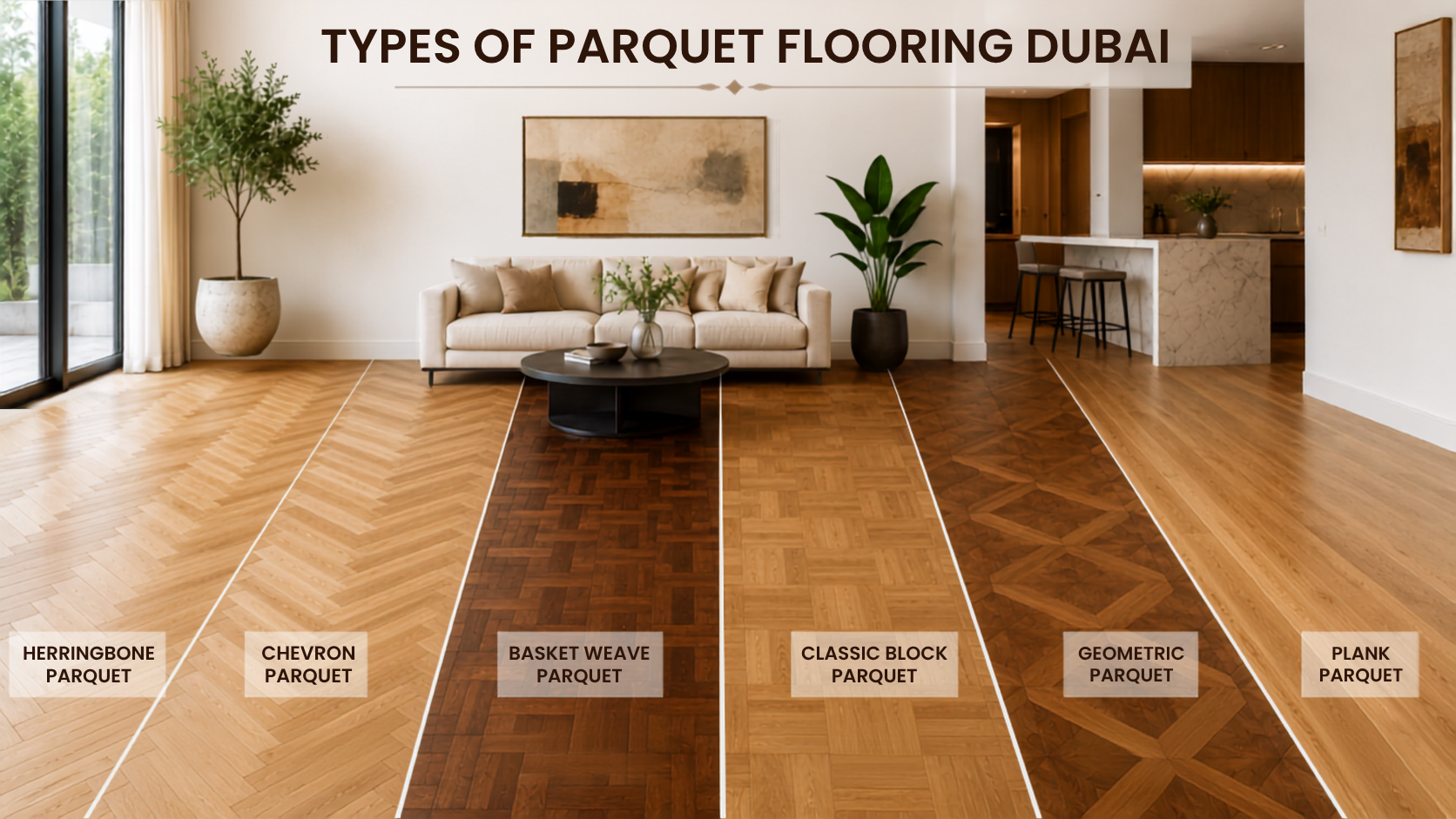
- Set the herringbone starting point away from the island, not centred on it — starting the pattern under a fixed, heavy object makes it far harder to correct if the layout drifts even slightly over a large floor area.
- Run the pattern direction with the main light source (usually toward the largest window or the living area), so the island doesn’t visually “break” the herringbone flow.
- Plan cut pieces at the room’s edges, not around the island, wherever possible — cuts near heavy furniture see more stress and are the first place small gaps show up.
- Chevron vs herringbone near an island: chevron (pre-angled planks) gives a cleaner, more continuous look flowing around large islands, while herringbone (square-cut planks forming the zigzag) is slightly more forgiving to install and repair in sections if a board is ever damaged.
Parquet Flooring Installation Dubai: What Matters Most Near the Island

Good parquet Flooring Installation Dubai teams already know this, but it’s worth homeowners understanding it too, so you can ask the right questions before work starts:
- Subfloor prep first. Any unevenness under an island footprint becomes far more noticeable once heavy cabinetry and stone countertops sit on top. Subfloor levelling should happen before the island base is fixed, not around it.
- Expansion gaps around the island base, not just at the walls. Wood flooring moves slightly with temperature; if it’s boxed in tightly against a fixed island base with zero gap, boards can bow or lift over time.
- Moisture barrier under the flooring in the kitchen zone specifically, even if the rest of the home doesn’t strictly need one — this is cheap insurance against sink and dishwasher leaks that go unnoticed for a while.
- Transition detailing where kitchen flooring meets tile, marble, or another material — a clean, sealed transition strip stops water travelling from the kitchen zone into the wood flooring seams.
- Sequence with your contractor. Flooring should ideally go in after rough plumbing and electrical for the island are confirmed, but before the island cabinetry is fixed in place — this avoids boxing the flooring in with no expansion room.
Sealing and Finish: The Difference Between Parquet That Lasts and Parquet That Doesn’t
Around a kitchen island specifically, the finish matters as much as the wood species:
- UV-cured lacquer finishes are generally more resistant to spills and daily wear than oiled finishes, making them a better default choice directly around an island.
- Oiled finishes look beautiful and are easier to spot-repair, but need more regular maintenance and are more vulnerable to standing liquid — better suited a little further from the immediate splash zone.
- Matte and low-sheen finishes hide micro-scratches from stool legs and foot traffic far better than high-gloss finishes, which show every mark under kitchen lighting.
- Ask for factory-applied, multi-coat finishes over site-applied single-coat options wherever the budget allows — factory finishes cure harder and more evenly.
Common Mistakes Dubai Homeowners Make With Parquet Around Kitchen Islands
- Choosing solid wood parquet purely for looks, without asking how it’s sealed or how it performs near water — the single biggest cause of regret.
- Skipping felt pads on bar stools, which turns every stool movement into a scratch point right where guests sit most.
- Not asking about the expansion gap at the island base — many DIY-supervised projects box the flooring in tight against the island, which shows up as lifting boards months later.
- Wiping spills late. Even good engineered wood parquet shouldn’t sit under standing water for hours — a quick wipe habit protects the investment far more than the finish alone.
- Mixing flooring types badly. Switching from parquet to tile right at the island edge with a poor transition strip is a common weak point for both water damage and visible wear lines.
- Ignoring rug/mat protection under the most-used stool. A washable mat at the busiest stool position takes most of the daily wear off the floor itself.
Maintenance Tips for Parquet Flooring Around a Kitchen Island
[IMAGE 6] Felt pads on bar stool legs on parquet flooring Alt text: “Felt protector pads on stool legs to protect parquet flooring”
- Wipe spills immediately rather than letting them air-dry on the surface
- Use a slightly damp (never wet) microfibre mop, not a soaked one, for routine cleaning
- Avoid steam mops on wood flooring — heat and moisture combined are the worst-case scenario for parquet seams
- Add felt protector pads to every stool and cabinet foot around the island, and check them every few months
- Re-oil or re-lacquer high-traffic zones around the island on a cycle recommended by your installer, rather than waiting until wear is visible
- If boards near the island do show wear before the rest of the floor, ask about spot-sanding and refinishing that section rather than assuming the whole floor needs replacing
Cost Considerations for Kitchen-Island Parquet Projects in Dubai
Pricing depends on wood species, pattern (straight-lay is more economical than herringbone or chevron), finish type, subfloor condition, and the amount of custom cutting needed around the island footprint. As a general rule, engineered wood parquet in a herringbone or chevron layout costs more per square metre than straight-lay boards, mainly due to the extra cutting and layout time required — and kitchen zones typically need a bit more prep (levelling, moisture barrier) than open living areas. The most reliable way to get an accurate number for your specific kitchen and island layout is a site measurement and consultation, since island shape and cabinetry design affect material wastage significantly.
Final Thoughts
Parquet flooring around a kitchen island isn’t a gamble if you go in with the right information: choose engineered wood over solid wood for most Dubai kitchens, insist on proper expansion gaps and a moisture barrier at the island base, and pick a finish built for spills, not just looks. Done right, it’s one of the most beautiful choices you can make for an open-plan Dubai home — and one that holds up for years around the busiest square metre in the house.
If you’re planning a kitchen renovation and want to see herringbone or engineered wood parquet samples suited to your specific island layout, Floor Concepts offers a free consultation and site assessment across Dubai.
Pingback: Parquet Flooring Problems: Gaps, Scratches & Cupping Fix