
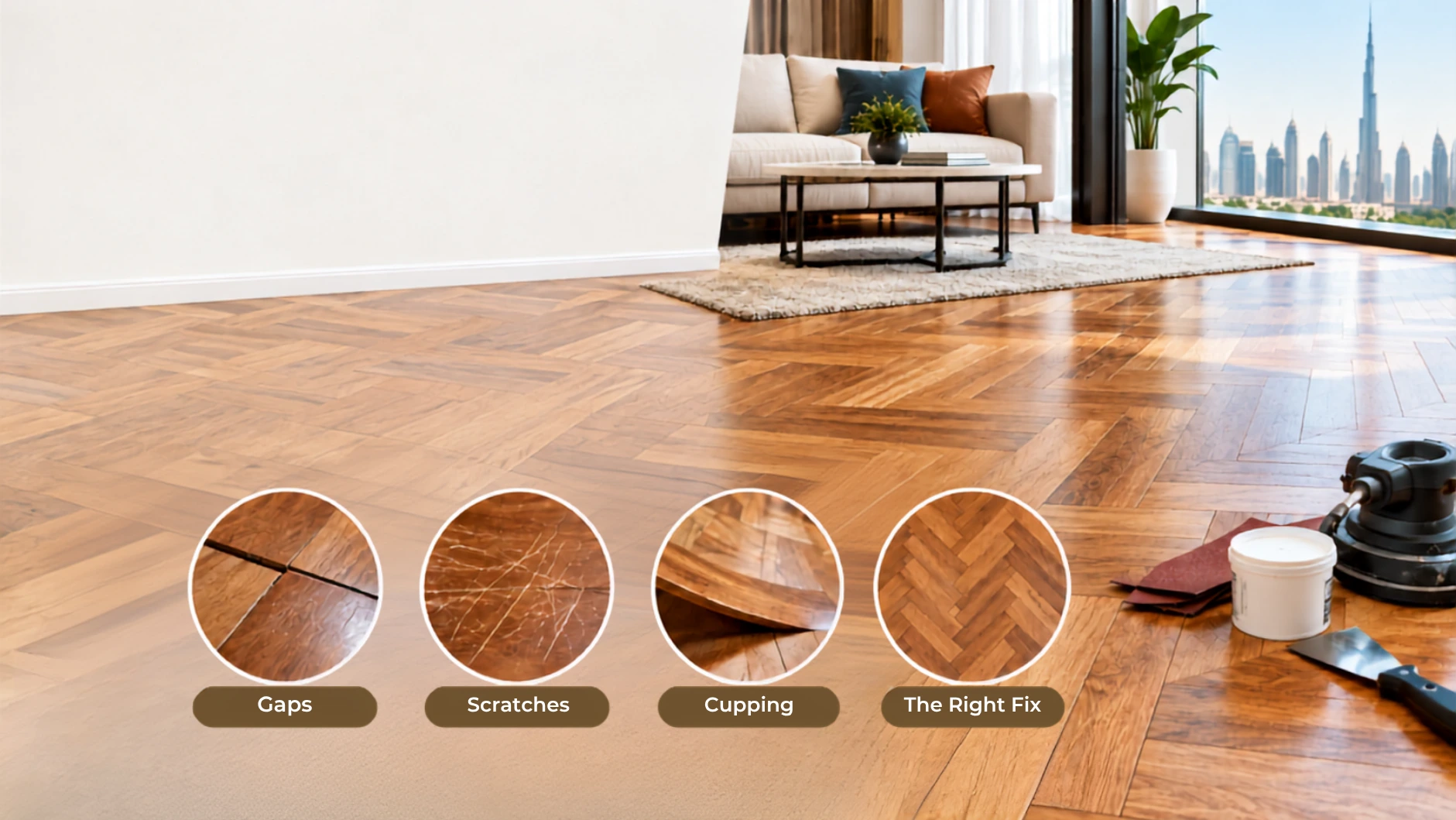
If your parquet flooring has started showing small gaps between the blocks, patches of scratches, or boards that curl slightly at the edges, you’re not alone. These are the three most common parquet flooring problems homeowners in Dubai report — and almost all of them trace back to one thing: how wood reacts to Dubai’s indoor climate.
The good news is that most of these issues are fixable, and nearly all of them are preventable with the right product choice and installation. This guide walks through why each problem happens, how to tell how serious it is, what you can fix yourself, and when it’s time to call a flooring professional.
Gaps and cupping in parquet flooring are usually caused by humidity changes — not necessarily poor-quality wood. Small seasonal gaps of around 2–3mm or less can occur naturally and may close as indoor humidity returns to normal.
Scratches can often be improved through buffing, sanding and refinishing, depending on their depth and the type of parquet finish.
When to Call a Professional:
Persistent cupping, lifting, or widespread gapping can indicate a subfloor moisture problem or installation issue and should be professionally inspected before repairs are attempted.
Expert Tip:
Before repairing parquet flooring, identify the underlying cause. Controlling indoor humidity, checking subfloor moisture, and correcting installation issues can help prevent the same problem from returning.
Why Parquet Flooring Problems Happen More in Dubai
Wood is a natural, hygroscopic material — it absorbs and releases moisture depending on the humidity around it. In most of the world, indoor humidity swings are mild. In the UAE, they’re not.
Dubai homes typically run air conditioning almost year-round, which pulls indoor humidity down to 30–40% or lower. Outdoor humidity, by contrast, can sit above 60–80% for much of the year, especially in summer. Every time a door or window opens, or the AC cycles off, the wood experiences a small humidity shock. Over months and years, this constant expansion and contraction is the single biggest driver of wood floor problems in this region — far more than in temperate climates most international flooring guides are written for.
This is exactly why wood floor problems guides written for the UK, Europe, or the US often don’t translate well to Dubai villas and apartments — the humidity swings here are simply more frequent and more extreme.
This doesn’t mean parquet is a poor choice for Dubai. Parquet Engineered Wood Flooring in particular is built with a multi-layer, cross-grain construction specifically to resist this kind of movement far better than solid wood. But no wood product is completely immune to climate — which is why understanding these problems matters before and after you buy.
The 3 Most Common Parquet Flooring Problems
1. Gaps Between Boards (Gapping)
What it looks like: Thin, visible lines appearing between individual blocks or planks, usually more noticeable in winter when indoor air is drier from AC use.
Why it happens: As indoor humidity drops, wood loses moisture and shrinks slightly across its width. Since the boards are fixed in place, this shrinkage shows up as a gap rather than the board simply getting smaller.
Is it serious?
- Gaps under 2–3mm that appear seasonally and close up again when humidity rises are considered normal wood movement.
- Gaps that are wide, permanent, or appearing in a pattern (e.g., along one wall) usually point to a subfloor, acclimatization, or humidity-control issue.
How to fix it:
- Use a humidifier to bring indoor humidity back toward the recommended 40–60% range, especially in peak AC season.
- For small, stable gaps, a colour-matched wood filler or wax stick can be used to fill individual gaps.
- For widespread or large gaps, a professional gap-filling service (rope filler or reactive resin, depending on the product) gives a cleaner, longer-lasting result than DIY filler.
2. Cupping (and Crowning)
What it looks like: The edges of each board sit slightly higher than the centre, so the floor feels wavy underfoot. The opposite — where the centre is higher than the edges — is called crowning.
Why it happens: Cupping almost always means the bottom of the board has taken on more moisture than the top, usually from subfloor moisture, a water spill left too long, or a plumbing leak nearby. Crowning is often the result of a floor that cupped, was sanded flat while still damp, and then continued drying — a classic sign of premature refinishing.
Is it serious? Yes — cupping is a moisture signal, not just a cosmetic issue. Left unaddressed, it can progress to board lifting, delamination (in engineered products), or mould risk beneath the floor.
How to fix it:
- Identify and remove the moisture source first (leak, spill, poor subfloor damp-proofing). Fixing the surface without fixing the cause will cause the problem to return.
- Let the floor dry out fully and stabilise — this can take days to weeks depending on severity.
- Only sand and refinish once moisture readings confirm the floor has returned to normal levels. Sanding too early is the single most common mistake that turns cupping into permanent crowning.
- A professional moisture inspection is strongly recommended before any refinishing work.
3. Scratches, Scuffs & Surface Wear
What it looks like: Fine hairline scratches from foot traffic and grit, or deeper scuffs from moving furniture, pet claws, or high heels.
Why it happens: Simple daily wear, sand and dust (common in Dubai) acting as an abrasive underfoot, or furniture without protective pads.
How to fix it:
- Light surface scratches: a matching touch-up pen or wax filler stick usually resolves it in minutes.
- Moderate scratching across a room: a screen-and-recoat (light surface sand plus a fresh top coat) restores the finish without a full sand-down.
- Deep or widespread scratching down to bare wood: full floor sanding and polishing is needed to remove the damaged layer and reapply protective lacquer or oil.
Other Parquet & Wood Floor Problems Worth Knowing
| Problem | Typical Cause | Fix |
|---|---|---|
| Squeaking boards | Loose subfloor fixing or gaps beneath boards | Re-secure boards or inject adhesive; rarely a DIY job |
| Fading or colour change | UV exposure through windows | Rotate rugs/furniture; use UV-filtering window film; choose UV-stable finishes |
| Sticky or dull surface | Wrong cleaning product residue build-up | Deep clean with a manufacturer-approved wood floor cleaner, avoid oil-based or wax cleaners on lacquered floors |
| Board lifting or peaking | Insufficient expansion gap at installation | Reinstate expansion gap at the perimeter; may need a professional re-lay |
| Mould smell beneath floor | Trapped subfloor moisture, poor damp-proof membrane | Full inspection, drying, and possible membrane correction before re-fitting |
Gaps vs. Cupping vs. Scratches: Quick Comparison
| Issue | Root Cause | DIY-Fixable? | Warning Sign to Watch |
|---|---|---|---|
| Gapping | Low humidity / seasonal wood shrinkage | Yes, for small gaps | Gaps over 3mm or not closing seasonally |
| Cupping | Excess moisture under or in the board | No — needs diagnosis first | Waviness underfoot, musty smell |
| Scratches | Surface wear, grit, furniture movement | Yes, for light scratches | Wear down to bare wood in traffic zones |
DIY Fix or Call a Professional? How to Decide
You can likely handle it yourself if:
- The issue is cosmetic (light scratches, small stable gaps)
- It’s isolated to a small area
- There’s no visible moisture, odour, or structural movement
Call a flooring professional if:
- You see cupping, crowning, or board lifting
- Gaps are widespread, wide, or growing
- There’s a musty smell or recent water exposure nearby
- The floor was installed more than 7–10 years ago and hasn’t been refinished
- You’re unsure of the cause — a wrong diagnosis (e.g., filling gaps caused by a moisture problem) often makes things worse
How to Prevent Parquet Flooring Problems in Dubai
- Choose the right product for the climate. Parquet Engineered Wood Flooring with a quality multi-layer core handles Dubai’s humidity swings noticeably better than solid parquet.
- Insist on proper acclimatization before installation. Wood should sit in the room it will be installed in for the manufacturer-recommended period so it adjusts to local conditions first.
- Leave a correct expansion gap around the room’s perimeter — this is a common shortcut in budget installations and a leading cause of later buckling.
- Control indoor humidity with AC settings or a humidifier, aiming for a stable 40–60% range where possible.
- Use furniture pads and entrance mats to reduce grit and scratching, especially near sliding doors and balconies.
- Wipe spills immediately and avoid wet mopping — use a damp (not wet) microfibre mop and manufacturer-approved cleaners only.
- Schedule periodic maintenance. A screen-and-recoat every few years extends the life of the finish long before a full sand-down is needed.
- Work with an experienced local installer. Subfloor preparation and installation technique matter more in Dubai’s climate than in milder regions — this is where most long-term problems actually start.
Buying Advice: Choosing Parquet That Resists These Problems
If you’re shopping for new Wooden Flooring Dubai options — whether replacing a problem floor or starting fresh — a few buying questions will save you future headaches:
- Solid or engineered? For Dubai’s climate, Parquet Engineered Wood Flooring is generally the more stable choice thanks to its cross-layered construction, which resists the expansion and contraction that causes gapping and cupping.
- What’s the wear layer thickness? A thicker wear layer allows more sand-and-refinish cycles over the floor’s lifetime, meaning scratches and wear can be corrected repeatedly rather than requiring full replacement.
- Does the supplier handle acclimatization and subfloor checks? Ask specifically — this step is skipped more often than it should be and is behind many of the gapping and cupping issues homeowners report a year or two after installation.
- What warranty is offered, and does it cover installation defects separately from product defects? A supplier who backs both the product and the workmanship gives you real recourse if problems appear early.
For a wider comparison of materials, see our guide on Engineered Wood Flooring Dubai options and how they compare to solid wood and SPC.
Getting a Professional Opinion
If your parquet flooring is showing gaps, cupping, or scratches and you’re not sure whether it’s normal wear or something that needs attention, an on-site inspection is the fastest way to know for sure. Floor Concepts offers floor sanding and polishing, moisture diagnostics, and re-installation services across Dubai, along with supply and installation of Engineered Wood Flooring Dubai for homeowners looking to upgrade to a more climate-stable product.
Book a free flooring inspection with Floor Concepts →
Frequently Asked Questions
Are gaps in parquet flooring normal?
Small seasonal gaps, generally under 2–3mm, are a normal part of how wood responds to indoor humidity changes and often shrink back when humidity rises. Gaps that are wider, permanent, or keep growing usually signal an installation or humidity-control issue worth having checked.
Can cupped parquet flooring be fixed without replacing it?
In many cases, yes. Once the moisture source is identified and resolved and the floor has fully dried and stabilised, sanding and refinishing can often restore a flat, even surface — as long as the boards haven’t been damaged beyond their wear layer.
How often should parquet flooring be sanded and polished?
This depends on foot traffic and the finish type, but many homes benefit from a light screen-and-recoat every few years, with a full sand-down needed far less often — typically only when scratches go through to bare wood.
Is parquet flooring a good choice for Dubai’s climate?
Yes, particularly Parquet Engineered Wood Flooring, which is engineered specifically to handle humidity fluctuations better than solid wood. Product choice, acclimatization, and correct Flooring Installation Dubai practices matter more to long-term performance than the climate alone.
What causes wood floor problems to appear after a few years but not immediately?
Wood floor problems like gapping and cupping are often cumulative — they build up over repeated humidity cycles, seasonal AC use, or a slow subfloor moisture issue, which is why they tend to show up gradually rather than right after installation.
Can I use a regular mop to clean parquet flooring?
It’s best to use a well-wrung, barely damp microfibre mop rather than a wet mop, along with a cleaner recommended for your floor’s specific finish, since excess water is one of the more common preventable causes of cupping.