
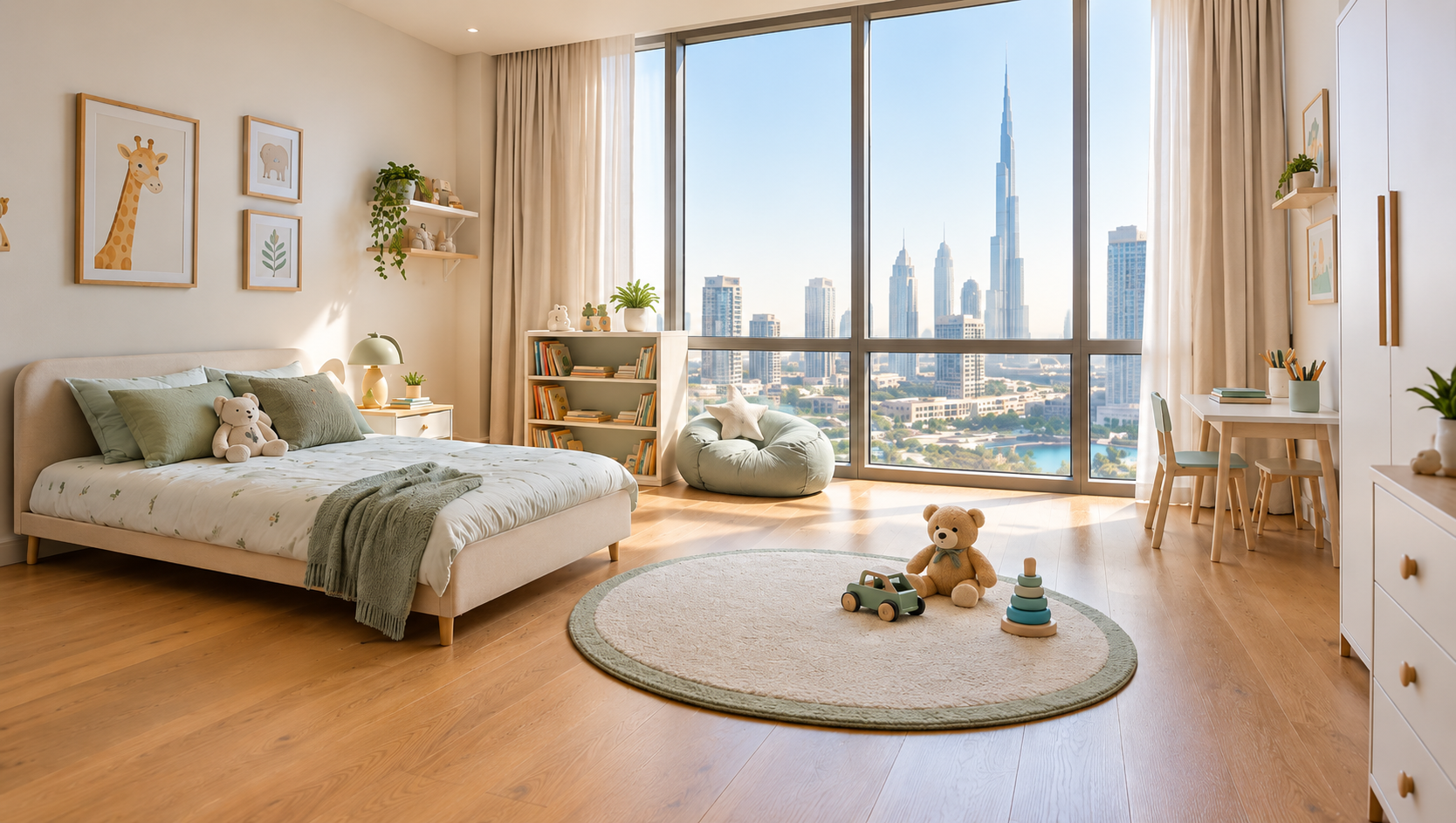
Choosing flooring for a child’s bedroom in Dubai isn’t the same as picking flooring for a living room. Kids sit, crawl, and play directly on the floor for hours. They spill juice, drag toys, and — especially in the toddler years — treat the floor as a giant table. On top of that, Dubai’s indoor climate is unusual: homes run on air conditioning almost year-round, which dries out the air and puts real stress on natural materials, while sealed windows mean dust and allergens can build up faster than in naturally ventilated homes. Flooring for a kids’ room has to handle all of this at once — safety, hygiene, comfort, and long-term durability — without looking clinical.
Most Dubai parents end up choosing between two broad routes: Wooden Flooring, valued for its natural warmth and long-term character, or Vinyl Flooring Dubai suppliers’ waterproof, low-maintenance ranges built specifically for busy, high-traffic rooms. Both can work beautifully in a kids’ room — the right pick just depends on your child’s age, how the room is used day to day, and how much upkeep you’re willing to do.
This guide breaks down exactly which flooring types work best for children’s rooms in Dubai villas and apartments, what to check before you buy, and the mistakes most parents make when choosing.
For most Dubai homes, SPC (rigid core) flooring and engineered wood flooring are the best all-round choices for a kids’ room. Both are scratch-resistant, easy to wipe clean, warm underfoot, and well suited to Dubai’s air-conditioned indoor climate.
Solid wood looks beautiful but is more prone to denting and moisture marks from spills, so it is generally better suited to a formal or teen bedroom than a toddler’s room.
For Nurseries & Playrooms:
Vinyl flooring (LVT) is a budget-friendly, waterproof option and a practical choice for rooms where spills, cleaning and everyday play are common.
Expert Tip:
For a kids’ room, don’t choose flooring based on appearance alone. Consider slip resistance, scratch resistance, easy maintenance, comfort underfoot, moisture resistance and the quality of the installation.
Why Flooring Choice Matters More in a Kids’ Room
A kids’ room floor does more work than any other floor in the house. Four things matter most:
- Safety — falls are inevitable with toddlers and active kids. A floor with some give, a matte non-slip finish, and no hard, cold surface reduces injury risk.
- Hygiene — children put their hands (and sometimes their mouths) on the floor. Flooring that doesn’t trap dust, mites, or allergens matters more here than anywhere else in the home, particularly in Dubai’s air-conditioned, low-ventilation interiors.
- Comfort — kids play, sit, and nap on the floor. A cold, hard tile or marble surface (common in Dubai villas and apartments) isn’t comfortable for long play sessions.
- Durability — crayons, toy cars, spilled juice, dropped blocks, and years of foot traffic. The floor needs to survive childhood, not just look good on installation day.
Get these four right and the room becomes genuinely easier to live with — fewer stains, fewer allergy flare-ups, fewer bumps and bruises, and a floor that still looks good when the “kids’ room” becomes a teenager’s room five years later.
What to Look for Before You Choose
Before comparing materials, run through this checklist:
- Water resistance — spills, drinks, and the occasional potty-training accident are inevitable.
- Scratch and impact resistance — check the wear layer thickness (for vinyl/SPC) or hardness rating (for wood species).
- Low-VOC / hypoallergenic certification — important in a sealed, air-conditioned room where a young child sleeps for 10+ hours a night.
- Slip resistance — a light texture or matte finish is safer than high-gloss.
- Acoustic performance — especially in Dubai apartments and towers, where running and jumping noise can travel to the unit below.
- Warranty and after-sales support — ask what’s covered for residential use, and for how many years.
- Ease of cleaning — you should be able to wipe up crayon, slime, or juice without damaging the surface.
Comparing the Best Flooring Options for Kids’ Rooms
1. SPC Flooring Dubai (Rigid Core) — Best All-Rounder
SPC Flooring Dubai (Stone Plastic Composite) has become one of the most popular choices for children’s rooms across the city, and for good reason. As a type of rigid core flooring, SPC is 100% waterproof, highly scratch-resistant, and doesn’t expand or contract with Dubai’s swings between air-conditioned indoor cool and outdoor heat the way some natural materials can. Most SPC planks come with an attached underlay (often IXPE foam), which adds a bit of cushioning underfoot and helps dampen sound — a real benefit in apartments.
- Best for: toddlers, playrooms, nurseries, families who want zero-maintenance flooring
- Watch for: wear layer of at least 0.3–0.5mm for genuine durability in an active kids’ room
2. Engineered Wood Flooring — Best for a Warmer, More Natural Look
Engineered wood flooring gives you the authentic look and warmth of real timber with better dimensional stability than solid wood, because it’s constructed in layers rather than a single plank of solid timber. This makes engineered wood flooring Dubai installations more forgiving of the city’s air-conditioned indoor climate than solid hardwood. It’s a strong choice for a school-age child’s or teenager’s room where the look matters as much as the practicality, and where spills are less frequent than in a toddler’s room.
- Best for: school-age kids, teen bedrooms, design-led nurseries where parents want a natural finish
- Watch for: a lacquered or UV-cured finish for easier cleaning, and a hardwood species (oak is the most common and durable choice in the UAE market)
3. Solid Wood Flooring Dubai — Beautiful, but Needs More Care
Solid wood flooring Dubai offers unmatched warmth and can be sanded and refinished multiple times over its life, which is a genuine long-term advantage. However, solid wood is more sensitive to moisture and impact dents than engineered or SPC options, so it’s better suited to a teenager’s room, a study, or a shared family space than a toddler’s bedroom where spills and toy-dragging are a daily reality.
- Best for: older children’s and teens’ rooms, homes that want a long-term, refinishable investment
- Watch for: rugs or play mats in high-traffic play zones to protect the surface
4. Vinyl Flooring Dubai (LVT) — Best Budget-Friendly, Waterproof Option
Vinyl flooring Dubai suppliers offer luxury vinyl tiles (LVT) in a huge range of wood- and stone-look finishes, and it remains one of the most practical choices for a young child’s room. It’s fully waterproof, soft underfoot compared to tile, warmer than marble, and typically the most affordable of the durable options. Modern LVT collections also come in playful colours and patterns, not just wood-look finishes, which works well for younger kids’ rooms.
- Best for: nurseries, playrooms, rental apartments, budget-conscious renovations
- Watch for: thickness and wear layer — thin, low-cost vinyl wears faster under toy traffic
5. What to Avoid (or Use With Caution)
- Loose carpet: soft and warm, but in Dubai’s climate it traps dust and allergens more than any hard-surface option, and it’s harder to fully sanitise after spills. If you want the soft-play feel, use a washable play rug over a hard-surface floor instead of wall-to-wall carpet.
- High-gloss tile or polished marble: common in Dubai villas, but cold underfoot and slippery when wet — not ideal as the primary surface in a young child’s room.
Kids’ Room Flooring Comparison Table
| Flooring Type | Water Resistance | Comfort Underfoot | Durability | Hygiene / Allergy-Friendly | Best Age Group | Relative Cost |
|---|---|---|---|---|---|---|
| SPC / Rigid Core Flooring | Excellent (100% waterproof) | Good (cushioned underlay) | Excellent | Excellent | Toddler – School-age | Mid-range |
| Engineered Wood Flooring | Moderate | Very Good (warm) | Very Good | Good | School-age – Teen | Mid–High |
| Solid Wood Flooring | Low–Moderate | Very Good (warm) | Good (refinishable) | Good | Teen / Study | High |
| Vinyl Flooring (LVT) | Excellent | Good | Good–Very Good | Very Good | Nursery – Toddler | Budget–Mid |
| Loose Carpet | Poor | Excellent | Moderate | Poor (traps allergens) | Not recommended as primary floor | Budget–Mid |
Best Flooring by Child’s Age
- Nursery (0–2 years): SPC or vinyl flooring — fully waterproof, soft, warm, and easy to disinfect after accidents.
- Toddler (2–5 years): SPC flooring is the strongest all-rounder — it survives toy-dragging, spills, and constant floor play.
- School-age (5–10 years): Engineered wood flooring or SPC, depending on whether you want a natural wood look or maximum low-maintenance durability.
- Teen (10+ years): Solid wood flooring Dubai or engineered wood — more design-forward, and by this age the room sees fewer spills and less rough play.
Sustainable Wood Flooring: A Growing Priority for Dubai Families
More parents are now asking specifically for sustainable wood flooring when furnishing a child’s room — and it’s a fair question, since kids spend the most hours of anyone in the house on that surface. Look for FSC-certified timber sourcing, low-VOC adhesives and finishes, and manufacturers who are transparent about where the wood comes from. Sustainable wood flooring isn’t just an environmental choice; low-VOC, responsibly finished wood also tends to mean better indoor air quality in a sealed, air-conditioned bedroom — which matters directly for a child’s health.
Installation Tips for Dubai Homes
Getting the material right is only half the job — installation quality determines how the floor actually performs day to day.
- Choose floating installation where possible. Most SPC and engineered wood products can be floated over an existing subfloor without glue, which means less disruption, no strong adhesive odours in a child’s bedroom, and easier removal later.
- Add an acoustic underlay in apartments. This isn’t optional in most Dubai towers — many building management rules require impact-sound insulation, and it also genuinely reduces the “running feet” noise transferring to the unit below.
- Check subfloor moisture and levelness first. Villas built on ground-level slabs can carry residual moisture; a professional flooring installation Dubai team will test this before laying engineered or solid wood.
- Leave expansion gaps. Wood-based flooring needs a small gap at the skirting to allow for natural movement — this is often missed by unqualified installers and leads to buckling later.
- Use professional installers, not a DIY job, for wood-based floors. Wooden flooring — solid or engineered — is sensitive to subfloor prep, humidity, and acclimatisation time before laying. A rushed DIY install is the single biggest cause of early wood flooring failures we see in Dubai homes.
Maintenance Tips to Keep a Kids’ Room Floor Looking New
- Sweep or vacuum (on a hard-floor setting) daily — sand and grit are the biggest cause of surface scratching.
- Wipe spills immediately with a damp, not wet, cloth — even on waterproof SPC and vinyl, standing liquid at the seams should be cleaned promptly.
- Use felt pads under furniture legs and bed frames.
- Avoid steam mops on wood and engineered wood — the heat and moisture can damage the finish over time.
- Trim toy wheels or attach protective pads to ride-on toys where possible.
- Re-apply a manufacturer-recommended wood care product on solid or engineered wood floors once or twice a year to maintain the finish.
Common Mistakes Parents Make When Choosing Kids’ Room Flooring
- Picking on looks alone — a beautiful floor that scratches in the first month isn’t a win.
- Skipping the wear-layer or hardness check — this single spec predicts most of a floor’s real-world durability.
- Ignoring acoustic underlay in apartments — leads to noise complaints and, sometimes, community fines.
- Choosing wall-to-wall carpet for allergy-prone kids — it looks cosy but is the hardest surface to keep allergen-free.
- Not asking about warranty terms for residential/child use — some warranties are voided by certain cleaning products or heavy furniture without protective pads.
- DIY installation to save cost — poor subfloor prep is the number one cause of squeaking, gapping, or buckling floors within the first year.
Final Thoughts
There’s no single “best” flooring for every kids’ room — the right choice depends on your child’s age, how the room is used, and whether you’re in a villa or an apartment. As a general rule: SPC flooring Dubai and vinyl flooring are the safest, lowest-maintenance choices for nurseries and toddlers, while engineered wood flooring Dubai and solid wood suit older kids’ and teens’ rooms where the look matters as much as the practicality. Whichever material you choose, the quality of installation — subfloor prep, expansion gaps, and acoustic underlay — matters just as much as the flooring itself.
Floor Concepts has fitted wooden, engineered wood, SPC, and vinyl flooring in family homes and nurseries across Dubai for over a decade. If you’d like a recommendation tailored to your child’s room, get in touch with our flooring specialists for a free consultation.
Frequently Asked Questions
What is the safest flooring for a toddler’s room?
SPC (rigid core) flooring and vinyl flooring are generally the safest choices for toddlers — both are waterproof, have a slightly cushioned feel, and offer a matte, non-slip finish that reduces the risk and impact of falls.
Is engineered wood flooring good for a kids’ bedroom?
Yes. Engineered wood flooring is more dimensionally stable than solid wood, handles Dubai’s air-conditioned indoor climate well, and offers a warm, natural surface. It suits school-age and teen bedrooms particularly well, where spills are less frequent than in a toddler’s room.
Is vinyl flooring safe for children?
Yes, modern vinyl flooring (LVT) is safe, waterproof, and easy to clean, making it one of the most practical choices for nurseries and playrooms. Choose a reputable, low-VOC certified product for a bedroom where a child sleeps.
SPC vs laminate — which is better for a kids’ room?
SPC flooring is generally the better choice for a kids’ room because it’s 100% waterproof, whereas laminate is only water-resistant and can swell if spills aren’t cleaned up quickly. Laminate can still work well as a budget option in a low-spill room, such as an older child’s bedroom.
Is solid wood flooring a good idea for a child’s room?
Solid wood flooring Dubai looks beautiful and can be refinished over time, but it’s more prone to dents and moisture damage than engineered wood or SPC. It’s better suited to a teenager’s room or a shared family space than a toddler’s bedroom.
How do I make my child’s floor more hygienic?
Choose a non-porous, wipeable surface such as SPC, vinyl, or a sealed wood finish, avoid wall-to-wall carpet, vacuum or sweep daily, and clean spills immediately rather than letting them sit.
Does flooring need to be soundproofed for a kids’ room in a Dubai apartment?
In most Dubai towers, yes — an acoustic underlay is either required by building management or strongly recommended to reduce impact noise (running, jumping, dropped toys) transferring to the unit below.
How much does flooring installation cost in Dubai for a kids’ room?
Cost depends on the material chosen, room size, and subfloor condition. SPC and vinyl are typically the most budget-friendly waterproof options, while engineered and solid wood sit at a higher price point. A flooring installation Dubai specialist can provide an accurate quote after assessing the room.
Can I install kids’ room flooring myself?
It’s possible for click-lock SPC or vinyl in a small room, but professional installation is strongly recommended for wood-based flooring, and for any room where acoustic underlay or subfloor levelling is needed — mistakes here are costly to fix later.