
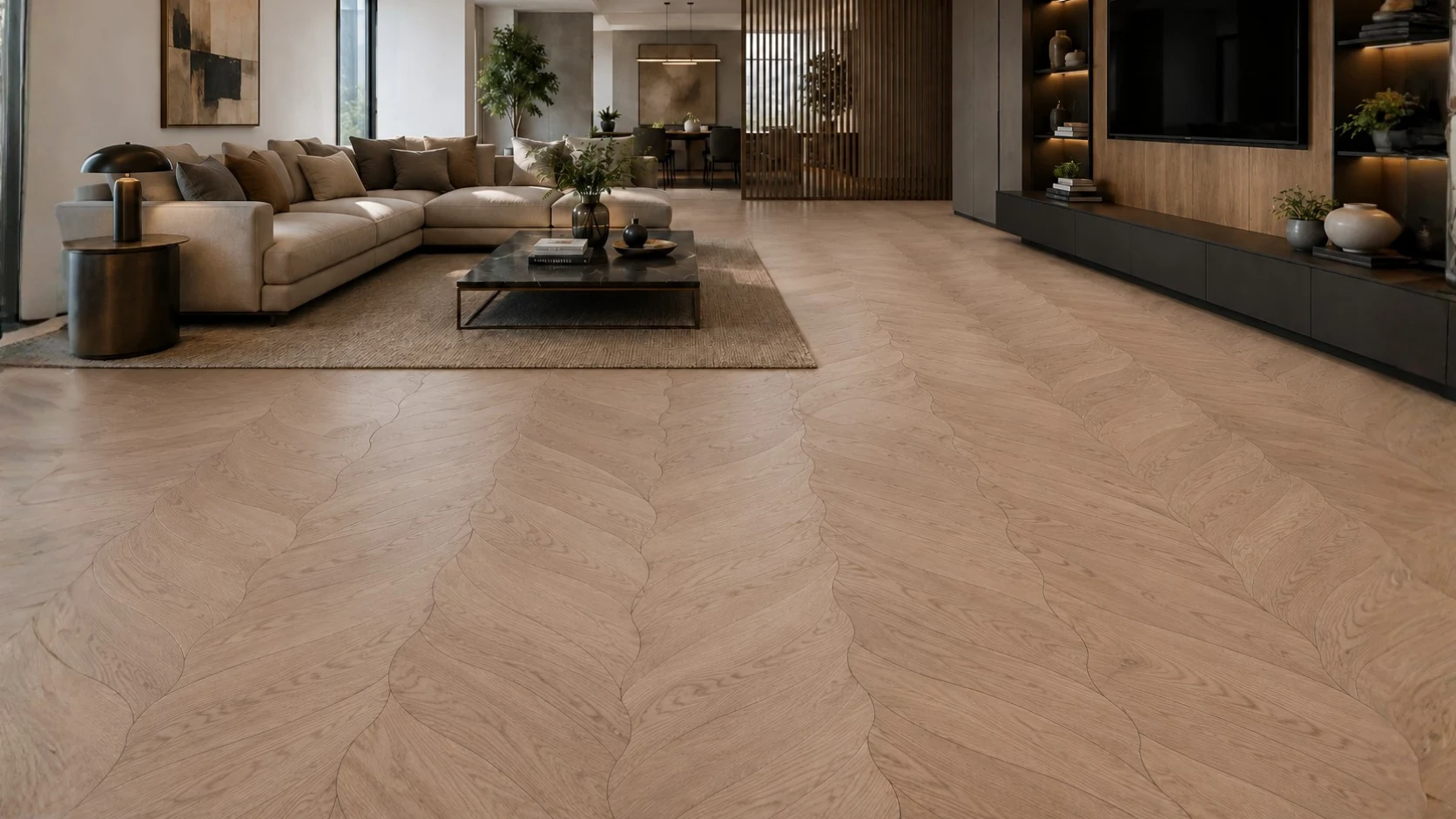
Walk into two flooring showrooms in Dubai with the same oak sample photo saved on your phone, and you can easily get two quotes that differ by 80–100%. Both floors look identical in the box. Both are called “engineered wood flooring.” Yet one costs AED 180 per square metre and the other AED 340.
The difference isn’t marketing. It’s grading — and grading in engineered wood flooring actually works on two separate levels that most buying guides mix together or ignore entirely:
- Face grade — the visual classification of the wood surface (Prime, Select, Natural, Rustic)
- Construction grade — the veneer thickness, core material, finish, and locking system underneath
Face grade affects how the floor looks. Construction grade affects how long it lasts, how it performs in Dubai’s climate, and what you’re actually paying for. Two floors can share the same face grade and still be worlds apart on construction — which is exactly why they can look the same and cost double.
This guide breaks down both, in plain terms, so you can compare quotes properly before you sign off on a supply-and-install contract. Whether you’re comparing quotes from a few engineered wood flooring Dubai suppliers or simply researching wood flooring Dubai options before your first showroom visit, understanding both grading systems will stop you from paying premium prices for a budget-grade core.
What “Grade” Actually Means in Engineered Wood Flooring
Face grade (the look)
Face grade describes the natural characteristics visible on the top wood layer: knots, grain pattern, colour variation, mineral streaks, and sapwood. It’s a styling decision, not a quality decision.
- Prime / Select grade — minimal knots, consistent colour, uniform grain. Suits modern, minimal interiors.
- Natural grade — some colour variation and small knots, a balanced “real wood” look without heavy character.
- Rustic / Character grade — visible knots, sapwood streaks, colour movement, sometimes filled cracks. Suits warm, traditional or farmhouse-style interiors.
Face grade applies equally to standard plank layouts and to pattern-laid floors — a parquet engineered wood flooring collection in herringbone or chevron will still be sold across the same Prime-to-Rustic range, since the pattern and the grade are two separate choices.
A Rustic-grade plank and a Prime-grade plank from the same product line will typically share the same core, the same wear layer thickness, and the same warranty. Face grade alone should not create a large price gap on its own.
Construction grade (the part nobody shows you in a showroom)
This is where the real price difference lives, and it’s rarely explained on the sample board. It comes down to four things:
- Veneer (wear layer) thickness — how much real wood is on top before you hit the core
- Core material and ply count — what’s actually holding the plank flat and stable
- Finish system — how the surface is protected and how it will age
- Locking mechanism and machining precision — how well it fits, seals, and stays flat over years
Two boxes can carry the same face grade and the same species name, and still differ by more than double in real cost because of these four factors.
Veneer Thickness: The Single Biggest Hidden Cost Driver
The veneer is the layer of real hardwood on top of the plank. It’s usually cut in one of three ways:
- Rotary peeled — cheapest, thinnest (often 0.6mm–1.5mm), can look slightly “plywood-like” with a wider, more repetitive grain pattern
- Sliced veneer — mid-range (typically 1.5mm–3mm), natural-looking grain, good for most residential use
- Sawn-cut veneer — thickest and most expensive (3mm–6mm), looks and sands almost exactly like solid wood
| Veneer thickness | Typical use case | Sanding/refinishing capacity | Relative cost |
|---|---|---|---|
| Under 1.5mm | Budget/promotional lines | Cannot be sanded — replace when worn | Lowest |
| 2mm–3mm | Standard residential floors | One light sand, if the finish allows | Mid |
| 4mm–6mm | Premium/villa-grade floors | 2–3 full sand-and-refinish cycles over the floor’s life | Highest |
This single spec can explain most of a 2x price gap on its own. A thin-veneer floor is not “bad” — it’s fine for a rental unit or a short-term fit-out. But it is not the same product as a thick sawn-veneer floor, even if the surface photo looks identical.
Quick check before you buy:
Ask the supplier for the veneer thickness in millimetres, not just “the wear layer is good quality.” Any reputable Dubai supplier should hand you a spec sheet with this number on request — if they can’t, that’s a red flag. This one number matters just as much when you’re comparing hardwood flooring Dubai suppliers, since solid and engineered products are often quoted side by side without this detail being volunteered.
Core Construction: What’s Actually Holding the Floor Together
Beneath the veneer sits the core, and this is where Dubai’s climate makes construction grade even more important than in cooler markets.
- HDF (high-density fibreboard) core — common in click-lock and SPC-adjacent engineered lines. Good dimensional stability if manufactured well, but quality varies enormously between manufacturers.
- Multi-ply plywood core (birch/eucalyptus, cross-layered) — generally the stronger, more climate-stable choice. Nine to eleven cross-layered plies resist the seasonal expansion and contraction that Dubai’s AC-driven humidity swings create — one reason premium wood floors sold for Dubai villas almost always specify a multi-ply core rather than a basic HDF board.
Dubai homes swing between very dry, cold, air-conditioned indoor air and very hot, humid outdoor air for much of the year. A poorly made core — thin plies, weak adhesive, inconsistent pressing — is far more likely to show gapping, cupping, or edge lifting within a couple of years in this environment than a well-made cross-ply core. This is also why “no warping or cracking in extreme climates” is one of the first things worth asking a supplier to demonstrate, not just claim.
Finish System: UV Lacquer vs Oil, and Why Coat Count Matters
The finish is what actually takes daily foot traffic, so its quality affects both looks and longevity:
- UV-cured lacquer — applied and cured in factory-controlled layers (often 7–11 coats on premium lines). More scratch- and scuff-resistant, easier to clean, more consistent sheen. The number of coats and whether aluminium oxide is added both affect durability and price.
- Oil finish — penetrates the wood rather than sitting on top, gives a more natural matte look and is easier to spot-repair, but generally needs more regular maintenance (periodic re-oiling) and is softer to daily wear.
Neither is objectively “better” — it’s a style-and-maintenance decision — but a floor with a thin, low-coat-count factory finish will visibly dull and scratch faster than one with a proper multi-coat UV system, even if both are labelled the same “grade” of wood on the box. Genuinely premium wood floors almost always disclose their coat count on the spec sheet; budget lines rarely do.
Locking System and Machining Precision
The click-lock (or tongue-and-groove) profile is milled into every plank, and precision here directly affects the finished floor:
- Precision-milled locking systems close tightly with minimal visible seams and resist moisture creeping into the joints
- Poorly tolerance-controlled machining leaves inconsistent gaps, which show up as visible lines and, in worst cases, allow moisture ingress at the joints over time
This is hard to judge from a single sample plank in a showroom — it only becomes obvious once several boxes are laid together across a real floor. Asking for a small trial area, or checking a completed project by the same supplier, is the practical way around this. Machining precision matters even more for parquet engineered wood flooring, since herringbone and chevron patterns rely on every plank meeting its neighbour at a precise angle — poor tolerances show up immediately as uneven joints.
So Why Do Two Similar-Looking Floors Cost Double? A Side-by-Side Example
| Spec | Floor A (Budget) | Floor B (Premium) |
|---|---|---|
| Face grade | Natural | Natural |
| Veneer thickness | 0.6mm–1mm (rotary peeled) | 3mm–4mm (sliced/sawn) |
| Core | Thin HDF, fewer plies | 9–11 ply cross-layered birch/eucalyptus |
| Finish | 2–3 coat factory UV | 7–9 coat UV lacquer or premium oil |
| Sanding/refinish potential | None | 2–3 cycles |
| Expected lifespan (well maintained) | 5–8 years | 20–30 years |
| Typical price gap | Baseline | 60–100%+ higher |
Both floors can carry the exact same species, colour, and even the same face grade name. The visible sample tells you almost nothing about the four rows in the middle of this table — and that’s exactly what a genuine quote comparison needs to surface. This is the comparison most engineered wood flooring Dubai buyers actually need before they sign off on a quote, not a side-by-side of two sample boards that look the same.
How to Read a Spec Sheet Before You Buy (Buyer’s Checklist)
Before comparing prices between suppliers, ask for these five numbers in writing:
- Wear layer thickness in mm
- Total plank thickness and core ply count
- Finish type and coat count
- AC rating or equivalent wear-resistance rating for the finish
- Warranty length, and specifically whether it covers the core/structure or only the finish
If a quote is significantly cheaper and the supplier can’t answer these five questions clearly, you’re very likely comparing a thin-veneer, thin-core floor against what you assumed was a like-for-like premium product. This checklist works for any engineered wood flooring Dubai quote, whatever brand or showroom it comes from.
Dubai & UAE-Specific Buying Advice
- Villas vs apartments: Villas often have larger uninterrupted floor areas and more direct exposure to sun through glazing — prioritise UV-stable finishes and a thicker, more stable core here. Apartments with consistent central AC generally have an easier environment, but still benefit from a stable cross-ply core.
- Acclimatization matters more here than in most markets. Boards should be allowed to acclimatize to indoor temperature and humidity for the period recommended by the manufacturer before installation — skipping this step is one of the most common causes of gapping in the first year.
- Check the subfloor moisture level before installation, particularly on ground-floor villas and units near landscaped areas — this is standard practice for any reputable installer working in the UAE.
- European-manufactured lines (Poland, Belgium, and similar origins) are widely used in Dubai’s premium residential and hospitality projects specifically because of consistent core construction and finish quality control — this is a reasonable proxy for build quality when comparing unfamiliar brands, though it isn’t a guarantee on its own. Most genuinely premium wood floors sold in the local market trace back to these origins.
- Warranty terms vary widely by supplier, from finish-only coverage to full structural warranties running up to 25–30 years on premium lines — always confirm what is actually covered before treating warranty length as a selling point.
- Ask for local project references: an established wood flooring Dubai supplier should be able to show completed villa or apartment projects in conditions similar to yours, not just factory photos from overseas. This applies equally whether you’re sourcing engineered wood flooring or comparing it against hardwood flooring Dubai suppliers offer for the same project.
Common Mistakes Buyers Make
- Comparing price per square metre without comparing veneer thickness or core construction — the single most common mistake
- Judging quality from a small sample board rather than asking for the technical spec sheet
- Assuming “engineered” automatically means lower quality than solid wood — a well-built engineered floor with a thick veneer and strong core can outperform solid wood in Dubai’s climate specifically because of its dimensional stability, which is why many hardwood flooring Dubai suppliers now recommend engineered constructions for villas over solid wood
- Skipping acclimatization to save a day or two on the installation timeline
- Choosing finish type based on looks alone, without factoring in the household’s maintenance habits (oil finishes need more upkeep than UV lacquer)
Maintenance Tips by Floor Type
- UV lacquer finish: Regular dry or slightly damp mopping with a pH-neutral wood floor cleaner; avoid steam mops, which can force moisture into seams
- Oil finish: Periodic re-oiling (roughly every 12–18 months in higher-traffic areas) keeps the surface protected and refreshes minor wear
- All engineered floors: Use felt pads under furniture, maintain indoor humidity in a moderate range where possible, and address any spills immediately rather than letting moisture sit on the surface or at the seams
These habits apply whichever wood flooring Dubai product you choose, and they matter more here than in milder climates because of the constant swing between air-conditioned and outdoor humidity levels.
Frequently Asked Questions
What is the difference between engineered wood flooring grades?
Face grade (Prime, Select, Natural, Rustic) describes the visual character of the wood — knots, grain, and colour variation. It does not, on its own, indicate construction quality. Two grades from the same product line typically share the same veneer thickness, core, and warranty.
Does a higher face grade mean better quality?
Not necessarily. A Rustic-grade floor can have the exact same veneer thickness and core as a Prime-grade floor from the same range — the difference is purely visual. Quality and durability come from construction grade (veneer thickness, core, finish), not face grade.
How thick should the wear layer be on engineered wood flooring?
For floors you want to sand and refinish over time, look for a wear layer of at least 3mm, ideally 4mm or more. Anything under 1.5mm generally cannot be sanded and should be treated as a floor you’ll replace rather than refinish.
Is engineered wood flooring suitable for Dubai’s climate?
Yes, when built with a stable cross-ply core and properly acclimatized before installation. In fact, a well-constructed engineered floor is often more climate-stable in Dubai’s AC-driven humidity swings than solid wood, because the cross-layered core resists expansion and contraction better.
Can engineered wood flooring be sanded and refinished?
Yes, if the veneer is thick enough (generally 3mm or more) and the finish and installation allow it. Thin-veneer floors (under 1.5mm–2mm) typically cannot be sanded without risking damage to the core.
What’s the difference between engineered wood flooring and parquet flooring?
Parquet refers to a pattern (herringbone, chevron, basket weave) rather than a construction type — parquet engineered wood flooring simply applies these classic patterns using engineered wood construction, combining the visual character of traditional parquet with the stability benefits of an engineered core.
Why do two floors with the same face grade cost so differently?
Because face grade only describes appearance. The price difference comes from veneer thickness, core ply count and material, finish coat quality, and locking-system precision — all of which are invisible on a small showroom sample but make a major difference in performance and lifespan.