
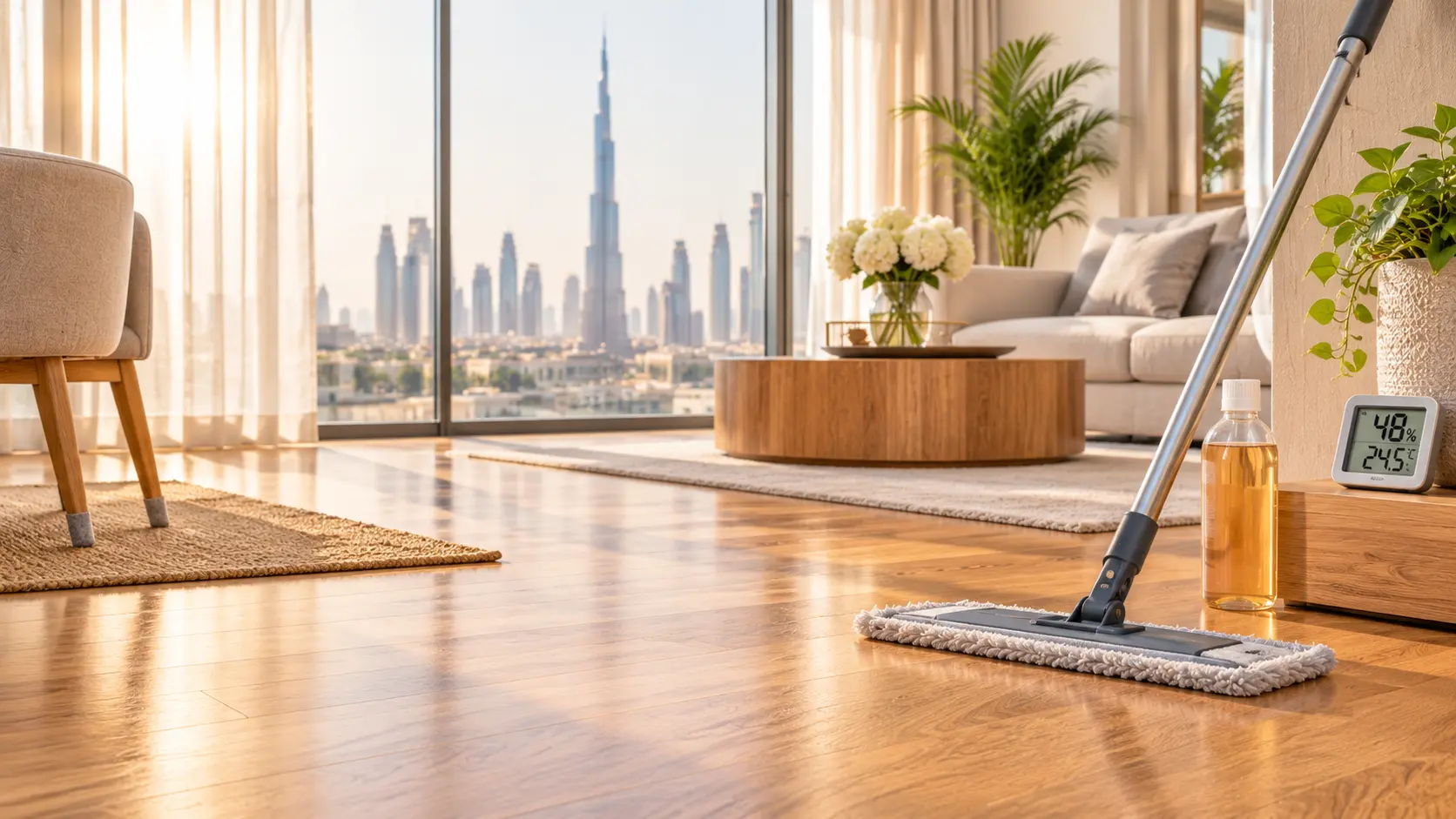
Wooden floors bring warmth to Dubai apartments, villas and offices, but the climate asks more of them than most people expect. Air-conditioned rooms run dry, summer air outside is humid, and fine dust finds its way in everywhere. Floor Concepts has supplied wood flooring Dubai homes and businesses rely on for over a decade, and this guide shares the routine we recommend: what to do daily, what to avoid, and when to call a professional. It applies to solid wood, engineered wood and parquet.
To maintain wooden flooring in Dubai, dry-dust or vacuum every few days, damp-clean weekly with a pH-neutral wood cleaner and a barely damp microfibre mop, and wipe spills straight away. Keep indoor humidity steady at roughly 30-50%, shield the floor from direct sun, sand and furniture scratches, and have a specialist inspect it once a year.
Key takeaways
- Stable humidity protects a wooden floor more than any cleaning product.
- Grit does more damage than water in Dubai, so clean dry first.
- Never use a steam mop or a soaking wet mop.
- Match your cleaner to your finish (lacquered or oiled).
- Act within minutes on leaks, including AC condensation.
Why Wooden Flooring Needs Different Care in Dubai
Wood is a natural material. It takes on moisture from the air and releases it again, and it moves slightly as it does. In Dubai the problem is rarely one extreme. It is the swing between several:
- Dry indoor air. Air conditioning can pull humidity down for months at a time, which can open small gaps between boards.
- Humid summers. Coastal communities such as Marina, JBR and Palm Jumeirah can feel noticeably more humid, and a closed, unconditioned room absorbs it.
- Fine sand and dust. It works like sandpaper under shoes and furniture, dulling the finish.
- Strong sunlight. Large glass walls and balcony doors expose floors to UV, which fades and discolours timber.
- Water from unusual places. AC drain lines, plant pots, pool-side villa entrances and balcony doors cause most of the leaks we see.
The benchmark most manufacturers use comes from the US-based National Wood Floor Association (NWFA): about 30-50% relative humidity and 16-27 C (60-80 F). It is a general guide, so always follow your own floor manufacturer’s care sheet if it differs.
Know Your Floor First: Solid, Engineered or Parquet
Care starts with knowing what is under your feet. When listings say hardwood flooring Dubai wide, they usually mean solid planks, but the three common types behave differently.
Solid wood | Engineered wood | Parquet | |
|---|---|---|---|
Construction | One piece of timber | Real wood top layer on a multi-layer base | Pieces laid in patterns such as herringbone; can be solid or engineered |
Reaction to humidity | Moves the most | More stable | Depends on build; movement shows at pattern joints |
Can it be sanded? | Usually several times | Depends on wear-layer thickness, so check the spec | Depends on thickness |
Care priority | Humidity control, timely refinishing | Gentle cleaning, avoid over-wetting | Protect joints from water, specialist polishing |
Solid wood flooring Dubai owners should treat humidity control as essential, because solid boards react most to dry AC air and humid spells. Engineered wood flooring Dubai installations are more dimensionally stable, which is one reason they are popular here, but they are not maintenance-free. The wear layer is real wood and it can still scratch, fade and swell if it gets wet.
Your Daily and Weekly Cleaning Routine
Every few days (daily near entrances): Dry-dust with a microfibre mop or vacuum with a soft brush head. Switch off any beater bar, which can scratch the finish.
Once a week, damp-clean in five steps:
- Dry-clean first. Mopping over grit grinds it into the finish.
- Use a pH-neutral cleaner made for wood, diluted exactly as the label says.
- Spray the mop pad, not the floor. Puddles are what damage joints.
- Mop with the grain in small sections.
- Check the floor dries within a minute or so. If water lingers, you used too much.
Monthly: Lift rugs and clean underneath, check felt pads on furniture, and look at sun-facing areas for fading.
What to Use and What to Avoid
Use:
- Microfibre mops and cloths
- A vacuum with a soft hard-floor head
- A pH-neutral wood floor cleaner
- A maintenance oil or polish recommended by your floor’s manufacturer
Avoid:
- Steam mops. Hot vapour forces moisture into joints, and many manufacturers advise against them.
- Soaking wet mops and buckets.
- Vinegar, bleach, ammonia and general-purpose cleaners, which can dull or strip finishes.
- Abrasive pads and scouring powders.
- Silicone-based polishes, which can stop a later recoat from bonding properly.
Know your finish. Lacquered floors have a surface film that is easy to wipe clean. Oiled floors (hard-wax oil) soak in and need oil-compatible care products, with a refresh coat every so often. Never use a product made for lacquered floors on an oiled one. If you are unsure which you have, ask the installer or check your care sheet.
Control Humidity: The Most Important Protection
A stable indoor climate does more for wooden flooring Dubai villas and apartments than any product on the shelf. Here is how to do it in practice:
- Buy a digital hygrometer (inexpensive) and keep one in your main living area. Aim for about 30-50%.
- Run the AC steadily. Big swings between very cold and off are harder on the floor than a steady, moderate setting.
- Do not switch the AC off for weeks in summer. If you travel, leave it on at a moderate setting so closed rooms do not fill with humid air.
- Below about 30%: use a humidifier in the room, especially during long AC use.
- Above about 50-60%: use a dehumidifier or improve ventilation and AC balance.
- Expect small seasonal changes. Hairline gaps in dry months that close up later are normal wood behaviour. Wide, uneven or growing gaps are not.
Protect the Floor From Sun, Sand, Furniture and Pets
- Sand: Put a mat at every entrance and keep shoes off. Dubai’s dust is the most common cause of dull, scratched finishes.
- Sun: Use curtains, blinds or UV-filtering window film on large glass. Move rugs and furniture now and then so the floor fades evenly.
- Furniture: Fit felt pads on every leg, replace them when worn, and lift rather than drag. Use wide rubber casters or a mat under office chairs.
- Rugs: Choose breathable rugs. Some rubber or vinyl backings can trap moisture or mark the finish.
- Pets: Keep nails trimmed and wipe up water-bowl spills promptly.
- Kitchens and bathrooms: Use mats by the sink and dishwasher, and wipe splashes right away.
Spills and Leaks: The First 10 Minutes
- Stop the source (turn off the tap, move the pot, switch off the leaking unit).
- Blot, do not wipe, with a dry cloth or towel, then dry the area thoroughly.
- Lift nearby rugs and items so air can reach the floor.
- Increase airflow with the AC and a fan on low. Avoid direct heat guns or hair dryers, which can crack the finish.
- Watch it for the next few days. Edges that lift or board edges that curl upwards are a cue to call a specialist before anything gets sanded or covered.
Wooden Floor Maintenance Calendar
When | What to do |
|---|---|
Every few days | Dry-dust or vacuum, entrances first |
Weekly | Damp-clean with pH-neutral wood cleaner |
Monthly | Clean under rugs, check felt pads, read your hygrometer log |
Every 3 months | Inspect high-traffic and sun-exposed areas, rotate rugs |
Yearly | Professional inspection; maintenance oil or recoat if the finish calls for it |
When finish is worn through | Sand and refinish (condition-based, not on a fixed date) |
Warning Signs and What to Do
Sign | Likely cause | What to do |
|---|---|---|
Cupping (edges higher than centre) | Moisture from below or high humidity | Find the source, stabilise humidity, call a specialist before sanding |
Gaps widening | Dry air or long AC use | Check humidity; add a humidifier; get it inspected if gaps keep growing |
Buckling or lifting boards | Significant water or very high moisture | Act urgently and call a specialist |
Dull or hazy patches | Worn finish or product residue | Stop the product; book a professional polish |
Fading or patchy colour | UV exposure | Curtains or UV film; rotate rugs |
Deep scratches | Grit or dragged furniture | Spot repair or recoat |
Recoat, Refinish or Replace?
- Dull finish, light scratches: A professional wooden polishing or screen-and-recoat refreshes the surface without removing much wood.
- Finish worn through, deep scratches, uneven colour: Full sanding and hardwood floor refinishing restores the floor, but only when enough wood remains above the tongue and groove. Solid boards usually allow it several times. Engineered boards depend on their wear layer. Hardwood flooring Dubai refinishing jobs should use dust extraction, so ask about it.
- Water-damaged or structurally failed boards: Repair or replace the affected area.
Only a floor assessment can tell you which one applies. A trusted wood flooring Dubai specialist will check wear-layer thickness and moisture before recommending sanding.
Wooden Flooring Dubai Mistakes We See Most
Wooden flooring Dubai projects that age early usually fail for the same few reasons:
- Using a steam mop or flooding the floor.
- Mopping before removing grit.
- Using household cleaners or vinegar mixes.
- Turning the AC off for long periods.
- Leaving sun-facing floors uncovered for years.
- Skipping felt pads and entrance mats.
- Using the wrong product for the finish type.
- Waiting for damage before calling a specialist.
If You Are Still Choosing a Floor
Maintenance is easier when the floor is right for the room from the start:
- Pick the construction for the space. Engineered wood flooring Dubai villas and apartments often favour is a stable choice for long AC use. Solid wood suits owners who will manage humidity closely.
- Check the wear layer of engineered boards and ask how many times it can be refinished.
- Compare finishes. Lacquer is generally easier to wipe clean; hard-wax oil is generally easier to spot-repair.
- Ask for the care guide and warranty terms in writing.
- Do not use indoor boards outdoors. For balconies and terraces, choose outdoor decking made for sun and rain.
- Insist on proper installation: subfloor moisture checks, acclimatisation where required, and correct expansion gaps.
How Floor Concepts Can Help
Whether you need new wooden flooring Dubai wide or care for an existing floor, Floor Concepts supplies and installs solid wood, engineered wood and parquet, and offers polishing and refinishing. Manufacturer warranties apply, and installation defects are covered for one year after completion. Browse our wooden flooring range, see recent projects, or visit our showroom at Oasis Mall, Level 3, Suite 103, Sheikh Zayed Road, Al Quoz 1, Dubai.
Ready to talk? Call +971 4 665 2211, email sales@floorconcepts.ae, or request a floor assessment.
Frequently Asked Questions
How often should I clean wooden floors in Dubai?
Dry-dust or vacuum every few days, and more often near entrances where sand collects. Damp-mop once a week with a pH-neutral wood cleaner and a well-wrung microfibre mop. Dust in Dubai is abrasive, so frequent dry cleaning protects the finish more than heavy mopping.
Can I use a steam mop on wooden flooring in Dubai?
No. Steam pushes heat and moisture into board joints and can damage the finish and the wood. Many manufacturers advise against steam mops on wood, and using one may affect your warranty.
What is the best humidity level for wooden floors?
The National Wood Floor Association recommends keeping indoor humidity at about 30-50% and temperature at about 16-27 C (60-80 F). Use a digital hygrometer to monitor it, and follow your floor manufacturer’s guidance if it differs.
Is engineered wood flooring easier to maintain than solid wood in Dubai?
Engineered wood is generally more dimensionally stable, so it reacts less to humidity changes. Daily cleaning is the same, and it is not maintenance-free: it still needs protection from water, grit and sun, and its wear layer limits how often it can be sanded.
How do I protect wooden floors from Dubai’s sun?
Use curtains, blinds or UV-filtering window film on large glass areas, and move rugs and furniture occasionally so the floor ages evenly. Direct sunlight can cause fading and uneven colour, especially on lighter timber.
How often should wooden floors be polished or refinished?
There is no fixed calendar. Recoat or polish when the finish looks dull or worn in traffic areas, and sand and refinish only when the finish has worn through or damage is deep. An annual professional inspection helps you catch wear early.
Should I turn the AC off when I travel?
It is safer not to switch it off for long periods in summer. Leave the AC running at a moderate setting so indoor humidity stays steady; closed, unconditioned rooms can become humid and the floor will absorb that moisture.
Why are gaps appearing between my floorboards?
Small seasonal gaps are normal when indoor air is dry, such as during long AC use, and often close as humidity rises. Check humidity with a hygrometer; if gaps are wide, uneven or keep growing, ask a flooring specialist to inspect the floor.
Can I use wooden flooring on a balcony in Dubai?
Indoor wooden flooring is not designed for exposed balconies. Use purpose-made outdoor decking, which is built for sun, rain and temperature swings, and follow its own cleaning and sealing guidance.