
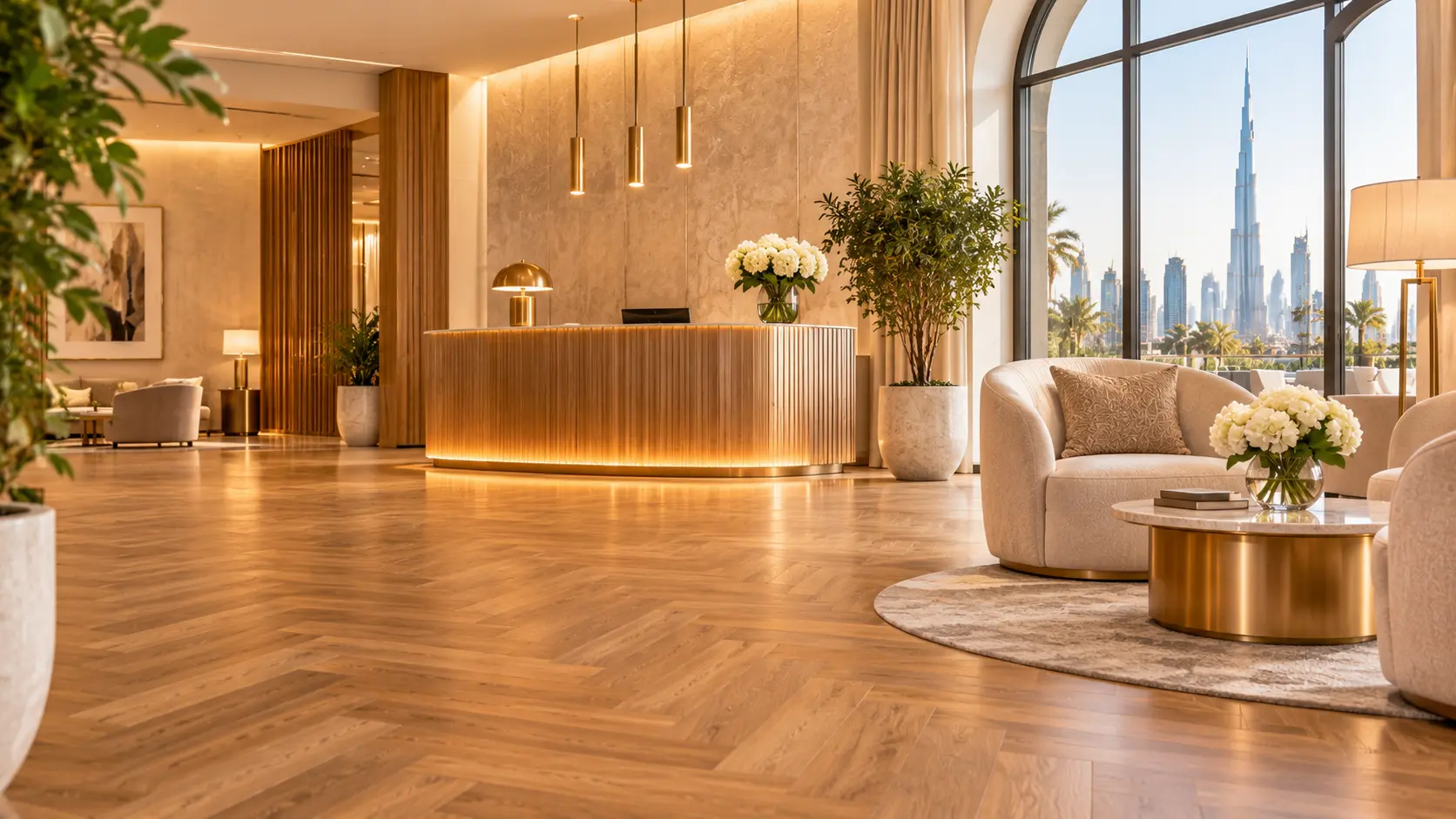
A boutique hotel sells a feeling before it sells a room. Guests notice the floor within seconds: the sound of their steps, the warmth underfoot, the way light moves across the grain. That is why commercial wood flooring remains one of the most effective materials in independent hospitality design.
But a hotel floor lives a harder life than a home floor. Luggage wheels, heels, room-service trolleys, daily machine cleaning and fine desert dust all work against the surface. In Dubai, add constant air conditioning and tight renovation schedules. That is why the build-up matters as much as the look, and why options such as engineered wood flooring, parquet wood flooring and SPC flooring each suit different parts of a hotel. This guide is for owners, designers, consultants and project managers choosing wood flooring Dubai hotels can rely on. It covers what to specify, where to use it, where not to, and how to keep it looking good for years. For the wider view across offices, retail and healthcare, read our commercial flooring in Dubai specification guide. For a deeper look at the core material, see our engineered wood flooring guide for Dubai.Quick Answer
For most boutique hotels in Dubai, the strongest choice is a commercial-grade engineered wood floor with a 3–6 mm oak wear layer, a stable multilayer core and a hard-wearing matt finish, installed over a moisture-tested subfloor. It gives guests real timber warmth, handles air-conditioning cycles better than solid wood, and can be refinished instead of replaced. Use wood-look SPC or luxury vinyl in wet or very high-abuse areas.
Key takeaways
- Specify by zone, not by hotel. Lobbies, corridors, rooms, restaurants and bathrooms each need a different floor build-up.
- Wear layer thickness, finish and subfloor moisture matter more than the species name on the sample.
- Acoustic performance and fire classification are specification items. Ask for test data early.
- Plan installation around live operations to protect room revenue.
- Choose a supplier who can show a maintenance plan, not just a catalogue.
Why Boutique Hotels Choose Wood Floors
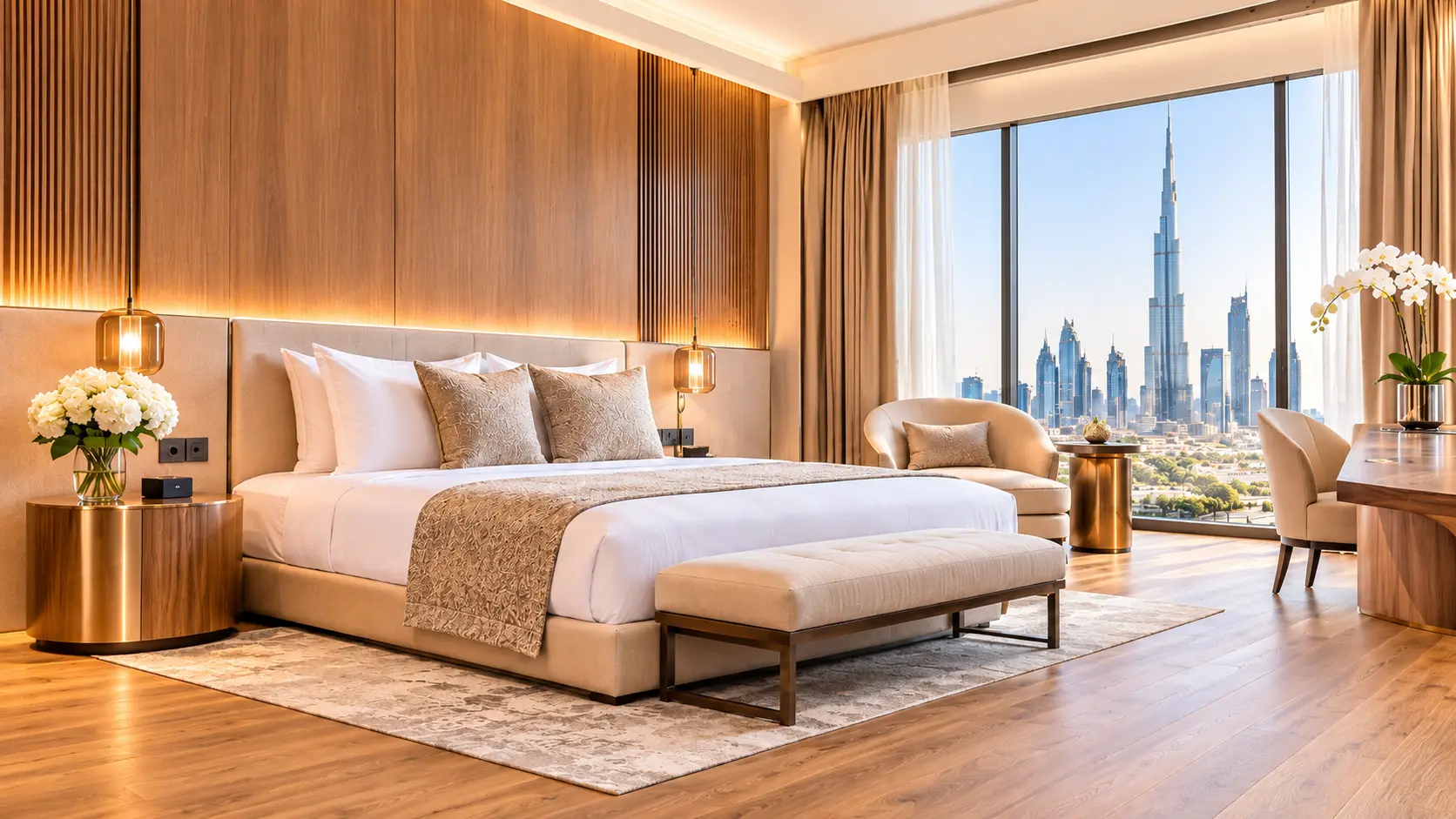 In short: wood creates continuity, warmth and perceived value, and a refinishable floor can be renewed rather than replaced.
- Identity. Natural grain and tone variation make each space feel curated. One timber story can link lobby, corridor and suite.
- Comfort. Wood feels warmer and softer underfoot than stone or porcelain, and with the right underlay it is quieter.
- Perceived value. Hotel interiors are photographed constantly. Warm timber tends to read as high-end on camera and in person.
- Lifecycle. A floor with a thick enough wear layer can be sanded and refinished, which spreads its cost over more years.
What Makes Commercial Wood Flooring Different from Residential?
In short: commercial wood flooring is specified for heavier traffic, defined maintenance and compliance requirements, not just appearance.| Factor | Typical residential floor | Boutique hotel floor |
|---|---|---|
| Traffic | Low to moderate | Continuous, with luggage and trolleys |
| Wear layer | Often 2–3 mm | 3–6 mm preferred where refinishing is planned |
| Finish | Light-use oil or lacquer | Hardened matt lacquer or hard-wax oil with a set maintenance schedule |
| Installation | Floating is common | Full-bond glue-down is common for stability and lower hollow sound |
| Warranty | Often longer | Commercial terms are often shorter and conditional on maintenance. Read them. |
| Compliance | Owner preference | Fire, slip, acoustic and brand standards |
Best Wood Floor Types for Boutique Hotels in Dubai
In short: engineered oak and engineered parquet suit most guest-facing areas. Wood-look SPC or LVT suits wet and back-of-house zones.| Floor type | Look | Stability in Dubai | Refinishable | Best areas | Watch-outs |
|---|---|---|---|---|---|
| Engineered oak (multilayer) | Real oak surface, wide planks | High | Yes, depends on wear layer | Lobbies, rooms, corridors, lounges | Needs a moisture-tested subfloor |
| Engineered parquet (herringbone, chevron) | Classic, design-led | High when glued down | Yes, typically 3 mm+ wear layer | Reception, suites, lounges | Higher labour cost, needs skilled fitters |
| Solid wood | Authentic, long-lived | Lower, more sensitive to humidity swings | Many times | Controlled interiors, feature areas | Gapping or cupping if humidity is unstable |
| Wood-look SPC / LVT | Convincing timber look | Very high, water-resistant | No (surface limited) | Bathrooms, wet zones, back-of-house | Not real wood |
| Laminate | Budget wood look | Moderate | No | Back-of-house only | Edge swelling if wet |
Which Floor Suits Each Area of a Boutique Hotel?
| Area | Recommended | Why it works |
|---|---|---|
| Entrance and lobby | Engineered parquet or wide-plank oak, plus walk-off matting | Highest wear. Grit from outside scratches finishes. |
| Reception and lounge | Engineered oak, herringbone or chevron | Statement areas where design matters most |
| Corridors | Glue-down engineered oak with acoustic underlay, or wood-look SPC | Trolleys and noise transfer to rooms |
| Guest rooms | Engineered oak planks | Warm, quiet, and easy to keep clean |
| Bathrooms and wet rooms | SPC, LVT or tile, not real wood | Standing water damages timber |
| Restaurant and bar | Hard-finish oak or wood-look SPC | Spills, chair movement |
| Pool deck and terraces | Outdoor decking | UV, heat and slip resistance |
| Back-of-house | Homogeneous vinyl | Heavy cleaning and durability |
Guest Comfort: Sound, Safety and Air Quality
In short: a hotel floor must be quiet, safe underfoot and low-emission, as well as attractive.- Acoustics. Hard floors bounce sound, and footfall noise into the room below is a common complaint. Specify an acoustic underlay or membrane with a tested impact-sound rating, and check it against your hotel brand standard and project specification. Rugs in suites and felt on furniture help too.
- Slip safety. Polished or glossy finishes can be slippery when wet. For entrances and areas near pools, ask for slip-resistance test data and choose a matt or brushed finish.
- Air quality. Ask for emission data on boards, finishes and adhesives (such as E1 formaldehyde class) and prefer low-VOC systems.
- Cleanliness. Smooth, sealed floors are easier to clean than carpet, but only if the finish is intact.
Wooden Flooring Dubai: Climate, Moisture and Subfloor Rules
In short: wood floors succeed or fail on moisture control, not species.- Keep the air-conditioning on. Wood moves with humidity. Check your product data sheet for the stable humidity range, and keep AC running during installation and in vacant rooms. Switching it off between bookings is a common cause of gaps and cupping.
- Test the slab. New concrete and screed can hold moisture. Use a calibrated test method and follow the adhesive and floor manufacturer’s limits, with a written report.
- Check flatness. Poor levels cause hollow spots, noise and joint stress. Level before you lay.
- Acclimatise as instructed. Follow the manufacturer’s guidance for storing boards on site.
- Protect against leaks. Seal thresholds near bathrooms and balconies, and avoid wet mopping.
- Control dust. Fine sand acts like sandpaper. Use entrance matting and daily dust control.
Design: Pattern, Tone and Finish
- Pattern. Herringbone or chevron adds heritage to lobbies. Wide planks calm smaller rooms. Running planks along a corridor lengthens the view.
- Tone. Mid-tone natural oak with gentle colour variation hides dust, scratches and footprints better than very dark or very pale floors.
- Finish. Matt or ultra-matt finishes cut glare and hide micro-scratches. High gloss shows every mark.
- Lacquer vs oil. Lacquer forms a protective film and needs less routine care, but local repair is harder. Hard-wax oil is easier to spot-repair and renew, but needs a scheduled maintenance routine.
- Brand colour. Custom stains and finishes can match your palette. Approve them in a full-size room mock-up under the room’s real lighting, not from a small sample.
Specification Checklist for Hotel Wood Flooring
- Wear layer thickness, species and grade
- Core construction and total thickness (check door thresholds and lift-lobby levels)
- Finish system and abrasion data
- Installation method and adhesive approved for commercial use
- Acoustic underlay rating
- Fire reaction classification as required by your consultant and local authorities. Ask for test certificates.
- Slip resistance by zone
- FSC or PEFC certified timber and low-emission materials
- Commercial warranty terms and conditions
- Batch consistency and spare stock (typically 5–10% extra, more for herringbone)
- Approved sample and room mock-up
Installing Wood Floors in a Live or Phased Hotel
- Phase by wing or floor so rooms return to inventory in planned blocks.
- Schedule noisy prep (grinding, levelling) for low-occupancy periods, with dust extraction.
- Respect adhesive curing and odour. Keep adjacent rooms closed and limit heavy traffic until the adhesive manufacturer’s cure time has passed.
- Book lifts and loading bays for deliveries outside peak hours.
- Protect finished floors with breathable covering until handover.
- Snag properly. Check expansion gaps, transitions, edge details and levels before sign-off.
Maintenance and Long-Term Performance
- Daily: dust mop or microfibre pad, and keep walk-off mats clean.
- Cleaning: damp (not wet) mopping with a pH-neutral cleaner approved for the finish. No steam mops.
- Periodic: machine cleaning with approved products in lobbies and corridors.
- Maintenance coats: in high-traffic zones, a screen-and-recoat every few years (depending on traffic and finish) restores protection without full sanding.
- Refinishing: when the finish and surface wear through, a professional sanding and polishing service can renew the floor if the wear layer allows.
- Furniture: felt pads and quality glides on every chair and table.
Common Mistakes to Avoid
- Specifying a residential board because it carries a “commercial” sticker
- Skipping the slab moisture test
- Switching off AC in vacant rooms
- Using real wood in wet zones
- Choosing a very dark or glossy floor for a high-traffic lobby
- Leaving acoustic underlay until guests complain
- Approving from a small sample instead of a room mock-up
- No entrance matting and no maintenance plan
- Under-ordering stock, which leads to mismatched batches later
How to Choose a Wood Flooring Company Dubai Hotels Can Trust
A reliable wood flooring company Dubai hospitality projects can depend on should supply, prepare, install and support the floor after handover. Ask these questions:- Can they show completed commercial or hospitality installations you can verify?
- Will they test the subfloor and give you a written report?
- Which products are approved for commercial use, and what does the warranty actually cover?
- Can they build a mock-up room before full delivery?
- Is installation phased, supervised and done by trained fitters?
- Is after-care available, including refinishing and defect liability?
- Can one supplier cover wood, SPC, vinyl, homogeneous and decking for single-point accountability?
Plan Your Boutique Hotel Flooring with Floor Concepts
Floor Concepts is a premium flooring supplier and installation company in Dubai. Our range covers engineered wood, solid wood, parquet, SPC, luxury vinyl, laminate, homogeneous, sports flooring, outdoor decking and wall coverings, plus floor sanding and polishing. Whether you need commercial wood flooring for a new boutique property, wood flooring Dubai specialists for a phased refurbishment, or a single partner for complete flooring Dubai projects, our team can help you compare options and plan the installation.- Showroom: Oasis Mall, Level 3 offices, Suite 103, Sheikh Zayed Road, Al Quoz 1, Dubai
- Phone: +971 4 665 2211
- Email: sales@floorconcepts.ae
- Download our catalogues or speak to our team for a site assessment and wooden flooring Dubai quotation.