
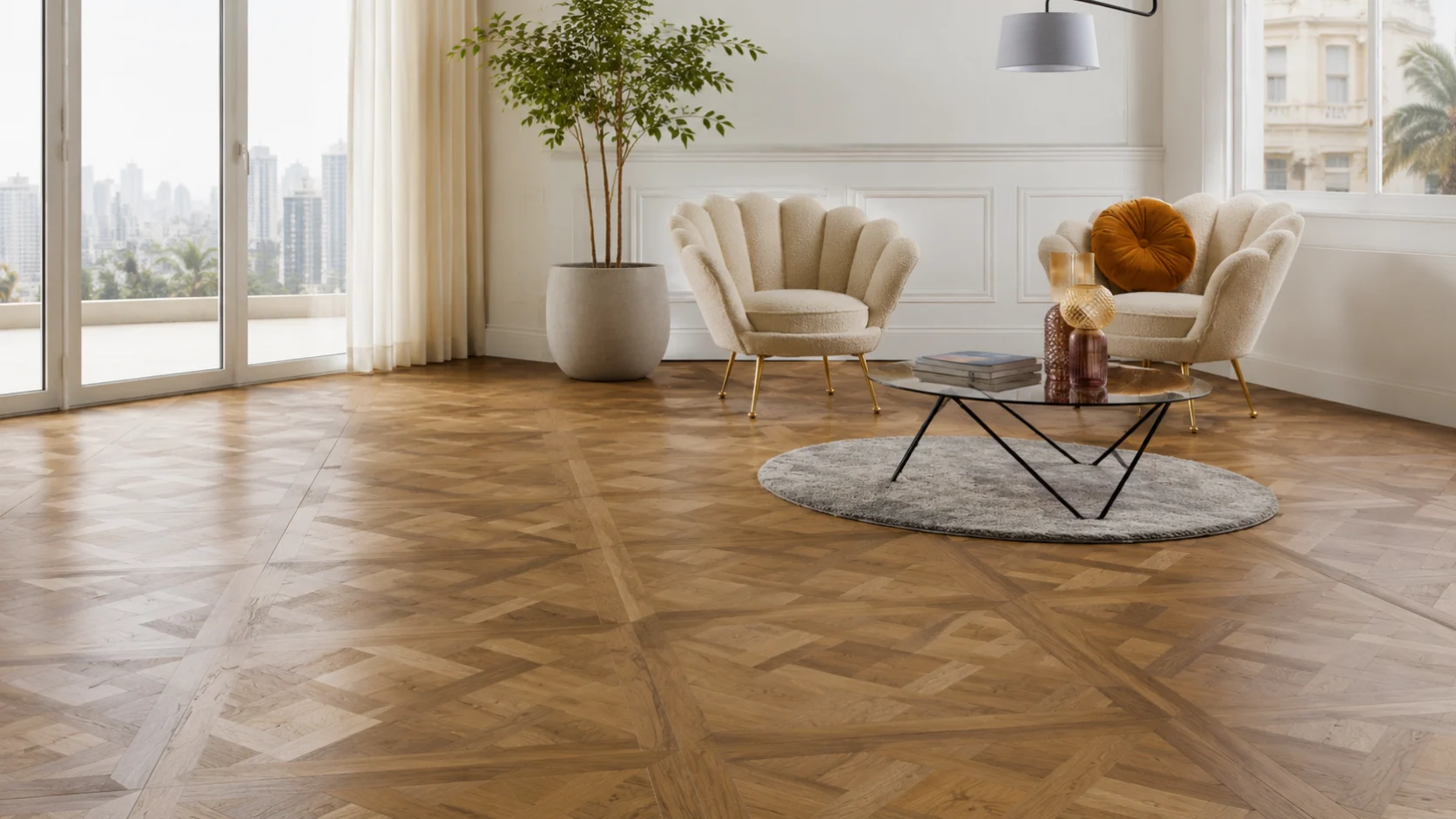
Solid wood flooring installation in Dubai is beautiful, but this is not a forgiving climate for it. Outdoor humidity can swing from under 30% in winter to over 80% in summer, while indoor air-conditioned rooms often sit at 40–50% humidity year-round. That gap between outside and inside air is exactly what causes wood to expand, contract, cup, or gap.
This guide explains exactly why Dubai’s climate is hard on solid wood, where it genuinely works, where it doesn’t, and how a proper solid wood flooring installation avoids the problems that give this material a bad reputation in the UAE.
Is Solid Wood Flooring Suitable for Dubai’s Climate?
Yes—but only under the right conditions. Solid wood flooring can work in Dubai, but only in climate-controlled interiors, with the right wood species, proper acclimation, and a moisture-management plan.
Expert Tip:
It is not the safest choice for every room, every property, or every budget. Any supplier who recommends solid wood without asking about your AC habits, subfloor, and room usage isn’t giving you the complete picture.
Why Dubai’s Climate Is Tough on Solid Wood
Wood is a natural, porous material. It absorbs and releases moisture from the surrounding air until it reaches a balance point called Equilibrium Moisture Content (EMC). When the air around it changes, the wood tries to catch up — and that movement is where problems start for wooden flooring Dubai homeowners often don’t anticipate.
In Dubai, three factors combine to make this worse than almost anywhere solid wood flooring traditionally comes from:
- Extreme humidity swings. Summer humidity outdoors regularly exceeds 80–90%, while AC-cooled indoor air can drop to 35–45%. Solid wood installed without accounting for this will keep moving long after installation day.
- Aggressive air conditioning. Dubai homes run AC almost year-round. Cold, dry, conditioned air pulls moisture out of wood faster than in milder climates, which is the main cause of shrinkage and gapping between planks.
- Direct sun exposure. UAE sunlight is intense. Rooms with large, unshaded windows can see localized heat and UV fading that ordinary wood flooring in temperate climates rarely experiences.
The visible results, when solid wood is installed without proper precautions, are:
- Gapping — planks shrink and pull apart as indoor air dries out in AC-heavy months.
- Cupping — plank edges rise higher than the centre when moisture is absorbed unevenly, often from below via a damp subfloor.
- Crowning — the opposite of cupping, where the centre rises, usually from over-sanding a previously cupped floor or from a moisture spike.
- Surface checking — fine cracks in the wood surface from rapid drying.
None of this means solid wood is impossible in Dubai. It means it needs to be treated as a climate-sensitive material, not a drop-in product.
So — Is It Actually Suitable? The Honest Verdict
Yes, with conditions. Solid wood flooring Dubai homeowners choose performs well when three things are true at the same time:
- The room has consistent, reliable air conditioning — not intermittent cooling, not a villa left empty for weeks with the AC off.
- The wood is properly acclimated and installed by a team that understands local humidity behaviour, not just generic international installation standards.
- The room use fits solid wood’s limits — living rooms, bedrooms, studies, and formal dining areas are good candidates; bathrooms, kitchens near water sources, laundry rooms, balconies, and any semi-outdoor space are not.
If any of those three conditions can’t be met, engineered wood flooring is the more sensible choice — it uses a cross-layered core that resists movement far better while still using a genuine hardwood wear layer on top, so you don’t lose the authentic look.
Who Should Choose Solid Wood in Dubai
- Villa owners with stable, whole-home climate control and no plans to leave the AC off for extended periods
- Buyers who specifically want the ability to sand and refinish a floor many times over decades
- Formal living areas, bedrooms, and studies where humidity is easiest to control
- Long-term residents who intend to stay in the property and value authenticity over lowest-maintenance convenience
Who Should Choose Engineered Wood Instead
- Apartment owners with shared or less consistent AC systems
- Rental properties, holiday homes, or villas left unoccupied for weeks at a time
- Budget-conscious buyers who still want a genuine wood surface
- Kitchens, family rooms with higher humidity exposure, or homes near the coast
| Factor | Solid Wood Flooring | Engineered Wood Flooring |
|---|---|---|
| Climate Stability | Sensitive to humidity changes; requires consistent air conditioning. | Cross-layered construction provides better dimensional stability. |
| Best Rooms | Bedrooms, living rooms, and studies with reliable AC. | Suitable for almost any room, including areas with moderate humidity. |
| Refinishing | Can be sanded and refinished approximately 4–6 times. | Usually refinished 1–3 times depending on veneer thickness. |
| Typical Lifespan (Dubai) | 20–40+ years with proper care and stable indoor conditions. | 20–30+ years and generally more forgiving of climate changes. |
| Indicative Cost | Higher investment (around AED 120–240+ per sqm, excluding installation). | Generally lower material cost while offering a similar finished appearance. |
| Risk if AC Fails | High risk of gaps, cupping, or movement if AC is off for long periods. | Lower risk, though some movement can still occur. |
| Authenticity | 100% solid hardwood throughout each plank. | Real hardwood top layer bonded to a high-performance engineered core. |
Costs vary by wood species, plank thickness, finish, and project size — treat the figures above as a planning range, not a fixed quote.
How a Proper Solid Wood Flooring Installation Works in Dubai
A correct solid wood flooring installation follows a specific sequence — and this is the part most guides skip. It’s also the part that actually determines whether your floor lasts 30 years or starts gapping within one summer.
1. Site and Subfloor Assessment
Before any wood arrives, the subfloor should be checked for moisture content and levelness. A concrete slab that’s still curing or has rising damp will transfer that moisture straight into solid wood planks, regardless of how well the wood itself was prepared.
2. AC Stabilisation Before Delivery
The room’s air conditioning should be running consistently for several days before the wood is delivered, so the space reaches the humidity level it will maintain long-term (generally 40–60% relative humidity for solid wood in Dubai interiors).
3. Acclimation
Once delivered, the wood needs to sit — ideally for a minimum of 5–7 days — inside the actual room where it will be installed, with packaging opened, so the planks can adjust to that room’s specific temperature and humidity before fitting begins. Skipping or shortening this step is the single most common cause of post-installation gapping.
4. Moisture Barrier Installation
A proper solid wood flooring installation always includes a moisture-control step on concrete subfloors: a dedicated underlay (foam, felt, or vapour barrier) goes down first to block moisture migration from the slab into the wood.
5. Expansion Gaps
Solid wood needs a perimeter expansion gap — typically 10–15mm, covered later by skirting or beading — to give the planks room to move seasonally without buckling.
6. Fixing Method
Nail-down or glue-down methods are generally preferred for solid wood in this climate over floating installations, since they hold the planks more firmly against movement.
7. Finishing and Sealing
A quality finish (oil or lacquer) slows moisture exchange through the surface. Edges, especially around door thresholds and skirting, should be properly sealed.
Maintaining Solid Wood Flooring in Dubai’s Climate
- Keep humidity steady. Aim for 40–60% indoor relative humidity year-round — a small hygrometer is a worthwhile AED 30–50 investment to monitor this.
- Never leave AC off for long stretches. If you travel, ask someone to keep the home ventilated or set AC to a maintenance temperature rather than switching it off completely.
- Sweep or vacuum regularly to remove the fine sand and dust that Dubai air carries indoors — it’s abrasive on any wood finish.
- Damp-mop only, never wet-mop. Standing water is one of the fastest ways to cause cupping.
- Use furniture pads and rugs in high-traffic zones, and avoid dragging heavy furniture across the surface.
- Protect from direct sun with UV-filtering window film or curtains in rooms with large glass exposure, to reduce fading and localized drying.
- Plan refinishing every 8–12 years depending on wear, rather than waiting until damage is severe.
Common Mistakes We See in Dubai Homes
- Installing wood the same day it’s delivered, without acclimation — the #1 cause of early gapping.
- Choosing solid wood for a kitchen or a balcony-adjacent room where moisture exposure is higher than the material can handle.
- Leaving a villa unoccupied with the AC off for weeks during summer travel, causing rapid humidity spikes.
- Ignoring subfloor moisture testing before installation, especially in newer buildings where concrete may still be curing.
- Buying on price alone from suppliers who don’t ask about your AC setup, room usage, or occupancy patterns before recommending solid wood.
- Hiring inexperienced crews for flooring installation Dubai projects, who follow generic international guidelines instead of accounting for local humidity swings.
The Bottom Line
Solid wood flooring isn’t automatically wrong for Dubai — it’s simply a material that demands respect for the local climate. In a well-conditioned villa bedroom or living room, installed by a team that acclimates the wood properly and manages humidity from day one, it can genuinely last for decades. In a rental apartment with inconsistent AC or a room exposed to moisture, it’s setting yourself up for problems that no amount of maintenance will fully solve.
If you’re weighing solid wood against engineered wood, SPC, or laminate for your specific property, Floor Concepts LLC offers free site assessments across Dubai — including subfloor moisture checks — before recommending a flooring system, not after you’ve already bought the wrong one.
Ready for a professional solid wood flooring installation in Dubai? Get a free consultation and site visit from Floor Concepts LLC — a trusted wood flooring company Dubai clients rely on for supply and installation across villas, apartments, and commercial spaces.
Frequently Asked Questions
Is solid wood flooring suitable for Dubai apartments?
It can work in apartments with consistent, well-maintained air conditioning, but engineered wood is generally the safer choice for apartments with shared building AC systems or less predictable humidity control.
What humidity level is best for solid wood flooring in Dubai?
Most solid wood species stay stable when indoor relative humidity is kept between 40% and 60% year-round. Consistently lower or higher levels increase the risk of gapping or cupping.
How long does solid wood flooring last in Dubai?
With proper acclimation, installation, and consistent climate control, solid wood flooring can last 20 to 40+ years and be refinished multiple times over that period.
Can solid wood flooring be installed in a Dubai villa with central AC?
Yes — villas with reliable, whole-home central air conditioning are generally the best-suited properties for solid wood flooring in the UAE, provided the home isn’t left without cooling for extended periods.
Is engineered wood better than solid wood for Dubai’s climate?
Engineered wood is more dimensionally stable because of its cross-layered core, making it more forgiving of humidity fluctuations. Solid wood offers a longer refinishing life and full authenticity, but requires stricter climate control to perform equally well.
How much does solid wood flooring installation cost in Dubai?
Material and installation costs typically range from around AED 120 to AED 240+ per square metre depending on wood species, plank thickness, and finish — get a site-specific quote, since subfloor condition and project size affect the final price.
Where should I avoid installing solid wood flooring in a Dubai home?
Avoid bathrooms, kitchens near water sources, laundry rooms, balconies, and any semi-outdoor or high-humidity area. These spaces are better suited to SPC, vinyl, or tiled flooring.