
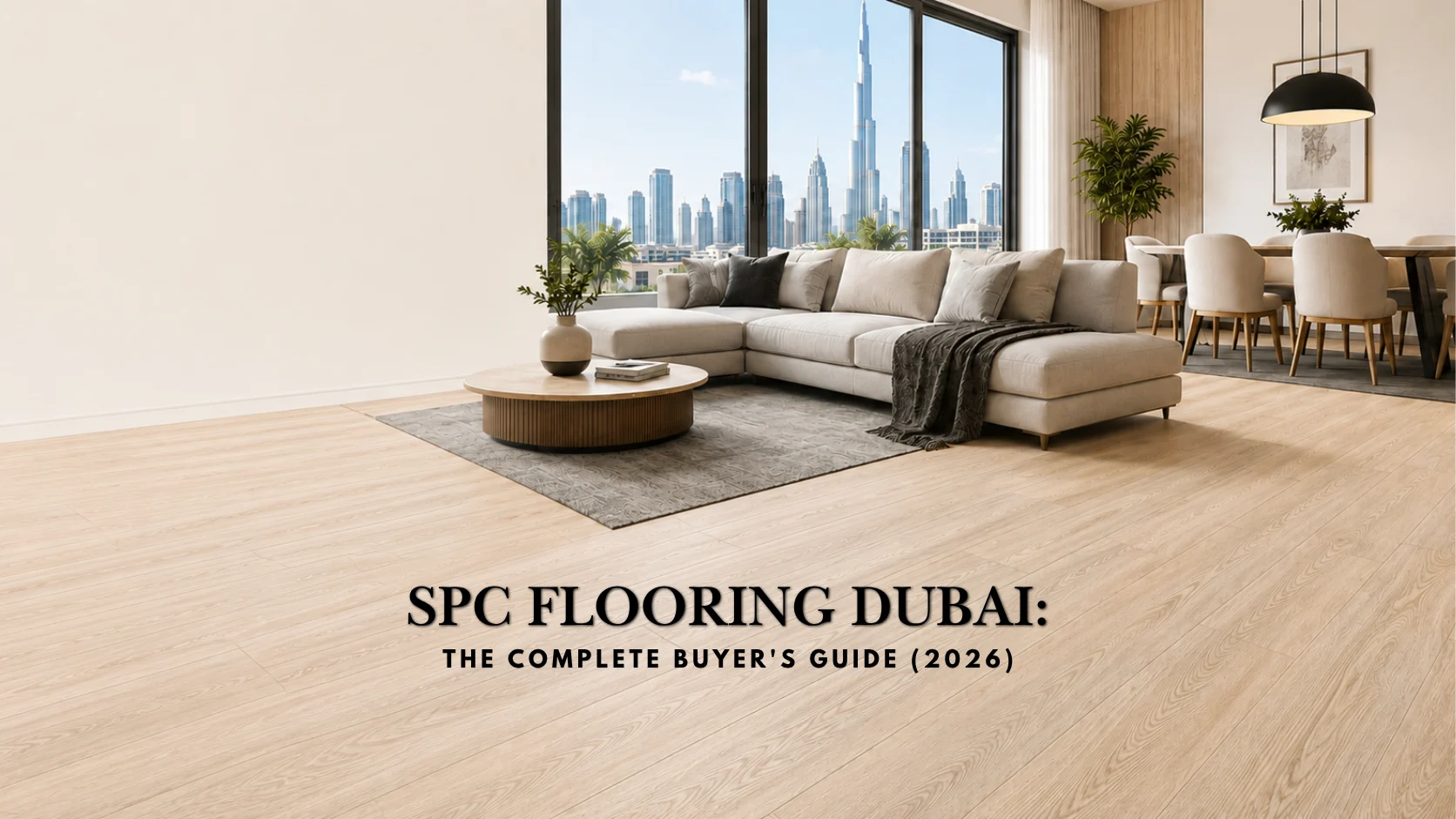
If you’re renovating a Dubai apartment, villa, or commercial space and someone has mentioned SPC flooring, you’re probably wondering what it actually is – and whether it’s genuinely better for this climate, or just well-marketed.
This guide answers both questions honestly. It covers what SPC flooring is, why it has become one of the most popular choices in Dubai over the past few years, what separates a good product from a cheap one, and what to expect on price and installation.
What Is SPC Flooring? (A Straightforward Definition)
SPC flooring – Stone Plastic Composite – is a rigid-core vinyl flooring made from a blend of limestone powder, polyvinyl chloride (PVC), and stabilisers. The limestone core is what separates it from regular vinyl or laminate. It gives SPC its characteristic stiffness, dimensional stability, and near-total resistance to water.
Unlike traditional vinyl, which has some flex, SPC does not bend, buckle, or hollow underfoot. Unlike laminate, it cannot swell or delaminate if moisture gets underneath. And unlike solid hardwood, it does not expand or contract meaningfully when temperatures shift – which is a significant advantage in a city where interiors swing between 20°C air conditioning and 45°C ambient heat.
The typical SPC plank has four layers:
- Wear layer– a transparent topcoat that protects against scratches, stains, and UV fading
- Decorative layer– a high-resolution print that replicates wood grain, stone, or concrete
- SPC core– the limestone-polymer composite that provides rigidity and waterproofing
- Underlayment– usually IXPE foam, attached to the back for cushioning and sound reduction
The result is a floor that looks convincingly like wood or stone but performs like neither – it outperforms both in moisture and durability while sitting well below both in price.
Why SPC Flooring Has Taken Off in Dubai
Dubai’s residential and commercial flooring market has shifted noticeably toward SPC over the past three to four years. The reasons are practical rather than trend-driven.
Temperature stability. Dubai’s interior environments are demanding. Rooms go from air-conditioned at 20°C to warm when the AC is off, or when a space is not yet cooled after construction. Traditional laminate expands and contracts with these swings, eventually gapping or buckling. Engineered wood handles it better, but is not immune. SPC’s dimensional stability means it simply does not move – a meaningful advantage for both installers and building owners.
100% waterproof core. SPC is genuinely waterproof, not just water-resistant. The stone-polymer core absorbs no moisture. This makes it appropriate for kitchens, bathrooms, laundry rooms, and high-humidity zones without any additional waterproofing treatments.
Durability under foot traffic. A quality SPC floor with a 0.5mm or thicker wear layer performs well in high-traffic residential spaces and light-to-medium commercial environments – retail units, clinics, serviced apartments, co-working spaces. It handles sand, grit, and shoe traffic without the surface degradation you’d see in cheaper vinyl.
Installation economics. SPC’s click-lock system means it floats over most existing subfloors – including existing tiles – without adhesive or nails. In Dubai, where renovation costs include labour and downtime, the speed and flexibility of SPC installation is a genuine financial benefit.
Price relative to alternatives. Quality SPC in Dubai typically costs less per square metre than engineered wood, significantly less than solid wood or parquet, and more than basic vinyl. For landlords, developers, and renovation projects where durability matters but budget is fixed, SPC sits in a persuasive middle position.
SPC Flooring vs Other Flooring Options in Dubai
Understanding SPC is easier alongside the alternatives most Dubai buyers consider.
| SPC Flooring | Engineered Wood | Vinyl (LVP) | Laminate | Porcelain Tile | |
| Waterproof | ✓ Fully | Partial | ✓ Fully | ✗ No | ✓ Fully |
| Heat/AC stable | ✓ Excellent | Good | Good | Poor | ✓ Excellent |
| Underfoot comfort | Moderate | Good | Good | Moderate | Hard/Cold |
| Realistic wood look | Very good | Real wood | Good | Good | Moderate |
| Price range (AED/m²) | 45–120 | 150–350+ | 35–90 | 40–90 | 60–200+ |
| Lifespan | 15–25 years | 25–50 years | 10–15 years | 10–15 years | 30–50 years |
| Suitable for wet rooms | ✓ Yes | Limited | ✓ Yes | ✗ No | ✓ Yes |
A few things this table does not capture: engineered wood feels and sounds noticeably different underfoot – warmer, more resonant. SPC is harder and slightly cooler. For luxury villas and owner-occupied residences where the premium feel justifies the cost, engineered wood or parquet is still the stronger choice. For rentals, family homes, offices, and commercial builds where durability and maintenance simplicity matter more, SPC is difficult to argue against.
How to Choose the Right SPC Flooring for Dubai
Not all SPC is equal. The Dubai market includes a wide range of products at very different quality levels, and it’s worth knowing what specifications to compare.
Wear Layer Thickness
The wear layer is the transparent topcoat that takes all the daily damage. Thicker is better.
- 2–0.3mm– residential light use; adequate for bedrooms, low-traffic rooms
- 3–0.5mm– residential standard; suitable for most family homes
- 5mm+– residential heavy use and light commercial; recommended for kitchens, hallways, rental properties
- 7mm+– commercial grade; for offices, retail, clinics
If a supplier quotes a low price and does not mention the wear layer, ask. Cheap SPC flooring Dubai often cuts corners here.
Total Thickness
SPC planks in Dubai typically range from 4mm to 8mm total thickness. Thicker planks feel more solid underfoot and are better at hiding minor subfloor imperfections. For most residential applications, 5–6mm is the standard. For commercial spaces or uneven subfloors, 6–8mm gives more tolerance.
Core Quality
The limestone core density matters. Higher-density cores are more dimensionally stable and dent-resistant. Unfortunately, this is harder to compare from a spec sheet – which is why buying from a supplier who carries established brands or can show testing certificates is worth the effort.
Finish and Embossing
A flat print looks noticeably less realistic than an embossed finish where the texture follows the grain or stone pattern. Look for “embossed in register” (EIR) finishes if realism matters to you. This matters most in living rooms and entryways where the floor is seen close up.
SPC Flooring Prices in Dubai: What to Expect
Prices vary based on wear layer, thickness, brand, and whether installation is included.
Supply only (per m², approximate):
- Budget range: AED 40–65
- Mid-range: AED 65–100
- Premium: AED 100–150+
Supply and installation (per m², approximate):
- Add AED 15–30/m² for professional installation depending on project complexity and access
As a rough guide, a 100m² apartment flooring project using mid-range SPC with professional installation typically lands between AED 8,000–13,000 all-in. That figure shifts based on whether skirting, subfloor preparation, or removal of existing flooring is required.
A note on very low quotes: SPC flooring priced below AED 40/m² exists in the Dubai market. It often cuts corners on wear layer thickness, core density, or both. For rental properties or short-term projects this may be acceptable. For owner-occupied homes or commercial spaces expecting years of service, it is usually a false economy.
SPC Flooring Installation in Dubai: What the Process Looks Like
A professional SPC flooring installation in Dubai follows a consistent sequence regardless of the supplier:
- Subfloor assessment. The installer checks for levelness, dips, and moisture. SPC tolerates minor imperfections better than engineered wood but still requires a reasonably flat base – typically within 3mm variance over 1.8 metres.
- Acclimation. Planks are left in the room for 24–48 hours to reach ambient temperature. Dubai’s temperature differentials make this worth respecting.
- Underlay (if not pre-attached). If the SPC product does not have an attached IXPE underlayment, a thin foam layer is laid first.
- Click-lock installation. Planks lock together without adhesive, floating over the subfloor. Expansion gaps of approximately 8–10mm are maintained around the perimeter – important in Dubai’s AC-heavy environments.
- Skirting and trim. Baseboards or skirting are reinstalled to cover expansion gaps and finish the edges.
A standard Dubai apartment of 80–100m² can typically be floored in one to two days by an experienced crew.
Can SPC be installed over existing tiles? In most cases, yes. The subfloor must be level and no tiles should be loose. This saves significant demolition cost – a meaningful advantage in occupied properties.
SPC Flooring Maintenance in Dubai
One of SPC’s practical advantages is that maintenance is straightforward.
- Daily: Sweep or vacuum to remove sand and grit. In Dubai, this matters – sand tracked in from outdoors is one of the main sources of surface micro-scratches over time.
- Weekly: Damp mop with a mild, pH-neutral floor cleaner. Avoid excessive water pooling, not because the SPC will absorb it, but because water can get into seams and sit under planks.
- Avoid: Steam mops, harsh chemical cleaners, or abrasive scrubbing pads.
- Furniture: Use felt pads under chairs and tables. Heavy furniture dragged across SPC will scratch the wear layer, regardless of its thickness.
SPC does not require sealing, waxing, refinishing, or periodic treatments of any kind. This simplicity is one of the reasons it appeals to landlords and property managers across Dubai.
FAQs About SPC Flooring in Dubai
What does SPC stand for in flooring?
SPC stands for Stone Plastic Composite – referring to the rigid core made from a blend of limestone powder, PVC, and stabilisers. The limestone gives the floor its rigidity and waterproof properties.
Is SPC flooring good for Dubai’s climate?
Yes. SPC is one of the most appropriate flooring materials for Dubai’s climate specifically because of its dimensional stability – it does not expand, contract, or warp under temperature changes between air-conditioned interiors and outdoor heat. It is also fully waterproof, which addresses humidity concerns.
How much does SPC flooring cost in Dubai?
SPC flooring in Dubai typically ranges from AED 45 to AED 120 per square metre for supply only, depending on thickness, wear layer quality, and brand. Professional installation adds approximately AED 15–30 per square metre.
How long does SPC flooring last?
With proper care and a wear layer of at least 0.3mm, residential SPC flooring in Dubai typically lasts 15 to 25 years. Commercial installations with thicker wear layers can last 10–20 years under heavier traffic.
Can SPC flooring be installed in bathrooms and kitchens in Dubai?
Yes. SPC is fully waterproof and appropriate for wet areas including bathrooms, kitchens, and laundry rooms. The stone core does not absorb moisture, making it more reliable in these environments than laminate or solid wood.
What is the difference between SPC and LVP?
LVP (Luxury Vinyl Plank) is flexible vinyl with a printed surface. SPC is a rigid-core product with a stone-composite base. SPC is harder, more dimensionally stable, and performs better under temperature fluctuations. LVP is softer underfoot and tends to be slightly less expensive, but less stable in Dubai’s heat.
Can SPC flooring be installed over existing tiles?
In most cases, yes – provided the tiles are firmly fixed, the surface is level, and there are no raised edges. This avoids demolition costs and is a common approach in Dubai renovation projects.
Is SPC flooring eco-friendly?
SPC flooring typically contains PVC, which is a synthetic polymer. Some SPC products carry low-VOC certifications (FloorScore, GREENGUARD) that indicate low chemical emissions, which matters for indoor air quality. Full lifecycle sustainability, however, is not SPC’s strongest argument – that is better made for FSC-certified engineered wood. If environmental credentials matter to your project, ask specifically about certifications.
Pingback: SPC Flooring Dubai: Realistic Lifespan, Wear & Care