
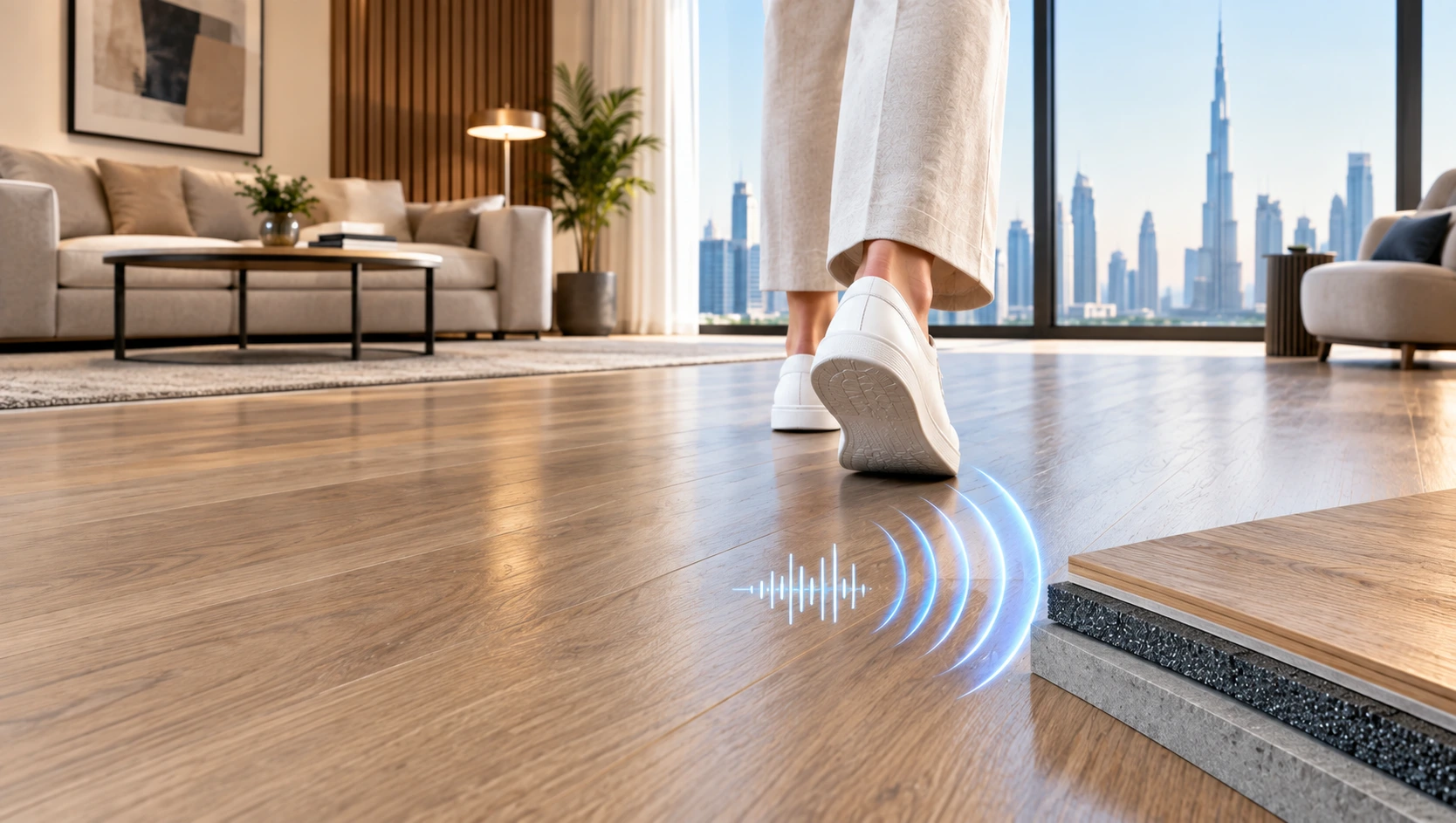
If you’ve ever heard every footstep from the apartment above, or had a hotel guest complain about noise from the room next door, the floor build-up is usually the reason — not the walls. It’s one of the most common calls we get at Floor Concepts: someone has already tried rugs, felt pads, or a new mattress upstairs, and the noise is still there, because none of those actually address how impact noise moves through a concrete slab.
Dubai’s building stock makes this worse than in many other cities. Almost every apartment tower here is built on reinforced concrete floors with no timber joist cavity to soak up vibration, so footsteps, dragged chairs, and dropped objects carry through to the unit below far more efficiently than they would in lower-rise timber-frame construction. That’s before you factor in open-plan offices with hardwood flooring and glass partitions, or hotels where a single noisy guest room can show up in next-day reviews.
The good news is that this is a solvable problem, and it doesn’t require breaking into the ceiling below or rebuilding a wall. The fix lives almost entirely in how the floor itself is built — which finish flooring you choose, which acoustic underlay sits beneath it, and how it’s installed. In this guide, we’ll walk through exactly how acoustic flooring works, how to read IIC and STC ratings without being misled by inflated marketing numbers, which products perform best for apartments, offices, and hotels in Dubai specifically, and the installation and buying mistakes that quietly undo an otherwise good acoustic flooring choice.
How Does Acoustic Flooring Reduce Footstep Noise?
Acoustic flooring reduces footstep and impact noise by combining a dense or engineered flooring surface such as SPC, engineered wood, vinyl, or homogeneous vinyl with a sound-absorbing underlay.
The underlay—not the flooring surface alone—does most of the acoustic work. It helps break the direct path that impact sound travels through a concrete slab, reducing the noise transmitted to the space below.
For Dubai Apartments:
For many residential applications, an underlay rated around IIC 50+, combined with a properly installed floating SPC or engineered wood floor, can provide a noticeable reduction in footstep and impact noise between floors.
Expert Tip:
Always check the flooring system as a whole—flooring + underlay + subfloor + installation method. Acoustic performance depends on how these components work together, not just on the flooring material itself.
What Is Acoustic Flooring?
Acoustic flooring is a flooring system specifically built to reduce the amount of sound that passes through a floor — either into the space below (impact noise, like footsteps) or between adjacent rooms (airborne noise, like voices and music). It’s not a single product. It’s a system: a finish floor (SPC, engineered wood, vinyl, laminate, or homogeneous flooring) installed over a purpose-made acoustic underlay, sometimes combined with a floating floor construction that physically separates the floor from the structural slab.
True acoustic flooring performance is measured with two industry-recognised ratings:
- IIC (Impact Insulation Class) — how well a floor/ceiling assembly blocks impact sound such as footsteps, dropped objects, or dragged furniture.
- STC (Sound Transmission Class) — how well it blocks airborne sound such as voices, TV, or music.
A flooring product on its own does not have a fixed IIC or STC value — the rating applies to the whole assembly: slab type, underlay, finish floor, and installation method together. This is the single most misunderstood point in the flooring-for-noise-reduction conversation, and it’s why two people can install the “same” acoustic flooring and get very different results.
Why Footstep Noise Is Such a Common Problem in Dubai
Dubai’s residential towers are built almost entirely from reinforced concrete slabs — there’s no timber joist cavity to absorb vibration the way there sometimes is in lower-rise Western construction. Concrete carries impact noise extremely efficiently, especially in buildings with hard flooring finishes like marble, ceramic tiles, or floors laid directly onto the slab without an underlay.
This is why impact noise — the thud of footsteps, dragged chairs, or something dropped on the floor above — is consistently one of the most common noise complaints in Dubai apartment towers, more so than voices or music (which fall under airborne noise). Once a hard floor is installed straight onto a bare slab, there is very little in the building itself to interrupt that vibration before it reaches the ceiling below.
Dubai also has general environmental noise limits set by Dubai Municipality — roughly 40–50 dBA during the day and 30–40 dBA at night in residential areas — which puts pressure on both building design and how residents fit out their units. Many master developers and owners’ associations in Dubai now require documented underlay specifications (minimum thickness and, increasingly, a stated IIC/STC value) before approving a flooring renovation in an apartment tower. If you’re renovating in a building managed by a developer or OA, it’s worth checking their fit-out guidelines before ordering material — this is one of the most common causes of delayed approvals we see.
Impact Noise vs Airborne Noise vs Flanking Noise
Getting the terminology right matters, because each noise type needs a different fix.
- Impact noise (structure-borne): Footsteps, heels, dragged furniture, objects dropped on the floor. Travels directly through the building structure. This is what acoustic flooring and underlay are primarily designed to reduce.
- Airborne noise: Voices, television, music. Travels through the air and then through floors, walls, and ceilings. Reduced mainly by adding mass and density to the assembly, not just cushioning.
- Flanking noise: Sound that bypasses the main barrier entirely — through gaps around pipe penetrations, skirting boards, or structural connections. This is why a thick underlay alone sometimes doesn’t fully solve a noise complaint: the sound is finding another route.
A proper acoustic flooring installation addresses impact noise directly and reduces airborne noise as a side benefit, but flanking noise usually needs additional sealing (acoustic-grade sealant around pipe penetrations and floor perimeters) to fully close the gap.
How Acoustic Flooring Actually Reduces Noise
Three things determine how much noise-reducing flooring actually helps:
- The underlay’s density and thickness. Denser, thicker acoustic underlays (commonly rubber, cork, or foam composites) absorb more impact energy before it reaches the slab. Very thin foam underlays (1–2mm) sold cheaply as “acoustic” often add little real-world benefit — treat any underlay under 2mm claiming a high IIC/STC rating with caution.
- A decoupled (floating) installation. When flooring floats over the underlay rather than being glued or nailed straight to the slab, there’s no rigid path for vibration to travel through. This is one reason floating SPC and engineered wood floors typically outperform glued-down hard tile for impact noise.
- The finish floor itself. Denser, more rigid Core floors (SPC, engineered wood) combined with a good underlay perform differently than softer vinyl. Neither is automatically “better” for acoustics — it depends on the underlay pairing.
On ratings — a word of caution: Genuine IIC/STC and Delta IIC figures come from independent lab testing of a full assembly (slab type + underlay + finish floor), following recognised test methods. Be wary of underlay marketed with STC/IIC ratings above 70 on a product just a few millimetres thick — those numbers are physically implausible for that thickness and are a known issue in the underlayment industry. Ask your supplier for the actual test assembly the rating was measured on, not just the headline number.
Best Acoustic Flooring Options Compared
| Flooring Type | Noise Reduction (with acoustic underlay) | Best For | Notes |
|---|---|---|---|
| SPC (Rigid Core Vinyl) | Very good — pairs well with 2–5mm acoustic underlay, floating install | Apartments, offices, retail | Dubai’s most popular choice for noise reduction + waterproofing + durability |
| Engineered Wood Flooring | Good to very good | Apartments, villas, hotel rooms | Natural warmth; underlay choice matters more than with SPC |
| Luxury Vinyl / LVT | Good | Offices, apartments | Slightly softer underfoot; performs well for airborne noise too |
| Laminate Flooring | Moderate to good | Budget apartments, offices | Needs a quality underlay — thin laminate on thin foam performs poorly |
| Homogeneous (Commercial) Vinyl | Moderate — better for airborne/foot traffic durability than pure impact reduction | Hospitals, schools, high-traffic commercial | Usually paired with acoustic backing in healthcare/education specs |
| Sports Flooring | Very good (impact-absorbing by design) | Gyms, sports halls, fitness studios | Purpose-built shock-absorption layer significantly cuts impact transmission |
Our take: For most Dubai apartments and offices, SPC flooring with a quality 3–5mm acoustic underlay offers the best balance of noise reduction, moisture resistance, durability, and cost. For hotel guest rooms and villas where a warmer, more premium feel matters, engineered wood over an acoustic underlay is usually the better fit, provided the underlay is matched correctly to a floating installation.
Acoustic Flooring for Apartments, Offices & Hotels — What Actually Differs
Apartments: The priority is impact noise between floors — footsteps are the #1 complaint. A floating SPC or engineered wood floor over an IIC 50+ rated underlay is the standard, effective solution, and increasingly what OAs and developers expect to see specified before approving a renovation.
Offices: Open-plan layouts amplify both footstep noise and voice carry-through, especially over raised access flooring or concrete slabs with glass partitions. Noise reducing flooring here is often paired with acoustic ceiling tiles and partition treatments — the floor alone won’t solve an open-plan noise problem, but it removes a major contributing source (chairs rolling, foot traffic, dropped items).
Hotels: Guest room noise complaints directly affect reviews and repeat bookings. Hotels typically need the highest acoustic performance of the three — both impact noise (footsteps from the room above) and airborne noise (TV, conversation next door) matter. This is where engineered wood or SPC over a premium acoustic underlay, combined with proper perimeter sealing to prevent flanking noise, delivers the most noticeable guest-experience improvement.
How to Choose the Right Acoustic Underlay (Buying Checklist)
- ✔ Ask for the IIC and STC rating of the tested assembly, not just the underlay in isolation.
- ✔ Match underlay thickness to your finish floor type — SPC, engineered wood, and laminate each have manufacturer-recommended underlay ranges.
- ✔ Confirm whether the flooring will be a floating install (recommended for best acoustic performance) or glue-down.
- ✔ For apartments, check your building/OA’s minimum underlay requirement before ordering — this varies by developer in Dubai.
- ✔ Avoid underlay marketed with implausibly high ratings for its thickness (a red flag, not a bonus).
- ✔ For hotels and offices, ask whether acoustic sealant is included for pipe and perimeter gaps — this closes flanking noise paths the underlay alone can’t fix.
Installation Guide: Getting Acoustic Flooring Right
- Subfloor preparation. The concrete slab must be clean, dry, and level. Any unevenness reduces underlay performance and can cause hollow spots or premature wear.
- Moisture check. Dubai’s climate and concrete curing timelines mean a moisture test is essential before laying underlay — trapped moisture under acoustic underlay can cause mould or delamination.
- Underlay installation. Rolled out edge-to-edge with seams taped, never overlapped, to maintain a consistent acoustic barrier.
- Floating floor installation. Finish flooring (SPC, engineered wood, laminate) is locked or clicked together without fixing to the subfloor, leaving an expansion gap at the perimeter.
- Perimeter and penetration sealing. Acoustic-grade sealant around pipes, door thresholds, and skirting junctions prevents flanking noise from undoing the underlay’s benefit.
- Skirting installation last. Skirting is fixed to the wall, not the floor, so the floating floor can move independently — critical for both acoustic performance and preventing squeaks.
Common Mistakes That Ruin Acoustic Performance
- Gluing or nailing flooring directly to the slab instead of floating it — this creates a rigid path for impact noise, defeating the purpose of the underlay.
- Buying underlay on price alone, without checking a real, assembly-tested IIC/STC rating.
- Skipping perimeter sealing, leaving flanking noise as an unresolved gap.
- Using a single underlay under the whole floor for very different uses (e.g., the same thin underlay under a gym and an office).
- Trusting rating numbers with no test assembly disclosed — a very common issue with cheap imported underlay in the UAE market.
- Ignoring the OA/developer sound-insulation requirement, which can lead to renovation approval delays or rework.
Maintenance Tips for Acoustic Flooring
- Use felt pads under furniture legs to protect both the finish floor and the acoustic performance of the underlay beneath.
- Avoid dragging heavy furniture — lift and place instead, especially on floating floors.
- Clean SPC, vinyl, and laminate with a damp (not wet) mop; avoid excess water pooling at seams, which can affect the underlay over time.
- For engineered wood, follow manufacturer-specific cleaning products to protect the finish without affecting the floating installation.
- Re-check perimeter sealant every few years, particularly around wet areas or high-traffic thresholds, as it’s the most common point where flanking noise creeps back in.
The Bottom Line
Reducing footstep noise isn’t about buying an “acoustic” branded product — it’s about specifying the right finish floor, the right tested underlay, and the right floating installation for your specific building and use case. In Dubai’s concrete-slab towers, that combination is the difference between a flooring upgrade that genuinely solves a noise complaint and one that looks good but changes nothing acoustically.
Need acoustic flooring that’s specified correctly for your building? Floor Concepts supplies and installs SPC, engineered wood, vinyl, and homogeneous acoustic flooring systems across Dubai apartments, offices, and hotels, with underlay matched to your building’s actual requirements. Contact our flooring specialists for a site assessment and product recommendation.
Frequently Asked Questions
Does SPC flooring reduce noise on its own?
Not significantly by itself. SPC flooring reduces noise effectively when installed as a floating floor over a quality acoustic underlay — the underlay does most of the actual noise reduction work, not the SPC layer alone.
What IIC rating do I need for a Dubai apartment?
IIC 50 is a widely used minimum benchmark for multi-family residential floor assemblies, but many Dubai developers and OAs now expect underlay documentation showing this or higher before approving a renovation. For noticeably quieter results, aim for an assembly rated IIC 60+.
Is engineered wood or SPC flooring quieter?
Both can perform very well for noise reduction when paired with the correct acoustic underlay. Engineered wood often feels slightly warmer and can offer strong airborne noise reduction; SPC is typically more consistent for impact noise and better suited to high-moisture or high-traffic areas. The underlay pairing matters more than the finish floor choice alone.
Can I add acoustic flooring without major construction work?
Yes. Acoustic flooring installed over your existing slab with a floating floor system does not require structural work — it’s one of the most practical noise reduction upgrades available for an apartment renovation, compared to ceiling or wall-based soundproofing.
What’s the difference between acoustic underlay and a normal underlay?
Standard underlay is designed mainly for comfort, moisture protection, and evening out subfloor imperfections. Acoustic underlay is specifically engineered and tested for IIC/STC/Delta IIC performance, using denser materials designed to absorb impact energy — the two are not interchangeable if noise reduction is the goal.
Does thicker underlay always mean better noise reduction?
Not necessarily. Density and material composition matter as much as thickness. A well-engineered 3mm rubber-based acoustic underlay can outperform a cheap 5mm foam product. Always check the tested rating, not just the millimetre thickness on the label.
Will acoustic flooring stop noise from a neighbouring apartment (through the wall)?
Acoustic flooring addresses floor-related impact and airborne noise, not noise transmitted directly through a shared wall. Wall-based noise needs separate acoustic wall treatment — ask your flooring supplier whether wall coverings or acoustic panels are needed alongside your flooring upgrade.
Is acoustic flooring more expensive than regular flooring?
Acoustic flooring costs more than a basic finish floor with no underlay, mainly due to the underlay material itself and floating installation labour. The cost difference is generally modest compared to the value of resolving an ongoing noise complaint or meeting a developer’s sound-insulation requirement.