
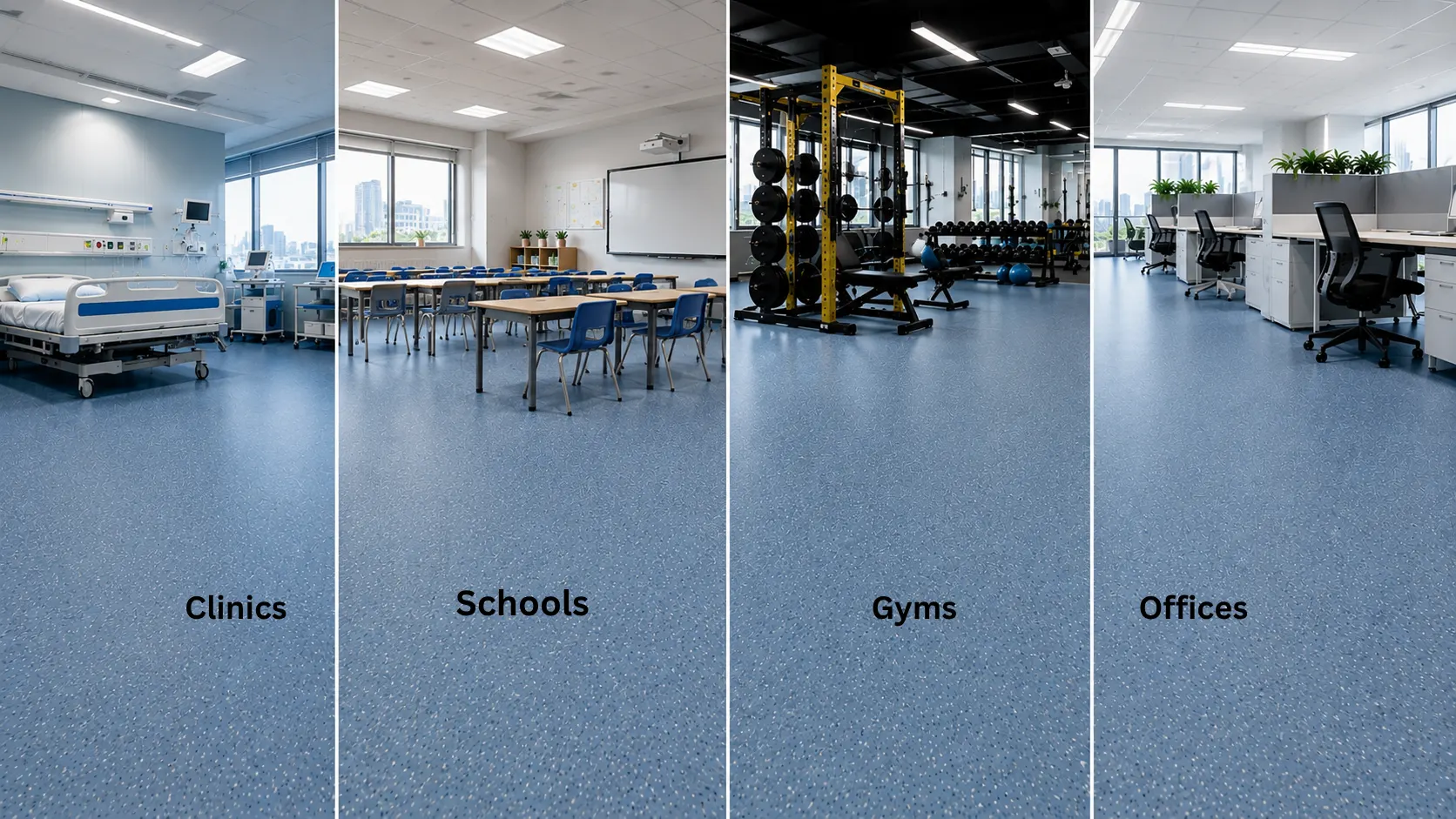
When most people think about flooring, they picture bedrooms, living rooms, maybe a villa lobby. What they don’t picture is the floor of a busy outpatient corridor at 7am, or a school hallway that sees 400 children cycle through it every break time, or a gym changing room that gets mopped twice a day with industrial disinfectant.
Homogeneous vinyl flooring is built specifically for those environments. It doesn’t appear in interior design magazines. It won’t come up when you search for “Dubai flooring trends.” But for the people who specify flooring for healthcare facilities, educational buildings, gyms, labs, and high-traffic commercial spaces across the UAE, it’s the default choice – and with good reason.
This guide explains what homogeneous flooring actually is, how it differs from heterogeneous vinyl, where it performs well (and where it doesn’t), and what to look for when specifying it for a project in Dubai.
What Homogeneous Flooring Actually Is
Homogeneous vinyl flooring is a single-layer product. The colour, pattern, and composition run consistently from the surface all the way through the full thickness of the sheet – typically 2mm. Because the material is uniform throughout, the floor doesn’t lose its appearance as it wears down. Scratch the surface and the colour underneath is the same. Heavy foot traffic, furniture drag, wheeled equipment – none of it exposes a different layer beneath.
This is the core structural difference from heterogeneous vinyl, which has a decorative top layer over a different base. Heterogeneous products can be more visually varied and are excellent for many spaces, but once the top layer is worn through, the floor shows degradation. Homogeneous vinyl doesn’t have this problem.
The practical result: in environments with sustained heavy traffic and aggressive cleaning schedules, homogeneous flooring keeps looking consistent for longer.
Homogeneous vs. Heterogeneous: When Each Makes Sense
The comparison matters because both are vinyl, both come in sheet or tile formats, and both are widely used in UAE commercial spaces. The choice depends on the environment.
| Factor | Homogeneous | Heterogeneous |
|---|---|---|
| Wear performance | Consistent throughout lifespan | Depends on wear layer thickness |
| Cleaning tolerance | High – withstands frequent disinfection | Moderate – depends on surface finish |
| Design variety | More limited (solid, marble-effect patterns) | Wide – realistic wood and stone looks |
| Typical applications | Healthcare, labs, schools, gyms | Offices, retail, hospitality, residential |
| Cost | Generally lower | Varies by brand and specification |
| Anti-static options | Available (ESD/conductive variants) | Less common |
Neither is universally better. Heterogeneous luxury vinyl is excellent in offices and hospitality where design is a priority and cleaning loads are moderate. Homogeneous vinyl earns its place where cleaning frequency, chemical resistance, and sustained durability matter more than visual complexity.
Where Homogeneous Flooring Is Used in Dubai
Healthcare Facilities
This is where homogeneous vinyl is most critical. Hospitals, polyclinics, dental clinics, day-surgery centres, laboratories, and pharmacies across the UAE require flooring that can be cleaned with strong disinfectants without degrading, shows no seams or grout lines where bacteria accumulate, resists staining from iodine, blood, and chemical spills, and in operating theatres and ICUs – dissipates electrostatic charge to protect sensitive equipment.
Conductive and ESD (electrostatic dissipative) homogeneous flooring variants are designed specifically for clinical environments where static build-up poses a risk to life-support or diagnostic equipment. Standard vinyl flooring does not meet these requirements.
Dubai Health Authority (DHA) guidelines for licensed facilities require flooring that meets hygiene and infection-control standards. Homogeneous vinyl – when seamlessly installed with coved skirting – eliminates floor-to-wall joints where contaminants collect. This seamless installation is a meaningful, not decorative, requirement in clinical settings.
Educational Facilities
Schools and universities in Dubai see a very specific kind of abuse: high volume, constant movement, frequent cleaning, and a mix of wet and dry conditions in different zones. Corridors, classrooms, canteens, and toilet corridors each present different demands.
Homogeneous vinyl handles all of them with a single product specification. It doesn’t require zone-by-zone product changes, which simplifies procurement, installation, and long-term maintenance. Its comfort underfoot – particularly in variants with a slight cushion – also reduces fatigue in environments where staff and students stand for extended periods.
Gyms and Sports Facilities
Floor Concepts also carries sports flooring – a specialist category – but for gym changing rooms, shower areas, reception lobbies, and non-court fitness spaces, homogeneous vinyl is frequently specified. It handles moisture, foot traffic, and daily cleaning cycles without warping or separating at seams.
For actual sport courts and performance areas where shock absorption and ball bounce characteristics matter, sport-specific flooring is the correct choice. But for the surrounding facility infrastructure, homogeneous vinyl is the standard.
Offices and Commercial Spaces
Open-plan offices with high staff density, retail spaces with constant customer movement, and government buildings with public-facing areas all benefit from homogeneous vinyl’s durability and low maintenance. It’s not always the most visually exciting choice – heterogeneous vinyl often provides better aesthetics in premium office fit-outs – but for large-scale, cost-conscious commercial projects where floor longevity over 10–15 years matters more than visual novelty, it’s a sensible specification.
What to Look for When Specifying Homogeneous Flooring in Dubai
Not all homogeneous vinyl is the same, and the difference matters particularly in regulated environments.
Wear Resistance Class
Products are classified by durability under EN ISO 10874 (European standard used across UAE specification):
- 31–33Commercial use, light to general traffic
- 34Commercial, heavy traffic (corridors, schools)
- 41–43Industrial and heavy commercial (hospitals, labs)
Healthcare and high-traffic educational spaces should specify minimum Class 34, ideally 43 for critical areas.
Chemical Resistance
Check that the product is tested and rated against the specific disinfectants used in your facility. Healthcare-grade products should withstand repeated exposure to hospital-grade disinfectants without surface breakdown. Standard commercial-grade products may not.
VOC Emissions
Indoor air quality matters – particularly in healthcare and education settings. Look for products compliant with low-VOC or zero-VOC certification (FloorScore, BREEAM-compatible, or similar). Many European-manufactured homogeneous products carry these certifications; products sourced without documented certification present a risk in sensitive environments.
ESD and Conductive Variants
For operating theatres, server rooms, pharmaceutical manufacturing areas, or anywhere with sensitive electronic equipment: specify ESD (electrostatic dissipative) or conductive homogeneous vinyl. These are distinct product categories and must be verified against the relevant IEC standards – they cannot be substituted with standard homogeneous vinyl.
Installation Method
Homogeneous vinyl sheets should be fully adhered to the subfloor for maximum performance. Floating installation is not recommended in commercial applications – it creates movement at seams and can allow moisture ingress underneath in high-cleaning environments. The subfloor must be level (within 3mm over 2 metres) and moisture-tested before installation. Skipping the moisture check in UAE ground-floor or podium-level spaces is a common cause of adhesive failure and floor lifting.
Maintenance: What Commercial Buyers Should Know
One of the main selling points of homogeneous vinyl is low maintenance cost. That’s true – but it requires the right maintenance routine to hold up over the long term.
- DailySweep or vacuum to remove grit and debris. Fine particles act as abrasives under foot traffic and degrade the surface faster than cleaning chemicals do.
- Regular moppingUse manufacturer-recommended neutral pH cleaner. Avoid strong solvent-based cleaners unless the product is specifically rated for them. In healthcare, use facility-approved disinfectants and verify compatibility with the flooring manufacturer.
- PeriodicSome homogeneous floors benefit from a maintenance polish application every 6–12 months, depending on traffic. This restores surface sheen and provides an additional protective layer. Not all products require this – check the manufacturer specification.
- What to avoidSteam cleaning (can lift adhesive at seams), abrasive pads or scourers (scratches the surface), and allowing standing water on unsealed perimeter areas.
Well-maintained homogeneous vinyl in a commercial setting should last 15–25 years. Poorly maintained, or maintained with incompatible chemicals, it degrades significantly faster.
How Floor Concepts Approaches Commercial Flooring Specification
Most residential flooring purchases involve a showroom visit, a few samples, and a reasonably straightforward decision. Commercial flooring – especially for healthcare or education – is more involved.
Floor Concepts works with fit-out contractors, facility managers, architects, and institutional procurement teams across the UAE. For homogeneous flooring projects, this typically involves a site assessment (subfloor condition, moisture levels, traffic patterns), product selection matched to the specific environment and certification requirements, sample supply for approval, and a coordinated installation timeline that minimises disruption to operational spaces.
The company’s homogeneous flooring range is available for direct consultation – including specification support for DHA-licensed healthcare facilities, KHDA-registered educational institutions, and commercial fit-out projects of any scale.
Conclusion
Homogeneous flooring isn’t a product most homeowners will ever need. But for anyone specifying flooring for a clinic, school, gym, laboratory, or large commercial space in Dubai, it deserves serious consideration alongside other commercial vinyl options.
Its strengths – consistent appearance under heavy wear, tolerance of aggressive cleaning, seamless installation, and availability in ESD variants – are specific and valuable in the environments it’s designed for. Its limitations – less design variety, requires professional installation and subfloor preparation – are real but usually secondary concerns in those same contexts.
If you’re working on a commercial fit-out or institutional project in the UAE and want to discuss homogeneous flooring specification, Floor Concepts offers in-person consultation at their showroom in Oasis Mall, Sheikh Zayed Road, and can provide product samples, specification documentation, and site assessment for projects across Dubai and the wider UAE.
Floor Concepts specialises in wooden, engineered wood, homogeneous vinyl, SPC, sports, and outdoor decking flooring for residential and commercial projects across the UAE.
Showroom: Oasis Mall, Level 3, Suite 103, Sheikh Zayed Road, Al Quoz 1, Dubai.
Frequently Asked Questions
What is homogeneous flooring and where is it used in Dubai?
Homogeneous flooring is a single-layer vinyl product where colour and composition are consistent throughout the full thickness of the sheet. In Dubai, it’s most commonly specified for healthcare facilities, schools, gyms, laboratories, and high-traffic commercial spaces where durability, hygiene, and chemical resistance matter more than decorative variety.
What is the difference between homogeneous and heterogeneous flooring?
Homogeneous vinyl is uniform throughout its thickness, meaning the floor maintains its appearance even as the surface wears. Heterogeneous vinyl has a decorative top layer over a different core – which allows for more design complexity but means wear eventually exposes the base material. Homogeneous is generally preferred for clinical and heavy-traffic environments; heterogeneous is often a better fit where aesthetics are a priority and cleaning loads are lighter.
Does homogeneous flooring meet DHA standards for healthcare facilities in Dubai?
Compliant homogeneous vinyl products – particularly those with seamless installation, antibacterial properties, and appropriate chemical resistance ratings – are widely used in DHA-licensed facilities across the UAE. Specification should be confirmed against the specific facility requirements, and installation must include covered skirting to eliminate floor-to-wall joints.
How long does homogeneous flooring last in a commercial space?
With appropriate maintenance, 15–25 years is a reasonable lifespan in commercial applications. Wear resistance class, cleaning routine, and subfloor preparation all affect actual longevity. Heavy-duty Class 43 products in well-maintained healthcare environments routinely reach the upper end of this range.
Can homogeneous flooring be installed over existing flooring in Dubai?
In most cases, homogeneous vinyl should be installed directly on a prepared subfloor rather than over existing flooring. The existing surface would need to be completely level, adhered, and moisture-controlled – conditions that are rarely met. A site assessment should determine whether subfloor preparation or full removal is required before installation.