
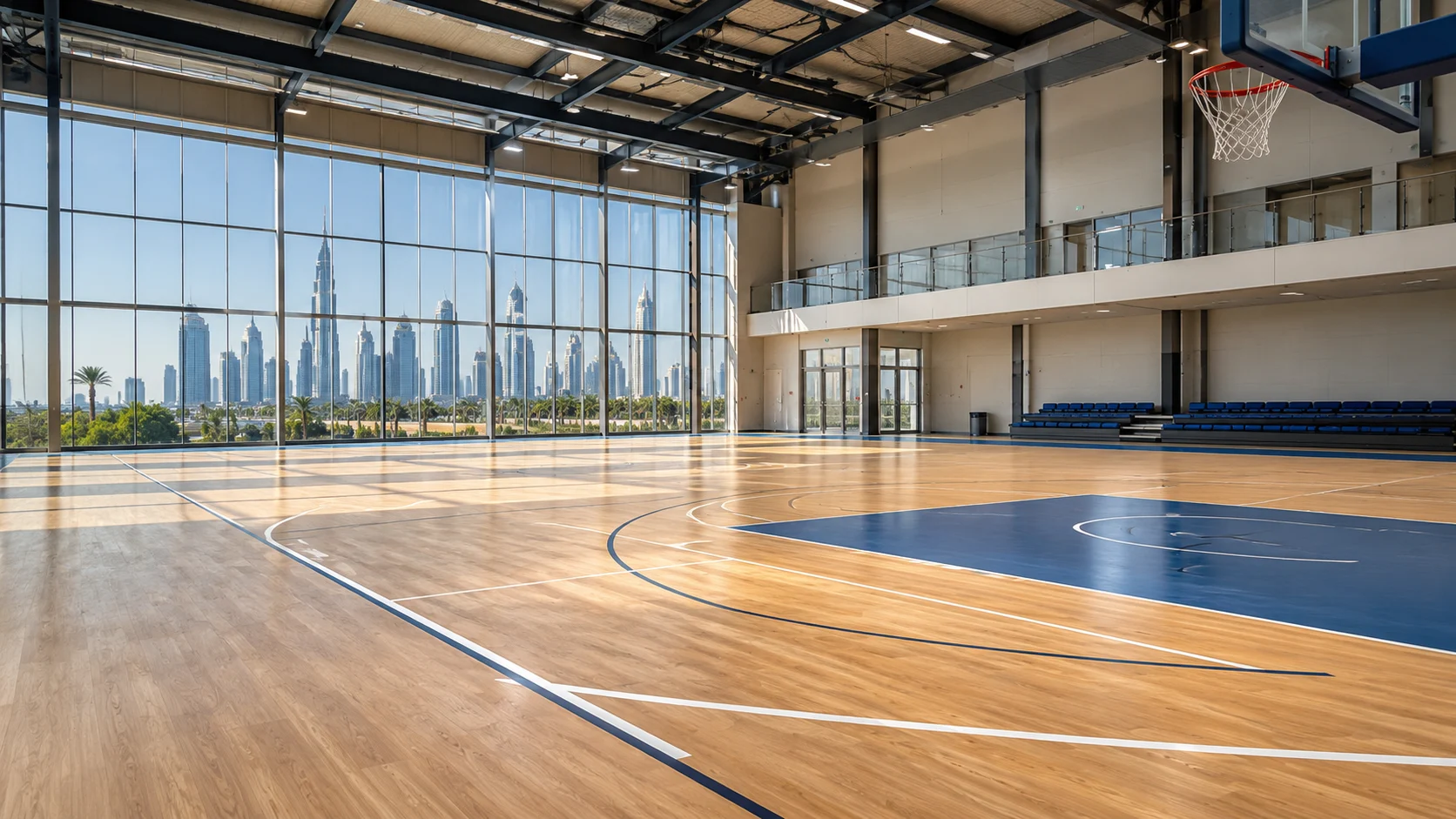
If you’re comparing sports flooring in Dubai, that’s the short version. Indoors, under AC, PVC sports flooring and rubber flooring are the two most reliable performers in the UAE. Outdoors, in direct sun and heat, acrylic sports surfacing and UV-stabilized artificial turf hold up best — while untreated rubber, standard vinyl, and hardwood struggle. The “best” surface isn’t one product; it’s the right product matched to the sport, the location, and Dubai’s specific climate stresses.
That last part is where most flooring guides fall short. They’ll tell you sports flooring is “durable” or “impact-absorbing” without explaining what actually breaks it in the UAE. This guide covers that — with a straight comparison, real installation and maintenance guidance, and the mistakes we see most often on flooring Dubai projects.
What Is the Best Sports Flooring for Dubai?
There isn’t one “best” sports flooring for Dubai—it depends on whether the space is indoor or outdoor.
For indoor facilities with air conditioning, PVC/vinyl sports flooring and rubber flooring are the top choices for gyms, fitness studios, schools, and multi-purpose sports halls because they provide excellent durability, comfort, and shock absorption.
For outdoor sports areas, acrylic sports surfacing and UV-stabilized artificial turf are specifically engineered to withstand Dubai’s intense sunlight, extreme temperatures, and UV exposure without rapid deterioration.
Expert Tip: Avoid using standard rubber flooring, indoor vinyl sports flooring, or hardwood sports flooring in outdoor UAE environments. These materials are not designed for continuous exposure to Dubai’s heat and sunlight, which can lead to fading, expansion, warping, or premature wear.
Why UAE Weather Changes the Flooring Decision
Dubai isn’t a “normal” climate for flooring, and treating it like one is the single biggest reason sports floors fail early here. Four factors matter more than anywhere else:
- Extreme surface heat. Ambient summer temperatures regularly pass 45°C, but a dark-coloured outdoor surface sitting in direct sun can run significantly hotter than the air temperature around it. That heat softens some materials and accelerates the ageing of others.
- UV exposure. Dubai gets intense, near year-round sun. Pigments fade, plastics become brittle, and adhesives weaken faster under UV than they would in a milder climate.
- Humidity swings. Coastal humidity outdoors versus constant air-conditioning indoors creates repeated expansion-and-contraction cycles. Materials that aren’t dimensionally stable — some hardwoods, some laminates — can gap, cup, or warp over a few seasons of this cycling.
- Sand and dust. Fine sand acts like sandpaper on any surface with foot traffic, especially outdoor and semi-outdoor courts near entrances, terraces, or ground-floor gyms.
Every recommendation below is filtered through those four stresses, not generic “durability” claims.
Sports Flooring Options: Quick Comparison for UAE Conditions
| Surface Type | Best For | Heat/UV Performance in UAE | Shock Absorption | Typical Setting |
|---|---|---|---|---|
| PVC / Vinyl Sports Flooring | Multi-purpose halls, fitness studios, school gyms | Excellent indoors under AC; not designed for direct outdoor sun | Very good | Indoor |
| Rubber Flooring | Weight rooms, CrossFit-style gyms, impact zones | Good indoors; standard rubber softens and can smell in direct heat outdoors | Excellent | Indoor / covered outdoor |
| Hardwood (Maple/Oak) | Basketball courts, dance/multi-sport halls | Sensitive to humidity cycling; needs tight climate control | Good | Indoor only |
| Polyurethane (PU) | Competitive indoor courts, running tracks (indoor) | Very good indoors; some outdoor PU systems exist but need UV-stable formulations | Excellent | Indoor / specified outdoor |
| Acrylic Sports Surfacing | Tennis, padel, basketball courts outdoors | Purpose-built for UAE heat and UV when properly specified | Moderate | Outdoor |
| Artificial Turf (UV-stabilized) | Padel back walls, 5-a-side pitches, rooftop courts | Good — but only with UV-treated, heat-resistant yarn | Moderate | Outdoor |
| SPC / Rigid Core | Multi-purpose halls, fitness reception areas | Excellent — dimensionally stable in heat | Low-moderate | Indoor |
This table reflects general material behaviour; always confirm the specific product’s UV, heat and slip-resistance rating with your supplier before specifying.
PVC / Vinyl Sports Flooring: The Default for Indoor Facilities
PVC (vinyl) sports flooring is the most common choice for indoor multi-purpose halls, school sports halls, and fitness studios in Dubai — and for good reason. Once installed indoors under consistent air-conditioning, it’s not fighting the climate at all; it’s operating in the exact stable, temperature-controlled environment it’s engineered for.
What actually matters when specifying it for the UAE:
- Wear layer and construction. Sports-grade PVC (like the systems Floor Concepts supplies) is built in layers — a shock-absorbing foam or foam-backed base under a dense, textured wear surface — specifically to manage impact and slip resistance, not just look like a court.
- Subfloor moisture check. Even indoors, ground-floor slabs in Dubai can carry residual moisture, especially in newer buildings. A moisture test before installation prevents adhesive failure later.
- Not for direct outdoor sun. Standard PVC sports flooring is not designed for prolonged UV and heat exposure. If you need a similar look and feel outdoors (a covered padel court, for example), ask your supplier for a UV-stabilized or outdoor-rated variant — don’t assume the indoor product will hold up under a canopy with reflected heat.
Rubber Flooring: Best for Impact Zones, With One UAE Caveat
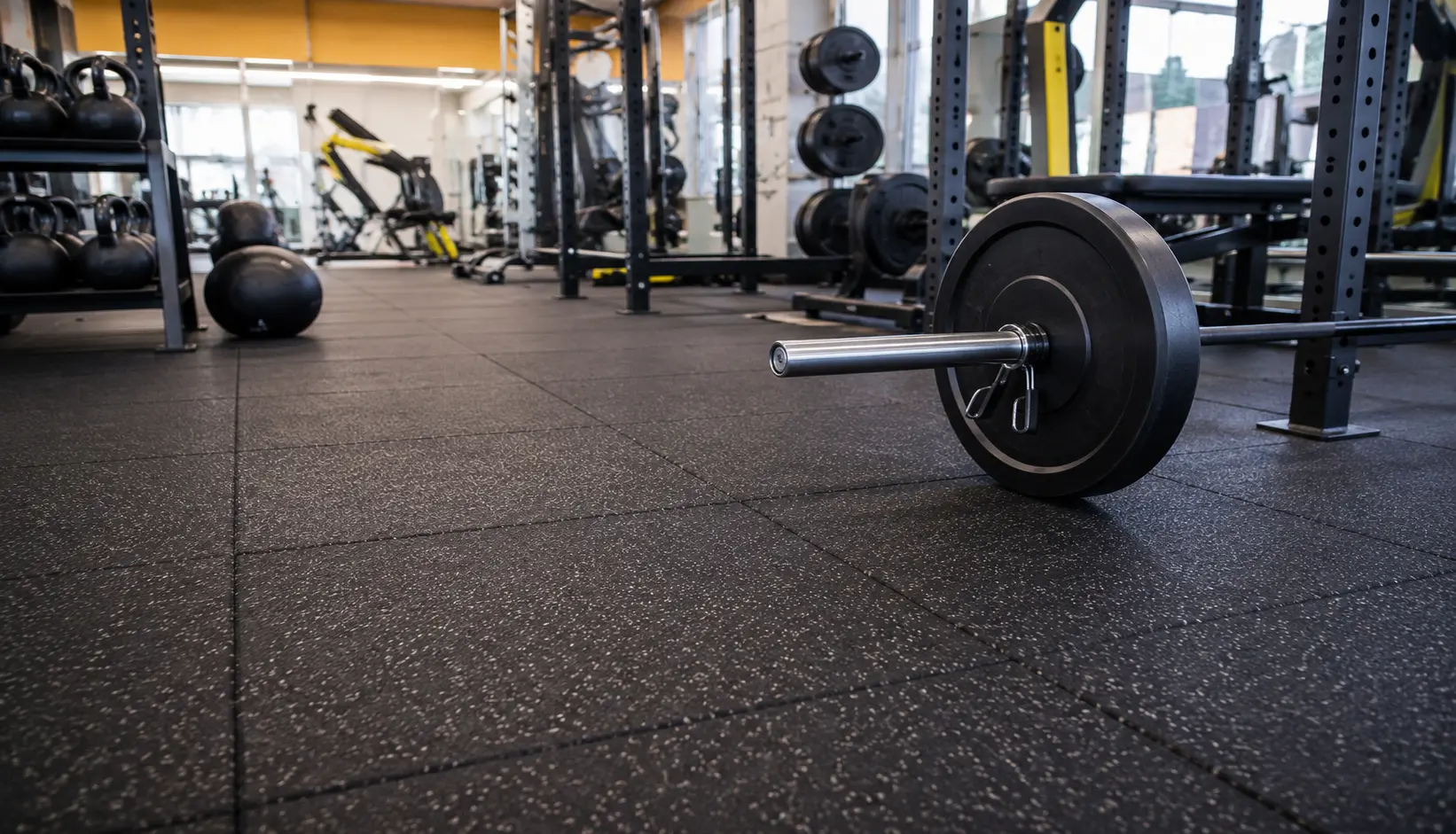
Rubber flooring is the standard choice for weight rooms, functional training zones, and anywhere heavy equipment gets dropped. Its shock absorption and sound dampening are hard to beat.
The UAE-specific caveat: standard rubber flooring is a poor choice for direct outdoor sun. Heat causes it to soften, and prolonged UV exposure combined with heat can produce a persistent rubber odour that’s far more noticeable in a hot, poorly ventilated space than in a cooler climate. If you want a rubber-like surface outdoors — a rooftop gym area, for example — look for EPDM rubber granule systems, which are specifically formulated for UV and heat resistance, rather than standard indoor gym rubber tiles.
Hardwood and Engineered Wood Sports Flooring: Handle With Care
Maple and oak sprung-floor systems are still the gold standard for competitive basketball and multi-sport halls — the ball bounce, foot grip, and appearance are hard to replicate with synthetic materials. But wood is also the most climate-sensitive option on this list.
In the UAE, humidity swings between an air-conditioned interior and the outside air are the real risk factor, not heat alone. If the AC system is switched off for extended periods (school holidays, a facility standing empty over summer), humidity can rise sharply indoors and cause a wood sports floor to expand, cup, or gap when temperatures swing back. Engineered wood Flooring systems with a stable multi-ply core handle this far better than solid hardwood, and a sprung sub-structure with proper expansion gaps is non-negotiable for any wood court in this climate. If a facility can’t guarantee consistent, year-round climate control, wood is not the right choice — full stop.
Polyurethane (PU) Sports Flooring: High Performance, Right Setting
PU flooring systems (poured or sheet) are used for competitive indoor courts and, in specified outdoor formulations, running tracks. Indoors, PU offers excellent shock absorption and a consistent playing surface that performs reliably under Dubai’s AC-controlled conditions. Outdoor PU systems exist and are used for athletics tracks regionally, but they require a UV-stable formulation specified for GCC conditions — a standard indoor PU spec will degrade quickly under direct sun.
Acrylic Sports Surfacing: Built for Dubai’s Outdoor Courts
For outdoor tennis, padel, and basketball courts, acrylic sports surfacing is the material most consistently used across the Gulf region — because it’s one of the few systems engineered from the start to handle intense heat and UV. A properly specified acrylic system includes UV-stable pigments and a textured, cushioned finish that manages surface temperature and slip resistance far better than a painted concrete court or a repurposed indoor material.
The trade-off: acrylic offers less shock absorption than an indoor cushioned surface, so it’s best suited to court sports rather than high-impact training use.
Artificial Turf: Only With the Right Yarn Spec
Artificial turf shows up constantly on Dubai rooftops, padel courts, and 5-a-side pitches — and it can perform very well, but only if it’s specified correctly. The failure point isn’t the concept of turf; it’s using turf that wasn’t designed for intense heat and UV. Look for UV-stabilized yarn and a heat-resistant backing, and check the manufacturer’s stated surface temperature performance before installing on a south-facing rooftop, where reflected heat from surrounding glass and concrete can push surface temperatures well above open-ground installations.
SPC / Rigid Core Flooring: The Stable Option for Multi-Use Halls
SPC (stone plastic composite) rigid-core flooring isn’t a traditional “sports floor,” but it’s increasingly used in multi-purpose halls, fitness reception areas, and light-activity studios in Dubai because of one specific advantage: dimensional stability. Its rigid core resists the expansion and contraction that affects laminate and some vinyl Flooring in heat, which matters in spaces with inconsistent air-conditioning. It offers less cushioning than dedicated sports rubber or PU, so it’s better suited to lower-impact use than to a full basketball court or weight room.
Indoor vs Outdoor: The Decision That Matters Most
Before comparing materials, answer one question: is this floor permanently indoors, permanently outdoors, or semi-exposed (covered but open-air, like a canopy-shaded padel court)?
- Fully indoor, AC-controlled: PVC, rubber, PU, hardwood, and SPC are all viable — choose based on sport and impact level, not climate.
- Fully outdoor: Acrylic and UV-stabilized turf are the realistic options. Standard indoor rubber, PVC, and hardwood Floor should be ruled out.
- Semi-exposed (covered, ventilated, but not climate-controlled): This is the trickiest category. Materials still see heat swings and some UV, so ask specifically for outdoor-rated or UV-stabilized versions of indoor products, and prioritise good ventilation over materials that trap heat.
Common Mistakes We See on Sports Flooring Projects in Dubai
- Specifying an indoor product for a semi-outdoor space (a covered but open-sided court) and being surprised when it fades or softens within a year.
- Skipping the subfloor moisture test because “it’s indoors, it should be dry” — ground-floor and podium slabs can still hold residual moisture.
- Ignoring expansion gaps during installation, especially with rigid-core and hardwood systems, which need room to move with temperature cycling.
- Choosing on price per square metre alone, without checking wear layer thickness, UV rating, or shock-absorption class for the intended sport.
- Assuming all “vinyl flooring” is the same — standard commercial vinyl and sports-grade PVC flooring are built to very different specifications; one is not a substitute for the other.
Installation Guidance for UAE Conditions
Good material choice can still fail with poor installation. For any flooring installation Dubai project, a qualified installer should:
- Test subfloor moisture and flatness before laying anything — especially on ground floors and podium levels.
- Allow materials to acclimatise to the room’s temperature and humidity for the manufacturer’s recommended period before installation, not immediately out of the packaging.
- Leave correct expansion gaps around the perimeter, sized for the material and the room’s expected temperature range.
- Confirm slip-resistance ratings match the sport — a basketball court and a yoga studio have very different grip requirements.
- For outdoor work, check drainage and fall gradients so water doesn’t pool on the surface during Dubai’s short but intense rain events.
Maintenance Tips: Keeping Sports Flooring Performing in UAE Heat
- Indoor PVC/rubber/PU floors: Damp-mop regularly rather than wet-mopping, and avoid harsh solvents that can dull the wear layer. Keep entrances matted to reduce sand and grit being tracked in — grit is what causes premature surface scratching, not general use.
- Outdoor acrylic courts: Rinse surface dust and sand off periodically; sand left to sit acts as an abrasive under foot traffic and speeds up wear.
- Artificial turf: Brush the pile periodically to stop it matting under heat, and rinse to clear dust — this also helps manage surface temperature on hot days.
- Wood floors: Monitor indoor humidity where possible; sustained AC downtime is the biggest risk to a wood court’s long-term stability, not daily use.
- All surfaces: Schedule a professional inspection at least annually — Dubai’s heat cycles accelerate wear that might take years to show elsewhere, so catching an early expansion gap or lifted edge saves a much bigger repair later.
Why Work With a Specialist Rather Than a General Contractor
Sports flooring is a specification problem before it’s an installation problem — the right underlay, wear layer, and UV rating matter more than the brand name on the box. Floor Concepts supplies and installs sports flooring systems (including Grabo PVC sports flooring for gyms, school sports halls, and multi-purpose facilities) alongside vinyl, SPC, and engineered wood ranges, so the same team scoping your project understands how each material behaves across Dubai’s climate — not just how it looks in a catalogue. If you’re comparing flooring companies in Dubai for a sports project, ask specifically what UV and heat testing the product has, not just its warranty length.
The Bottom Line
There’s no single “best” sports flooring for Dubai — there’s a best match for your sport, your setting, and how much of the UAE’s heat, UV, and humidity that floor will actually face. Indoors, PVC, rubber, PU, and hardwood all work well under proper AC and installation; outdoors, only heat- and UV-engineered materials like acrylic and UV-stabilized turf hold up long-term. Getting the spec right at the start is far cheaper than replacing a floor that failed after one Dubai summer.
If you’re planning a gym, school sports hall, or outdoor court and want a recommendation based on your specific space, get in touch with Floor Concepts for a site assessment and product match.
FAQs
Which flooring is best for outdoor sports courts in Dubai?
Acrylic sports surfacing is the most consistently reliable choice for outdoor tennis, padel, and basketball courts in the UAE, because it’s engineered for UV and heat resistance. UV-stabilized artificial turf is a strong option for football pitches and padel back walls.
Does vinyl sports flooring get too hot in Dubai sun?
Standard PVC sports flooring is designed for indoor, climate-controlled use and isn’t intended for prolonged direct sun. For outdoor or semi-outdoor use, ask your supplier for a UV-stabilized, outdoor-rated version rather than the standard indoor product.
What’s the best flooring for a home gym in Dubai?
For an indoor home gym, rubber flooring is generally the best fit for weight and impact zones, while sports-grade PVC works well for cardio and functional training areas. Both perform reliably under normal AC conditions.
Is rubber flooring good for UAE weather?
Indoors, yes — rubber flooring performs very well under Dubai’s air-conditioned conditions. Outdoors in direct sun, standard rubber can soften and develop odour under sustained heat, so an EPDM outdoor-rated system is the better choice for exposed areas.
How often should sports flooring be maintained in Dubai?
Daily light cleaning (damp-mopping or dust removal) plus at least one professional inspection a year is a reasonable baseline. Outdoor and semi-exposed surfaces benefit from more frequent sand and dust removal, since grit accelerates surface wear faster in the UAE than in cooler, less dusty climates.
Can I install sports flooring over an existing tile or concrete floor?
In many cases, yes — most PVC, rubber, and SPC sports flooring systems can be installed over a properly prepared existing subfloor, provided it’s flat, clean, and tested for moisture. A site survey is the only reliable way to confirm this for a specific space.